Tracking business miles for tax purposes has always been tedious. The good news? AI has made the standard mileage deduction far easier to claim correctly. Whether you're a rideshare driver, real estate agent, or freelance consultant, using artificial intelligence to document your mileage can save hours of work and potentially thousands of dollars.
The IRS updates mileage rates periodically, and a driver logging 20,000 business miles in a high-rate year could claim over $13,000 in deductions - AI tools help you capture every eligible mile with less effort and fewer errors than manual methods ever could.
Understanding the Standard Mileage Deduction
The standard mileage deduction lets you write off a fixed amount per business mile instead of tracking every individual car expense. It's the simpler of two IRS-approved methods, and for most moderate-distance drivers, it's also the more generous one.
Current IRS Mileage Rates
The IRS sets standard mileage rates each year - check IRS.gov for the most current figures. The table below shows the three rate categories that apply to different driving purposes:
Purpose
Rate
Notes
Business use
See IRS.gov
Highest rate — set annually, occasionally mid-year
Medical / Moving (military only)
See IRS.gov
Lower rate — adjusted with business rate
Charitable driving
14¢/mile (fixed)
Set by statute — rarely changes
Illustrative deduction potential — hypothetical business rate scenarios by miles driven
To qualify, you must use the standard mileage rate in the first year you place a car in service for business. You cannot use it if you've already claimed accelerated depreciation, operate a fleet of five or more cars simultaneously, or used the actual expense method in year one.
What the IRS Requires in Every Log Entry
The IRS requires records that include: the date of the trip, the starting location, the destination, the business purpose, and the miles driven. A vague entry like 'drove around for work' won't survive an audit. A compliant entry looks like:
March 14, 2024 - Home office to client meeting at 450 Oak Street, Springfield - 23 miles round trip - Quarterly account review.
Automating Mileage Tracking with AI-Powered Apps
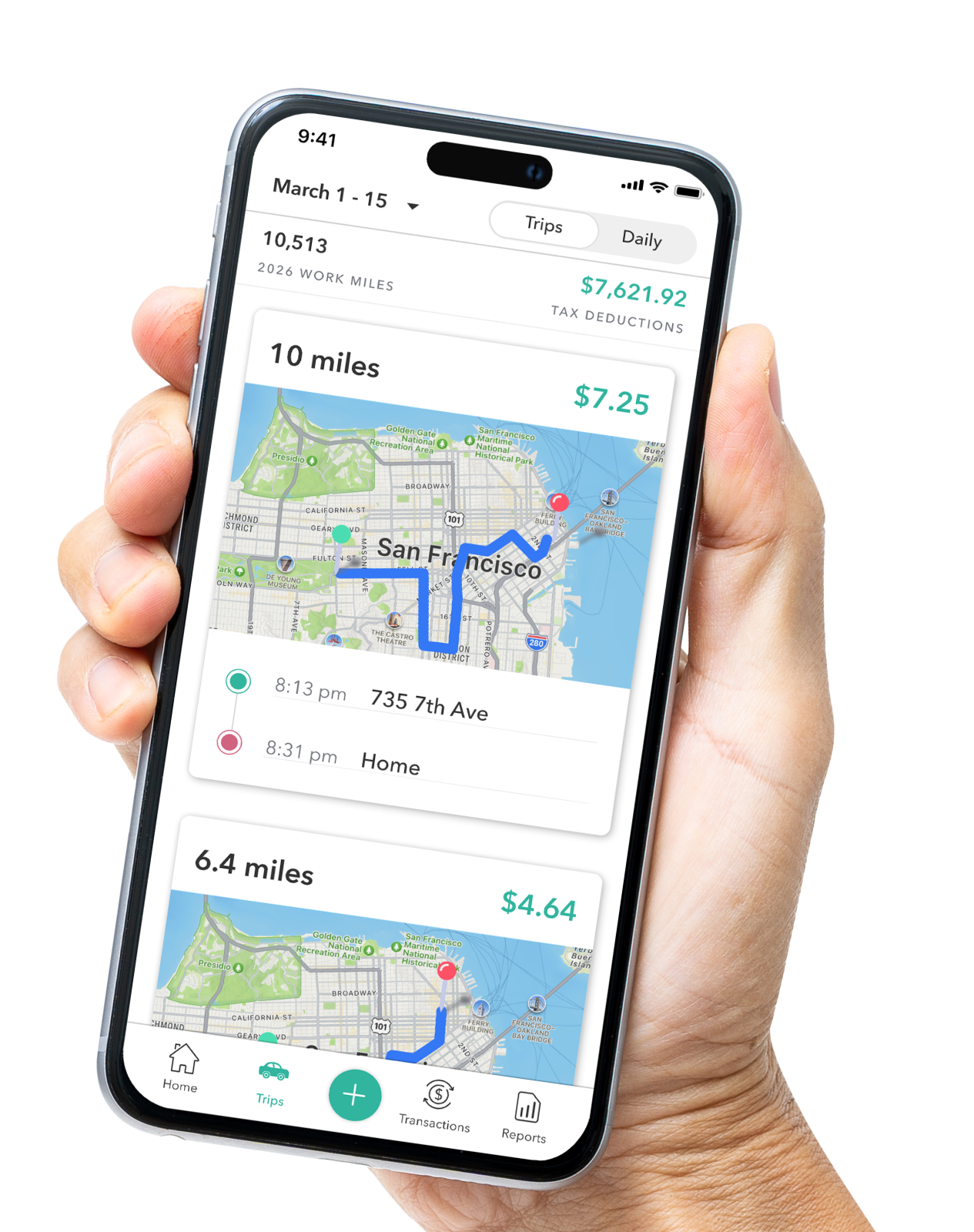
The most practical way most drivers interact with AI for their mileage deduction is through smartphone apps that run in the background and do the tracking automatically.
Predictive Trip Classification & Smart Logging
Modern mileage apps use machine learning to learn your driving habits. After a few weeks of use, the app starts predicting which trips are business-related and which are personal. If you drive to the same client site every Tuesday, the app recognizes that pattern and auto-classifies future Tuesday trips as business miles.
Predictive classification typically reaches 90%+ accuracy within the first month. Instead of manually logging 40 trips a week, you're swiping to approve or correct a handful of suggestions - dropping 15-20 minutes of daily logging to under two minutes.
GPS and Geofencing for Hands-Free Documentation
GPS-based tracking detects vehicle movement and begins recording a trip without manual input. Geofencing goes further by creating virtual boundaries around locations you visit frequently:
• Set a geofence around your home, office, and top client locations
• When you leave one geofenced area and arrive at another, the trip is logged automatically
• The app calculates distance and applies the correct classification
GPS-based distance measurements typically fall within 1-3% of actual odometer readings - well within IRS tolerances. Cross-referencing your odometer periodically takes about ten seconds per trip and is a smart corroboration habit.
Using Large Language Models for Deduction Calculations
Beyond dedicated tracking apps, large language models like ChatGPT, Claude, and Gemini can help calculate your standard mileage deduction - especially when data is spread across spreadsheets, receipts, or partial logs.
Prompt Engineering for Accurate Outputs
The quality of what you get from an LLM depends entirely on how you ask. A vague prompt gives generic formulas; a specific prompt gets specific answers. Here's an example of an effective prompt:
"I drove 18,450 business miles this tax year. The current IRS standard mileage rate is [X] cents per mile. I also drove 2,300 miles for qualified medical purposes at [Y] cents per mile. Calculate my total mileage deduction and show your work."
20,000
72.5¢
$8,000
80%
Standard Mileage
$14,500
Better method
Actual Expenses
$6,400
Better method
Standard mileage saves you $8,100 more
For illustrative purposes only. Adjust the rate slider to match the current IRS figure. Consult a licensed tax professional for your specific situation.
Always provide the current year's rate yourself rather than asking the model to look it up. LLMs can have outdated training data, and using the wrong rate would throw off your entire deduction.
Parsing Odometer Readings and Receipts
If you have maintenance receipts or odometer photos from oil changes, AI can extract and organize that data using OCR (optical character recognition). For example: oil changes in January, April, July, and October with readings of 45,200 / 49,800 / 54,100 / 58,900 means 13,700 total miles driven. At 75% business-use, that's 10,275 business miles and a $6,884.25 deduction.
This approach is especially useful for people who didn't use a tracking app all year and need to reconstruct mileage from available records. It's not as precise as real-time GPS tracking, but it's far better than guessing - and the IRS accepts reasonable reconstruction methods when supported by corroborating evidence.
Validating AI Outputs Against IRS Standards
AI is powerful, but it's not infallible. Every output needs human review, especially when tax compliance and potential audit exposure are on the line.
Ensuring Data Accuracy and Audit Readiness
The IRS expects mileage records to be 'contemporaneous' - created at or near the time of each trip. AI tracking apps satisfy this by logging trips in real time. Your records should include these five data points for every business trip:
• Date of the trip
• Starting location
• Destination
• Business purpose
• Miles driven
Cross-check your AI-generated totals against at least one independent source. Simple sanity checks catch errors before the IRS does.
Identifying AI Hallucinations in Calculations
LLMs sometimes produce confident but wrong answers - called 'hallucinations.' Common patterns to watch for include: applying the business rate to personal miles, using rates from the wrong tax year, and rounding errors that compound across thousands of trips.
Always verify the math independently. If an LLM gives you a total that doesn't match a quick calculator check, that discrepancy could trigger an audit adjustment. Treat AI outputs as a first draft - review them, verify the math, and confirm the rates match current IRS guidance.
Optimizing Your Tax Strategy with AI
Standard Mileage vs. Actual Expenses: A Comparison
The IRS lets you choose between the standard mileage rate and the actual expense method each year (with restrictions). The comparison table below summarizes the key differences:
Factor
Standard Mileage
Actual Expenses
Tracking effort
Low — just log miles
High — all expenses
Best for
High-mileage drivers
Expensive vehicles
First-year restriction
Must elect in year 1
Can elect any year
SE tax reduction
Yes
Yes
Depreciation included
Built in to rate
Must calculate separately
Where standard mileage overtakes actual expenses — example at $8,000 annual car costs / 80% business use
Standard mileage (rate adjustable below) Actual expenses ($8k × 80%)
67¢
Feed an LLM your actual car expenses for the year alongside your total business miles, and ask it to calculate your deduction under both methods. AI can run both calculations in seconds and show you exactly where the crossover point is.
Self-Employment Tax Savings
Self-employed drivers should remember that their mileage deduction reduces their Schedule C net income, which in turn reduces their self-employment tax. At 15.3% SE tax, a large mileage deduction doesn't just save income tax - it also saves meaningfully on SE tax. AI tools can model this full combined impact quickly.
Future Trends in AI-Driven Tax Preparation
Within the next two to three years, expect to see mileage tracking apps that integrate directly with tax filing software, eliminating manual data entry. Real-time deduction estimates that update as you drive will help you make mid-year decisions about vehicle purchases.
IRS modernization efforts are also pushing toward digital-first documentation. AI-generated mileage logs that meet contemporaneous recording standards will likely become the norm. The agency has already signaled interest in accepting digitally verified records - which plays directly into the strengths of AI tracking tools.
Frequently Asked Questions
The following questions address the most common concerns about AI-powered mileage tracking and the standard mileage deduction.
Yes — AI-generated logs are fully acceptable to the IRS, provided they meet the same documentation standards as any other record-keeping method. The IRS requires that mileage records be "contemporaneous," meaning they were created at or near the time of each trip rather than reconstructed weeks later. AI tracking apps satisfy this requirement because they log trips in real time via GPS.
To be audit-ready, every entry must include: the date of the trip, the starting location, the destination, the business purpose, and the miles driven. If your app captures all five of these automatically, your logs should hold up under scrutiny.
It's also a good idea to export and save a backup of your logs periodically, so you're not relying solely on a third-party app's servers if you ever need to produce records.
Not always — it depends on your specific vehicle costs and how many miles you drive. The standard mileage method tends to win for high-mileage drivers in fuel-efficient or older vehicles with low insurance and maintenance costs, because the flat rate per mile often exceeds what you'd actually spend.
The actual expense method can come out ahead if you drive a newer or expensive vehicle with high depreciation, carry a premium insurance policy, or have significant loan interest. Eligible actual expenses include gas, oil, insurance, repairs, tires, registration fees, lease payments, and depreciation — all multiplied by your business-use percentage.
The only reliable way to know which method wins is to run the numbers under both. AI tools make this fast: feed them your total annual car costs and business-use percentage and they'll calculate both scenarios side by side. Important: once you use the actual expense method for a given vehicle, you generally cannot switch back to standard mileage for that same vehicle in a future year.
It's your responsibility — not the app's — to ensure that every trip classified as business actually was business. The IRS holds you accountable for the accuracy of your mileage records regardless of what tool generated them. Claiming personal miles as business miles, even accidentally, is an audit red flag that can result in disallowed deductions, back taxes, interest, and penalties.
Most AI mileage apps let you review and reclassify trips on a weekly or monthly basis. Build a habit of auditing your log regularly rather than waiting until tax time, when it's much harder to remember the purpose of individual trips.
If you do find a miscategorized trip, correct it promptly and note the change. A pattern of consistent, timely corrections actually demonstrates good faith record-keeping — which works in your favor if you're ever questioned by the IRS.
Yes, but there's a critical restriction: you must elect the standard mileage rate in the first year you place a vehicle in service for business. If you use the actual expense method in year one, you're locked into it for the life of that vehicle — you cannot switch to standard mileage in a later year.
If you do elect standard mileage in year one, you have more flexibility going forward. You can switch to actual expenses in a subsequent year, and then switch back again, though certain depreciation adjustments apply when switching back. The IRS requires straight-line depreciation if you return to the standard rate after a period on actual expenses.
For drivers buying a new vehicle with high first-year depreciation, using actual expenses from day one may capture a much larger initial deduction — but at the permanent cost of losing the simpler standard mileage option. An AI tool can model multi-year projections under both methods, which is worth doing before you commit to your year-one election.
Yes — recording your odometer at the beginning and end of each tax year remains a best practice even when you're using an AI tracking app. The IRS recommends this because your total odometer movement provides an independent baseline you can use to cross-check your app's logged business miles.
For example, if your app reports 18,000 business miles but your odometer only moved 19,000 miles total, that implies fewer than 1,000 personal miles driven all year — which is implausible for most people and would raise immediate questions in an audit.
Most AI mileage apps prompt you to log beginning and end-of-year odometer readings for exactly this reason. It takes about ten seconds and meaningfully strengthens your documentation. Some drivers also note their odometer at each fill-up or service appointment, creating a running corroboration trail throughout the year.
Yes — the cost of a mileage tracking app you use for business is an ordinary and necessary business expense, which means it's fully deductible. Self-employed individuals report this on Schedule C, typically under "Other expenses." Keep a copy of your subscription receipts or bank statements as documentation.
If you use the app exclusively for business mileage tracking, the full subscription cost is deductible. If you use it for personal purposes as well, you should deduct only the percentage attributable to business use. For most independent contractors and freelancers, the app exists solely to document business driving, making it a straightforward 100% business expense.
The same logic extends to related tools in your workflow — accounting software, a dedicated phone data plan used for business, and even a portion of your phone's cost if it serves a genuine business function. Keep receipts and document the business purpose for anything you plan to deduct.
Always go directly to the IRS rather than relying on third-party articles, tax software defaults, or AI language models. The IRS publishes mileage rate announcements in numbered IRS Notices, which are available at IRS.gov. Search for "standard mileage rate" or check the IRS Newsroom for the most recent announcement.
Rates are typically announced in December for the upcoming tax year, though the IRS has occasionally issued mid-year adjustments in response to sharp changes in fuel costs. If a mid-year adjustment occurs, you'll need to apply the correct rate to each portion of the year separately.
AI language models have training data cutoffs and may confidently cite an outdated rate. This is one area where you should always verify against the primary IRS source before filing — applying even a slightly wrong rate across 20,000+ miles is a meaningful dollar error, and one that's entirely avoidable with a quick check at IRS.gov.
If you've been tracking miles by hand - or not tracking them at all - now is the time to switch. AI-powered mileage apps have matured to the point where they handle the entire
Smarter Miles, Bigger Deductions
Go beyond AI mileage tracking, the Everlance Tax Calculator helps you calculate deductions, compare methods, and file with confidence
We help people save time and money. At Everlance, we're on a mission to empower mobile workers and businesses. That sometimes leads us to generalize tax information. Everlance team members are not certified tax professionals. If you need help with your specific tax situation, please reach out to your tax advisor.




.webp)

.svg)


.svg)
