As a DoorDash driver, you're running your own business. That means the IRS lets you deduct a wide range of expenses that reduce your taxable income and your tax bill.
Most Dashers leave money on the table because they don't know what qualifies. This guide breaks down every legitimate deduction available to you, organized by category, so you can file with confidence and keep more of what you earn.
One important note: DoorDash does not withhold taxes from your earnings. You're responsible for tracking and reporting your own income and expenses. Good records throughout the year make tax time significantly easier.
Business mileage
For most Dashers, mileage is the single largest tax deduction available.
The IRS allows self-employed drivers to deduct a set rate for every mile driven for business purposes. This covers miles driven to pick up an order, from the restaurant to the customer, and any other driving directly tied to your deliveries.
📌 Don't guess on mileage
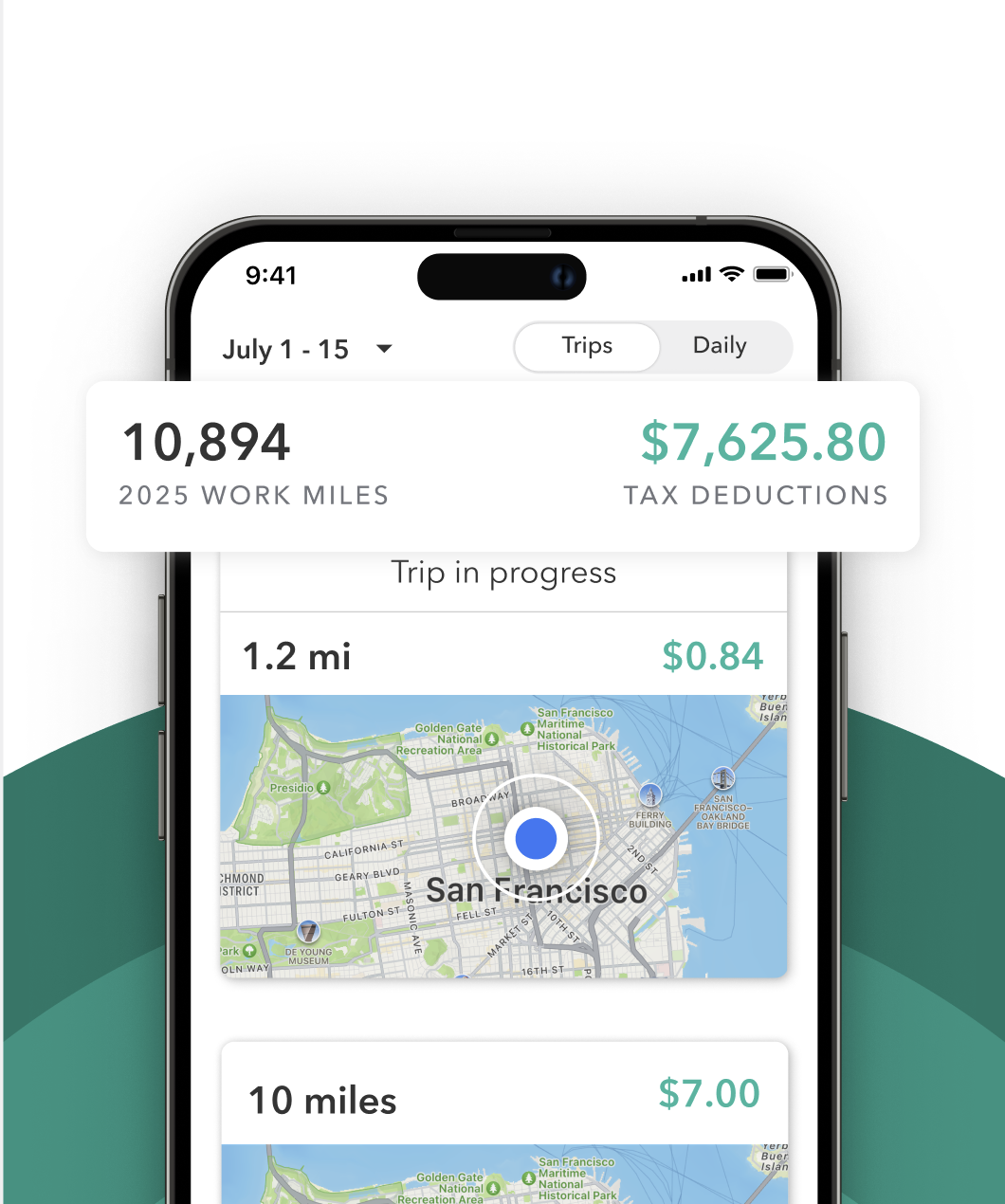
The IRS requires a contemporaneous mileage log, meaning you need to record trips as they happen, not reconstruct them later. Everlance automatically tracks every mile in the background while you Dash and generates IRS-compliant reports at tax time.
You have two options for deducting vehicle costs: the IRS mileage rate or actual vehicle expenses. You must choose one method and stick with it for the entire tax year for that vehicle. Most Dashers benefit more from the standard mileage rate, but your situation may vary.
🚗
Driving to pick up an order
Every mile from accepting an order to arriving at the restaurant counts as a deductible business mile. This includes time spent navigating to the pickup location, even if the route is indirect.
📦
Driving to deliver an order
Miles from the restaurant to the customer's door are fully deductible. This is typically the longest leg of each trip and the most consistently logged portion of a Dasher's mileage.
🗺️
Driving between delivery zones
If you reposition to a busier area between orders while the app is active, those miles are deductible. The key is that the drive has a clear business purpose, moving to where the work is.
🛒
Driving to pick up delivery supplies
If you drive to purchase hot bags, phone accessories, or other equipment used for your deliveries, those miles count as business mileage. Keep a note of the trip purpose so it's documented if you're ever audited.
🔧
Driving to a car service appointment
Miles driven to and from an oil change, tire shop, or mechanic for maintenance related to your delivery vehicle are deductible at your business-use percentage. Log the trip and note the business purpose.
📌 What doesn't count: your commute
Miles driven from your home to your first pickup, and from your last delivery back home, are considered personal commute miles by the IRS and are not deductible unless you claim your home as a home office for tax purposes. For everything else, see our DoorDash Mileage Guide for a full breakdown of tracking, logging, and filing.
Vehicle expenses
If you choose not to use the standard mileage rate, you can instead deduct your actual vehicle expenses. This means tracking every dollar you spend on your car and deducting the portion that corresponds to your business use. For example, if you use your vehicle 70% for DoorDash and 30% personally, you can deduct 70% of each qualifying expense.
You cannot combine this method with the standard mileage rate for the same vehicle in the same year. Choose the method that produces the larger deduction for your situation.
⛽
Gas
Deduct the business-use percentage of your total annual fuel costs. Save receipts or use a fuel tracking app to document expenses throughout the year. This is typically the largest line item under the actual expense method.
🛡️
Car insurance
Your auto insurance premiums are deductible at your business-use percentage. If you purchased a rideshare or delivery add-on policy specifically for DoorDash work, that portion may be fully deductible. Standard mileage rate filers cannot deduct insurance separately.
🔧
Repairs and maintenance
Oil changes, brake work, tire replacements, and other repairs are deductible at your business-use percentage. Keep all service receipts. If you use the standard mileage rate, routine maintenance is already factored in and cannot be deducted separately.
🚘
Depreciation
Under the actual expense method, you can deduct a portion of your vehicle's depreciation each year based on your business-use percentage. Depreciation rules are complex and depend on when the vehicle was placed in service and how it is used. A tax professional can help you calculate this correctly.
🧼
Car cleaning and detailing
Keeping your vehicle clean is a reasonable and necessary part of operating as a delivery driver. Car washes and detailing costs are deductible at your business-use percentage under the actual expense method.
🏷️
Registration and fees
Annual vehicle registration fees and any other state or local fees tied to your vehicle are deductible at your business-use percentage under the actual expense method.
Phone & delivery equipment
Your phone and the gear you use to complete deliveries are legitimate business expenses.
These deductions apply regardless of whether you use the standard mileage rate or actual vehicle expenses, however make sure you're only deducting the business use percentage.
📱
Phone and data plan
Your phone is a required tool for Dashing. Deduct the business-use percentage of your monthly phone bill and the cost of the device itself. If you use your phone 60% for DoorDash and 40% personally, you can deduct 60% of each cost. Keep it consistent and documentable.
🧳
Hot bags and insulated carriers
Insulated bags, drink carriers, and other equipment you purchase to keep orders intact are fully deductible. This includes items purchased independently, not just those sold through DoorDash. If DoorDash reimbursed you for any equipment, you cannot also deduct that amount.
📷
Dash cam
A dash cam purchased primarily for your delivery work is deductible at your business-use percentage. Many Dashers consider this both a safety investment and a legitimate business expense given the liability exposure that comes with driving professionally.
🔌
Phone mount and car charger
Accessories that support your phone while working, like a windshield mount or a car charger, are deductible. These are small purchases but they add up and are easy to document.
Tolls and parking fees
Parking fees and tolls are deductible regardless of which vehicle expense method you use.
This is one of the few vehicle-related costs that is not tied to your mileage vs. actual expense choice. Save receipts, screenshots, or toll account statements to document these throughout the year.
Note: Parking tickets, speeding tickets, and other fines are not deductible.
🅿️
Parking fees
Any parking fees paid while picking up or delivering an order are fully deductible. This includes metered parking, paid lots, and garage fees. Personal parking, like at your home or a non-work location, does not qualify.
🛣️
Tolls
Tolls paid on routes taken for deliveries are fully deductible. If you use an electronic toll account like E-ZPass, your statements serve as ready-made documentation. Only tolls paid during active delivery trips qualify.
Health and retirement benefits
One of the most overlooked advantages of self-employment is the ability to deduct costs that traditional employees pay entirely out of pocket. If you are not covered by an employer plan through another job or a spouse, these deductions can be significant.
🏥
Health insurance premiums
If you pay for your own health, dental, or vision insurance and are not eligible for coverage through a spouse's employer plan, you may be able to deduct those premiums in full. This is an above-the-line deduction, meaning you get it even without itemizing.
💰
Retirement contributions
Contributions to a SEP-IRA, Solo 401(k), or SIMPLE IRA reduce your taxable income dollar-for-dollar. Self-employed workers can contribute significantly more to these accounts than traditional employees can to a standard 401(k). If you're not yet using a self-employed retirement account, this is one of the highest-leverage deductions available to you.
🧾
Self-employment tax deduction
As a self-employed Dasher, you pay both the employee and employer portions of Social Security and Medicare taxes. The IRS allows you to deduct half of your self-employment tax from your gross income. This is an above-the-line deduction available to all self-employed filers regardless of whether you itemize.
General business expenses
These deductions cover the administrative and operational costs of running your delivery business. They are easy to overlook but fully legitimate and worth tracking throughout the year.
📲
Business app subscriptions
Apps you use specifically to manage your DoorDash business are deductible. This includes mileage tracking apps, expense tracking software, navigation apps with paid tiers, and any other subscription tied directly to your delivery work.
📋
Tax preparation fees
The cost of tax software, filing fees, or a CPA related to your self-employment income is deductible. If you use a tax professional who handles both your personal and business returns, only the portion attributable to your gig work qualifies.
🏦
Bank and payment processing fees
If you maintain a dedicated business bank account or pay fees related to receiving your DoorDash earnings, those fees are deductible. Monthly maintenance fees, transfer fees, and similar charges tied to your business finances qualify.
What Dashers cannot deduct
Not every expense qualifies. Here are the most common mistakes Dashers make when filing:
| Expense |
Why it doesn't qualify |
| Commute miles |
Miles driven from your home to your first pickup are personal commute miles and are not deductible. |
| Meals eaten on the job |
Food you buy and consume while Dashing is a personal expense, not a deductible business meal. |
| Regular clothing |
Clothes you wear while delivering, even if worn exclusively for Dashing, are considered personal expenses and do not qualify. |
| Reimbursed expenses |
Any cost that DoorDash reimbursed you for cannot also be claimed as a deduction. |
| Fines and traffic tickets |
Traffic violations and parking tickets received while working are not deductible, even if incurred during a delivery. |
How to track DoorDash deductions
The IRS requires documentation for every deduction you claim. For mileage, that means a log that includes the date, destination, and business purpose of each trip. For other expenses, save your receipts.
The easiest way to stay organized is to use a mileage tracking app for Dashers that tracks everything automatically throughout the year. Everlance runs in the background while you Dash, logs your miles, and lets you categorize expenses as you go. Come tax time, your records are already done.
Frequently Asked Questions
Does DoorDash send a 1099?
Yes. If you earned $600 or more through DoorDash in a calendar year, you will receive a 1099-NEC form. You are required to report your income even if you do not receive a 1099, and even if you earned less than $600.
Do I have to pay quarterly taxes as a Dasher?
If you expect to owe more than $1,000 in federal taxes for the year, the IRS expects you to make estimated quarterly payments. Missing these payments can result in an underpayment penalty at tax time. Everlance can help you estimate what you owe each quarter based on your earnings and deductions.
Can I deduct mileage and actual car expenses at the same time?
No. You must choose one method per vehicle per year. You cannot switch mid-year, and once you use the actual expense method for a vehicle, you may be restricted from switching to the standard mileage rate in future years. Choose carefully.
What if I Dash and also have a W-2 job?
Your DoorDash income is reported separately from W-2 employment income on a Schedule C. You can claim all the deductions in this guide against your Dasher earnings. Your employer's tax withholding does not cover your gig income, so you may need to make quarterly estimated payments or adjust your W-4 withholding.
Do I need to keep receipts for everything?
Yes. The IRS can audit self-employed filers, and you need documentation to back up every deduction you claim. For mileage, a contemporaneous log is required. For other expenses, save digital or physical receipts. An expense tracking app that stores receipts automatically is the easiest way to stay compliant year-round.










.svg)
