
Uber, Lyft & Rideshare Drivers

IRS Mileage Deduction for Rideshare Drivers

Rideshare drivers miss hundreds in mileage deductions every tax season. Passenger pickups, repositioning drives, and post-drop-off miles all qualify β€” automatic GPS tracking captures every deductible mile, effortlessly.
Trusted by over 4 million drivers

4.8/5 on App Store
IRS-Compliant Reports
Automatic GPS Tracking
4M+ Self-Employed Users
SOC 2 Certified
What counts as a deductible trip

More of Your Miles Qualify Than the App Shows You

The IRS allows rideshare drivers to deduct any ordinary and necessary business mile, not just passenger trips. Deadhead miles and repositioning drives qualify too, and understanding that difference meaningfully changes what you keep at tax time.

GPS mileage tracker
GPS mileage tracker
GPS mileage tracker
Export mileage
Export mileage
Export mileage

Rides with Passengers On Board

Every mile driven from pickup to drop-off is fully deductible, this is the most obvious qualifying trip, but it's only the starting point of your total deduction. Every completed ride counts, across every platform and every city you operate in.

Everlance expense tracking app

Deadhead Miles (Pickup to Passenger)

The drive from where you accepted a ride request to where your passenger is waiting is fully deductible, yet most drivers consistently undercount these miles because the app doesn't highlight them separately. In dense urban markets, deadhead miles accumulate fast.

Everlance expense tracking app

Repositioning Between Rides

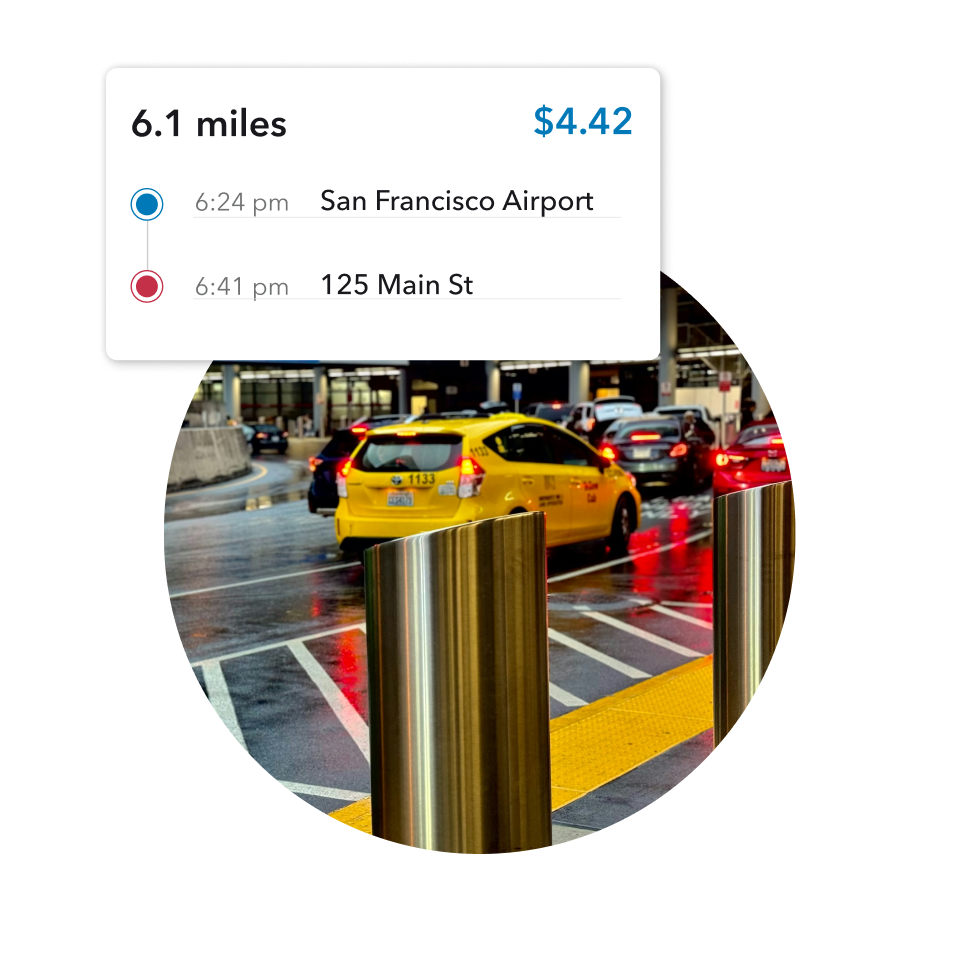
Driving to a busier zone, an airport queue, or a high-demand area after dropping off a passenger fully qualifies as a deductible business mile, as long as the drive is motivated by business activity. Always log both the purpose and distance to protect the deduction.
Everlance expense tracking app

Platform & Account-Related Driving

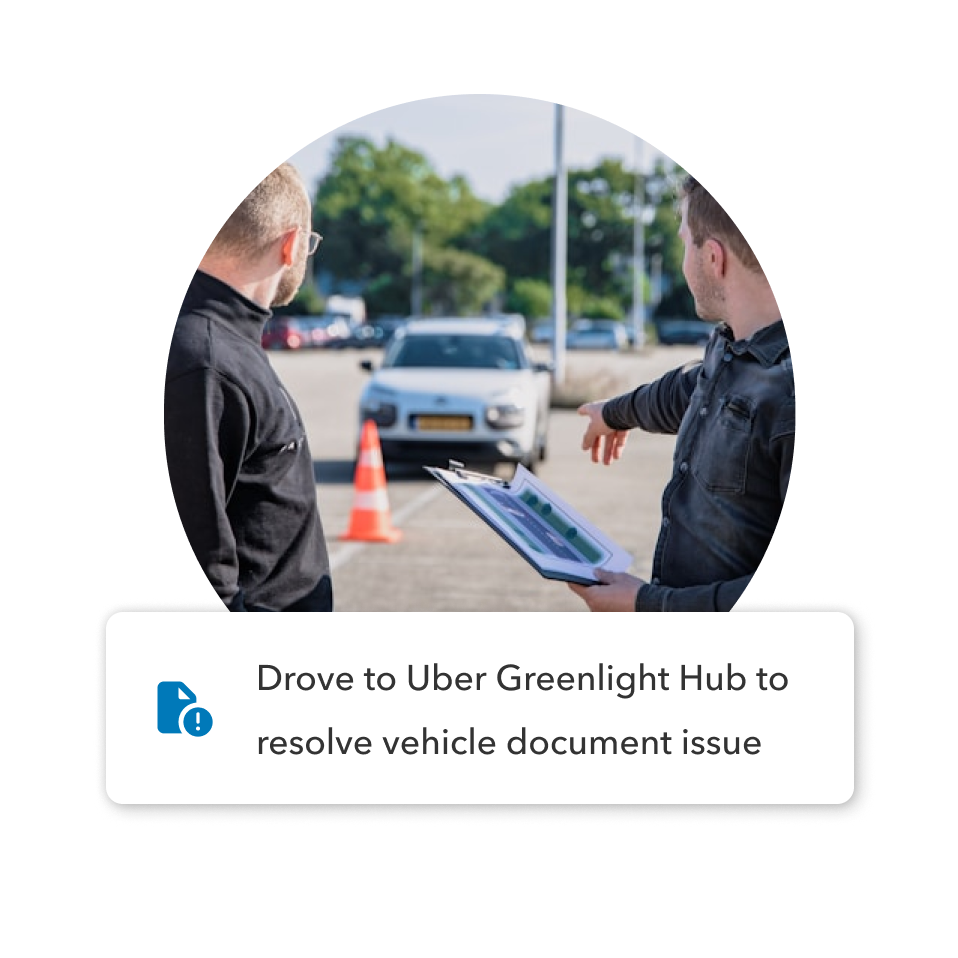
Driving to resolve a platform issue, attend a required onboarding session, or visit a driver support hub all qualify as ordinary and necessary business activities under IRS rules. These trips are easy to overlook but fully deductible.
Everlance expense tracking app

Multi-Platform Days

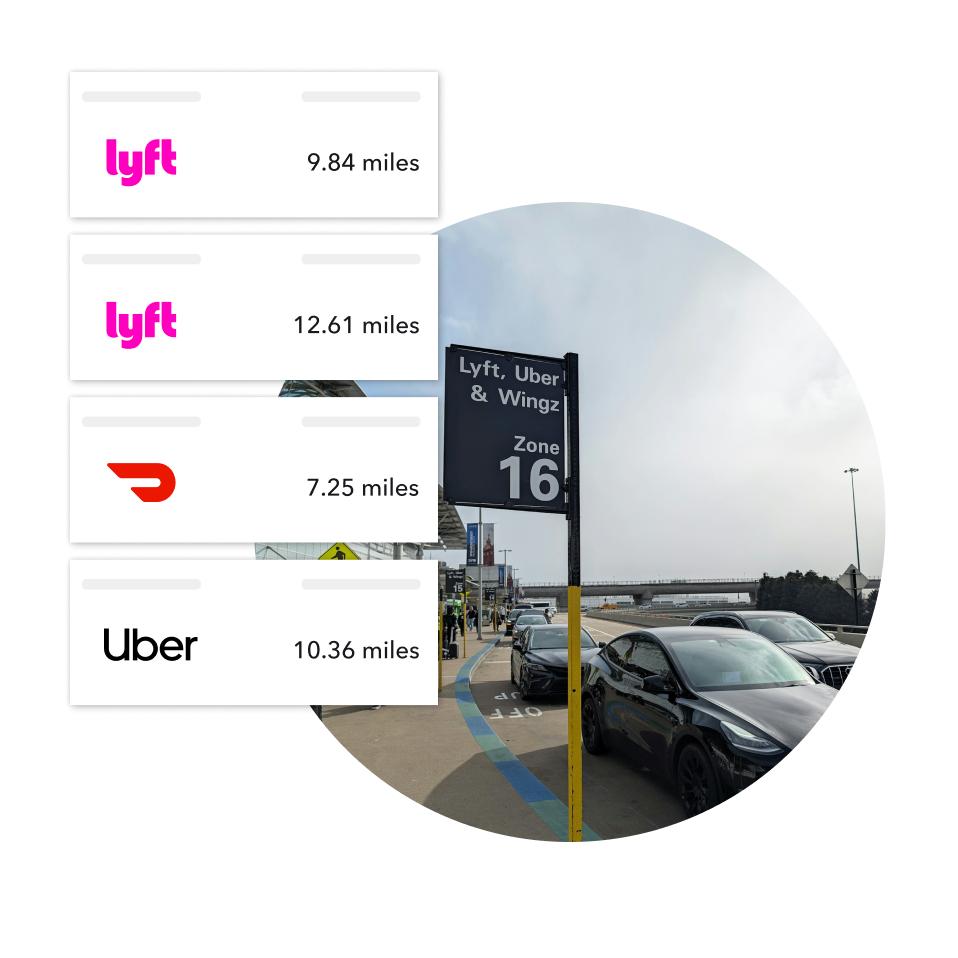
If you drive for Uber, Lyft, DoorDash, or any combination of platforms in a single day, every qualifying business mile across all of them is fully deductible. Your mileage log simply needs to capture each trip's purpose and distance to keep everything IRS-compliant.
Everlance expense tracking app

Vehicle Maintenance for Business Use

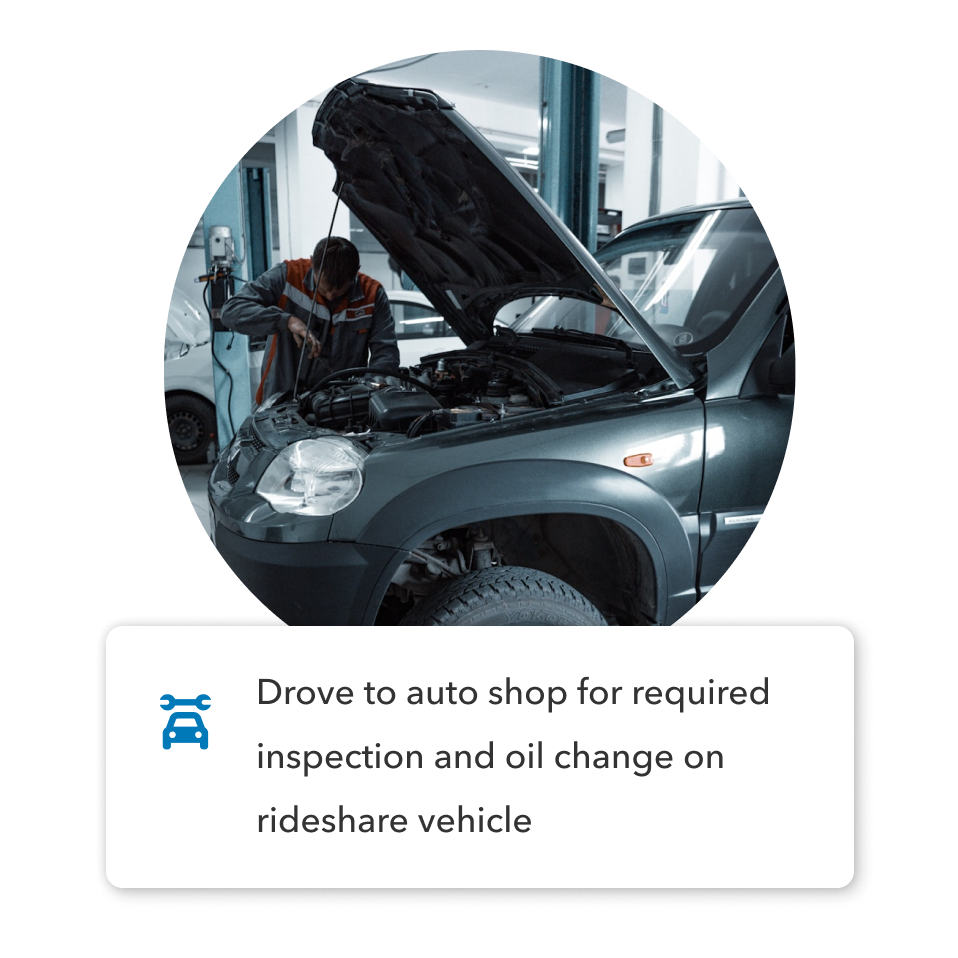
Driving to get an oil change, tire rotation, or any maintenance required to keep your rideshare vehicle road-ready is a fully deductible business trip, not a personal errand. The IRS recognizes that maintaining your vehicle is ordinary and necessary to your business.
Everlance expense tracking app
Estimate your 2026 deduction

Every Mile You Drive Has a Dollar Value β€” Do You Know Yours?

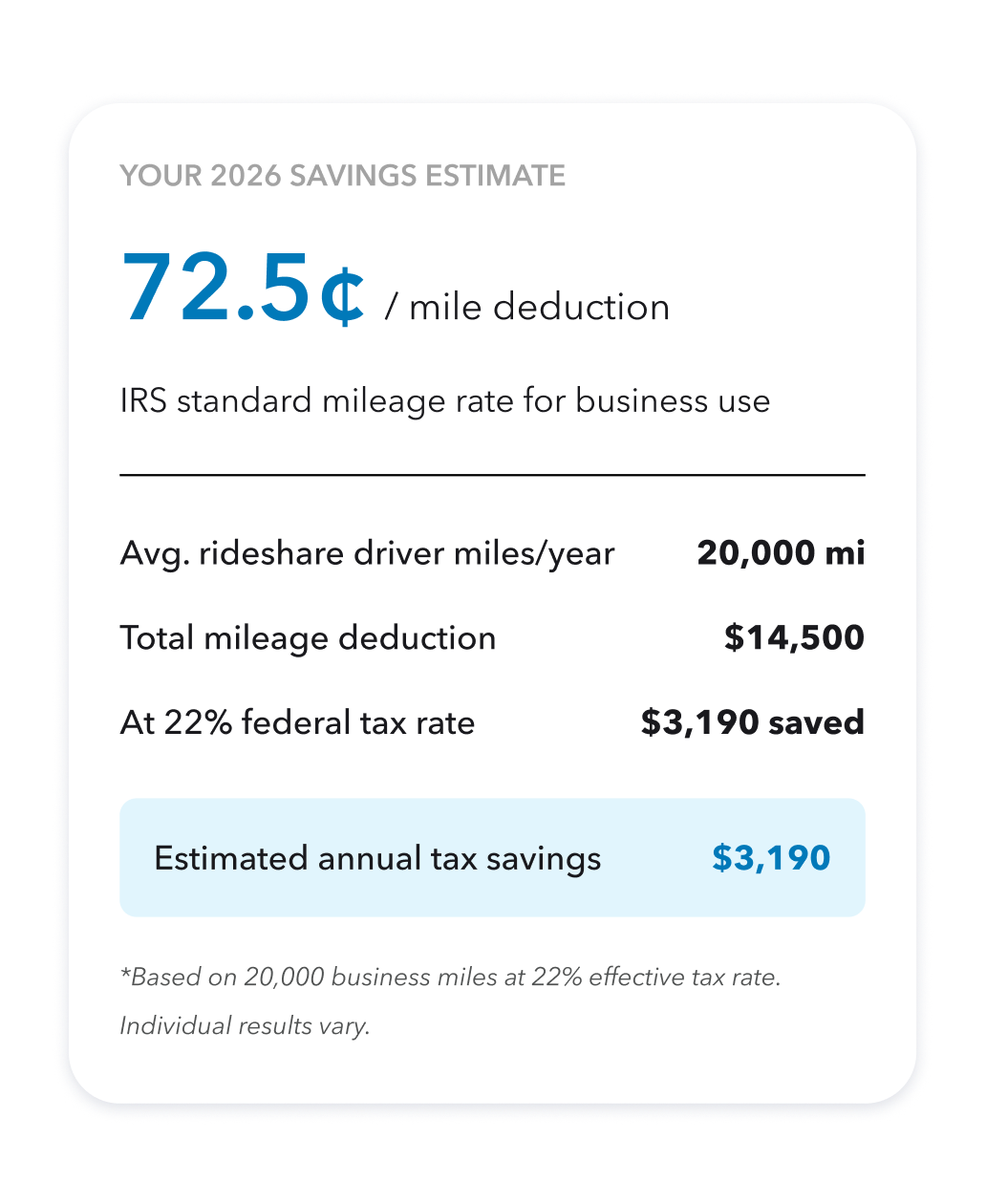
At the current IRS standard mileage rate, rideshare drivers who stay consistent on the road are sitting on a significant deduction, and most don't realize how large it actually is. A full-time driver putting in 40 hours a week across a mid-size market can realistically log 25,000 to 35,000 business miles in a year. At the current rate, that translates to a deduction worth $18,125 to $25,375, meaningfully reducing your taxable income. For high-volume drivers pushing 40,000 miles or more annually, that figure climbs even higher, making accurate mileage tracking one of the most valuable financial habits you can build.

Estimate my savings

Annual business miles 30,000
1,000 30,000 60,000
Federal tax rate 22%
10% 22% 37%

Estimated annual tax savings

$4,785

($21,750 total deduction)

Start Tracking β€” It's Free

βœ“ 2026 IRS Rate: 72.5Β’ per mile  Β·  Full-time rideshare drivers typically log 25,000–35,000 miles/year.

IRS compliance

The IRS Doesn't Accept "I Think I Drove That" as a Record

Rideshare drivers are among the most audited self-employed workers in the gig economy, Β largely because the scale of the deductions they claim draws attention. The IRS requires contemporaneous records, meaning your mileage log must reflect what actually happened at the time it happened, not a reconstruction weeks or months later. Four pieces of information per trip. No exceptions.

Miles driven

Total miles per trip, not a daily or weekly estimate. Everlance captures this automatically via GPS β€” no odometer readings, no manual input, no guesswork.

Business purpose

Note the specific purpose: "Uber ride, passenger pickup at 33 Main St" or "repositioning to airport queue." Entries like "work" or "driving" will not satisfy IRS scrutiny.

Date of the trip

Log the exact date at the time of the drive. The IRS cross-references claimed mileage against platform trip histories and payment records β€” inconsistencies are a red flag.

Starting & ending location

Record the full starting and ending address for every trip. GPS-captured coordinates are the gold standard β€” they're objective, timestamped, and nearly impossible to dispute in an audit.

Date of the trip

Log the exact date at the time of the drive. The IRS cross-references claimed mileage against platform trip histories and payment records β€” inconsistencies are a red flag.

Starting & ending location

Record the full starting and ending address for every trip. GPS-captured coordinates are the gold standard β€” they're objective, timestamped, and nearly impossible to dispute in an audit.

Business purpose

Note the specific purpose: "Uber ride, passenger pickup at 33 Main St" or "repositioning to airport queue." Entries like "work" or "driving" will not satisfy IRS scrutiny.

Miles driven

Total miles per trip, not a daily or weekly estimate. Everlance captures this automatically via GPS β€” no odometer readings, no manual input, no guesswork.

Common questions

Rideshare Driver Mileage Deduction β€” FAQ

Answers to the most common questions Uber, Lyft, and rideshare drivers ask about IRS mileage deductions. Each answer is written to give you a clear, actionable response, not tax jargon. For advice specific to your situation, consult a qualified CPA or tax professional.

The IRS publishes a standard mileage rate for business use each year, and as a self-employed rideshare driver β€” whether you drive for Uber, Lyft, or both β€” you can deduct that rate for every qualifying business mile you drive. The rate applies to sole proprietors and single-member LLCs filing Schedule C. Rideshare drivers are classified as independent contractors, not employees, which means the full standard mileage deduction is available to you on your federal return. Check the IRS website or consult your CPA each January for the current year's rate.

Yes β€” and this is one of the most under-claimed deductions in the gig economy. Miles driven to pick up a passenger after accepting a ride request, miles spent repositioning to a higher-demand area, and miles driven to a driver support hub or required onboarding event all qualify as ordinary and necessary business mileage under IRS Publication 463. Your deduction is not limited to the miles the app tracks while a passenger is in your car.

Yes. Deadhead miles β€” the distance you drive from your last drop-off to your next passenger pickup β€” are fully deductible business miles. They are a direct and necessary cost of operating as a rideshare driver. Because rideshare platforms typically only track miles with a passenger on board, these miles are systematically undercounted by drivers who rely solely on platform data at tax time. Everlance captures every mile from the moment you leave for your first pickup to the moment you return home, ensuring nothing is missed.

It depends on how many hours you drive and in what market, but the numbers are often larger than drivers expect. A full-time driver logging 25,000 to 35,000 business miles per year can generate a deduction that significantly reduces their taxable gig income, translating to thousands of dollars in federal tax savings at a 22% rate, plus applicable state deductions. Even part-time drivers putting in 10,000 to 15,000 miles annually see meaningful savings. Every mile you fail to capture is money you are effectively returning to the IRS.

Yes. Any drive made for the purpose of maintaining your rideshare vehicle β€” oil changes, tire rotations, inspections, or car washes required to meet platform standards β€” qualifies as an ordinary and necessary business expense. These are not personal errands; they are a required part of operating your vehicle as a commercial rideshare driver. Log the purpose clearly: "drove to auto shop for oil change on rideshare vehicle." That level of specificity is sufficient for IRS purposes.

The commute from your home to the area where you start accepting rides does not automatically qualify β€” however, if you maintain a qualifying home office and your vehicle is your primary business tool, travel from your home can be deductible from the moment you leave your driveway. Personal trips made between rides, or driving to run personal errands during your shift, are not deductible for the personal portion. The business purpose of the trip β€” not the timing β€” is what determines deductibility.

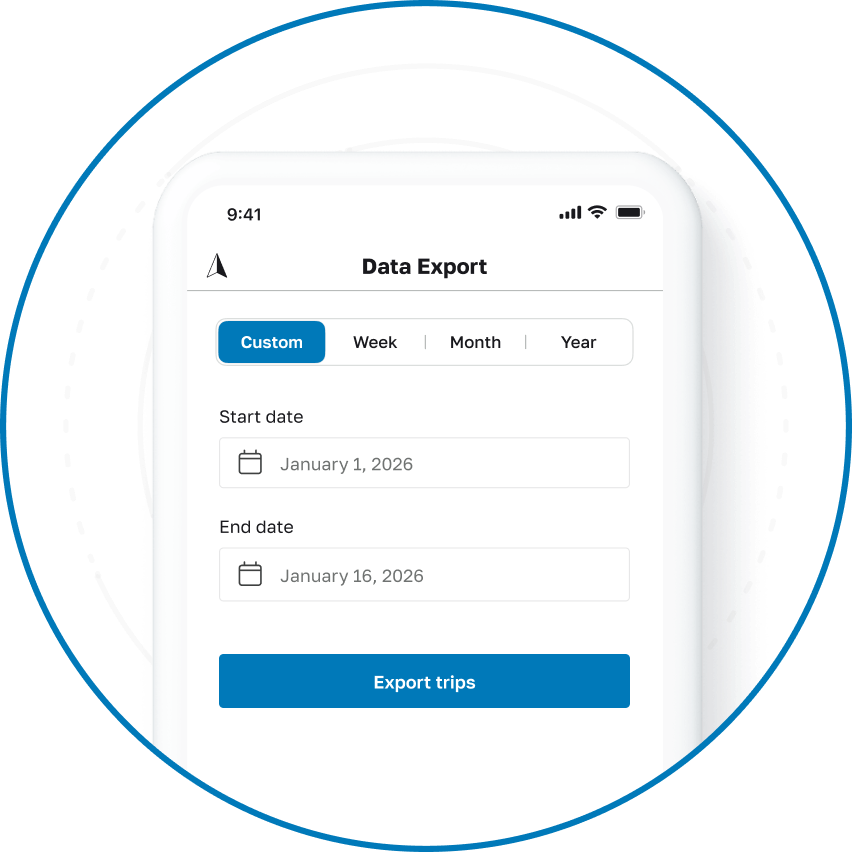
Yes β€” and this is non-negotiable. The IRS requires contemporaneous mileage records, meaning each trip must be logged at or near the time it occurs, not reconstructed later from app history or memory. Your log must include the date, starting and ending location, business purpose, and total miles for every trip. Rideshare drivers who rely solely on platform-generated summaries are at risk of losing a significant portion of their deduction in an audit, because those summaries don't capture all qualifying miles. Everlance runs in the background via GPS from the moment your car starts moving, timestamping and geo-verifying every trip automatically. At year-end, export a complete IRS-compliant mileage report in one tap.

Most rideshare drivers benefit significantly more from the standard mileage rate because the high volume of miles driven tends to produce a larger deduction than tallying actual vehicle expenses like gas, insurance, and depreciation. The actual expense method can occasionally outperform for drivers with newer, higher-cost vehicles with significant first-year depreciation, but the record-keeping burden is considerably greater.

One critical rule applies: you must choose the standard mileage method in the first year you use a vehicle for business. Switching to actual expenses in a later year locks you out of the standard rate for that vehicle going forward. Work with your CPA in year one to make the right call.

Every Ride Is a Deduction. Capture It.

Automatic GPS tracking captures every deductible mile across all platforms,generate your IRS-compliant report instantly.