If you've earned any interest from a bank account, CD, or bond in 2026, there's a good chance a small tax form is heading your way early next year: the 1099-INT. Here's the good news: this form is straightforward, and understanding it takes about five minutes. The bad news? Ignoring it or misreading it can lead to IRS headaches you really don't want.
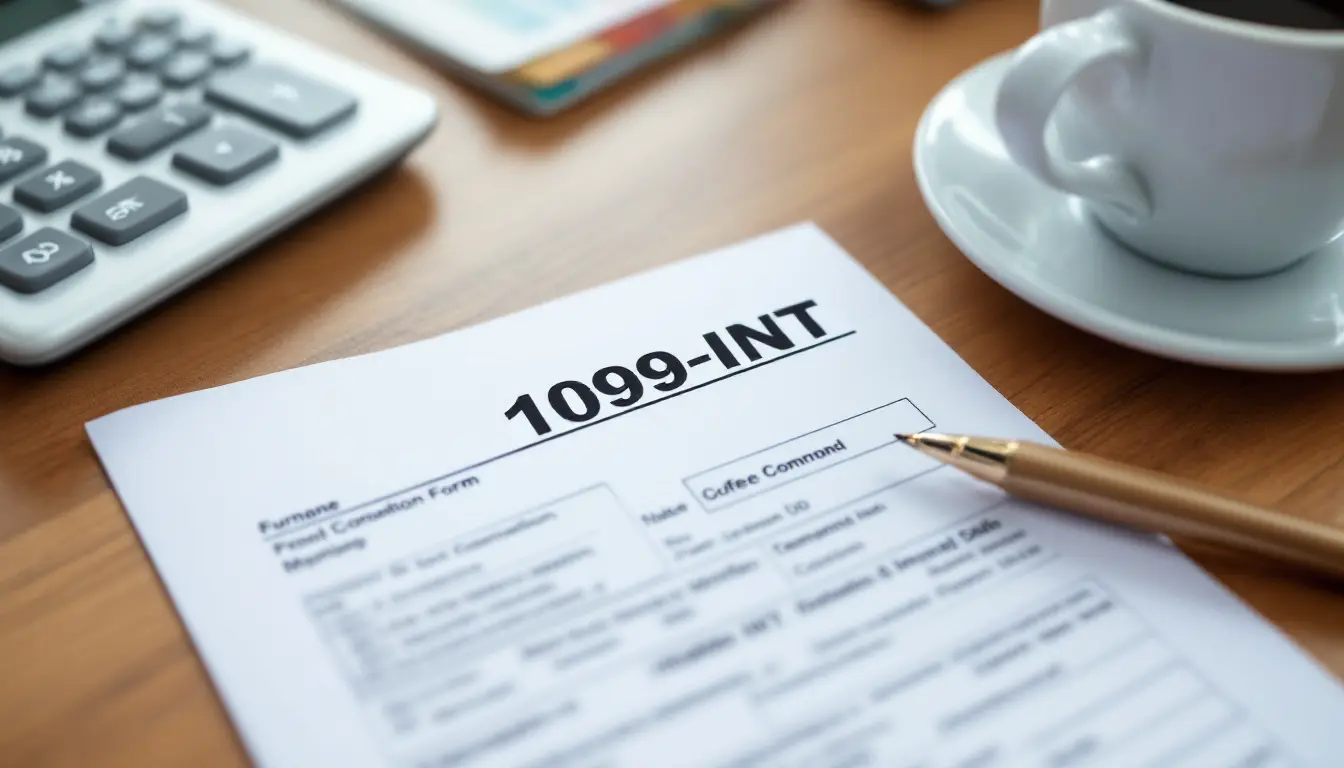
A 1099-INT form is the IRS document that reports interest income you've earned during the tax year. Banks, credit unions, brokerage firms, and other financial institutions send it to you (and to the IRS) whenever you've earned $10 or more in interest. Even if you don't receive one, you're still required to report all interest income on your tax return. That's a detail a lot of people miss, and it can trigger notices from the IRS down the road.
The 1099-INT is designated by the Internal Revenue Service (IRS) for reporting interest income. The form covers interest payments of $10 or more received during the tax year. Any interest earned, regardless of the amount, must be reported on your tax return, but only amounts of $10 or more trigger the official 1099-INT paperwork.
This form is part of the broader 1099 series, which includes various forms for reporting different types of income. The "INT" stands for "Interest," which tells you exactly what it covers. Interest income can come from savings accounts, certificates of deposit (CDs), money market accounts, U.S. Treasury bonds, and other sources, making this one of the most common tax forms Americans encounter each year. In fact, the IRS processes hundreds of millions of information returns annually, and 1099-INT forms make up a significant portion of that volume.
The primary purpose of the 1099-INT form is to give the IRS a record of all interest payments made to taxpayers, which helps confirm total income. Financial institutions are required to provide this form to both the taxpayer and the IRS if the total interest earned meets or exceeds $10. With this information, the IRS can track income and flag potential underreporting.
The 1099-INT also helps you accurately compute your taxable income. The form spells out exactly how much interest was earned, so you can report the correct amount when you file. Beyond the total interest, the form may also include information about federal income tax withheld, which matters if you've opted for backup withholding on your interest income. For 2026, the backup withholding rate remains at 24%, so if that applies to you, you'll want to account for it when calculating your refund or balance due.
One thing that trips people up: if you receive multiple 1099-INT forms from different financial institutions, you need to add up all the interest earned and report the total. Say you have a high-yield savings account at one bank earning $85 in interest and a CD at another earning $120. You'll get two separate forms, and both amounts need to appear on your tax return. Keeping organized records throughout the year makes this much easier when January rolls around.
The 1099-INT contains several sections, each serving a specific purpose:
To read a 1099-INT form effectively, focus on the box numbers. Box 1 is where most of the action is: it displays the total taxable interest income earned during the year, and that's the number you'll transfer to your tax return (specifically, Schedule B if your total interest income exceeds $1,500).
Check Box 2 if you broke a CD early. That penalty amount can be deducted as an adjustment to income on Schedule 1 of Form 1040, which reduces your taxable income. A lot of people miss this deduction because they don't realize it exists.
Also check Box 4 for any federal tax withheld. If backup withholding was applied, you'll want to claim that credit on your return to avoid overpaying. Think of it like paycheck withholding: the money was already sent to the IRS on your behalf, and you get credit for it when you file.
Here's a quick comparison of how to handle these forms:
Good practice: You receive three 1099-INT forms in late January 2027 (for the 2026 tax year). You immediately file them in a dedicated tax folder, cross-reference the amounts against your bank statements, and note the totals in a spreadsheet. When you file in March, everything matches up perfectly.
Bad practice: You toss the forms in a junk drawer, forget about one from a brokerage account, and report only partial interest income. Six months later, you get a CP2000 notice from the IRS saying you underreported income by $340. Now you owe the tax plus interest and possibly a penalty.
The difference between these two scenarios is about 15 minutes of organization.
Anyone who earns interest from financial institutions is eligible to receive a 1099-INT. The IRS mandates that financial institutions provide this form if a taxpayer earns $10 or more in interest throughout the tax year. This includes interest from savings accounts, CDs, money market accounts, and certain bond investments.
If you hold multiple accounts, the combined interest may exceed the threshold even if individual accounts fall below $10. For example, you might earn $6 in interest at one bank and $8 at another. Neither bank is required to send you a 1099-INT, but you're still obligated to report that $14 on your tax return. The IRS doesn't care whether you got the paperwork; they care whether you reported the income.
With savings account rates in 2026 hovering between 4% and 5% APY at many online banks, more Americans are earning meaningful interest income than in previous years. Someone with $10,000 in a high-yield savings account could easily earn $400 to $500 in interest over the year. That's real money, and it's fully taxable at your ordinary income tax rate.
Certain types of interest income from bonds or other investment vehicles may also generate a 1099-INT. Taxpayers should keep track of any interest payments they receive, as these directly affect overall taxable income and tax liability.
Financial institutions such as banks, credit unions, and investment firms are responsible for issuing 1099-INT forms. These institutions must ensure that the forms accurately reflect the interest earned by their clients during the year. By sending out the 1099-INT, they comply with IRS regulations and help their customers file accurate returns.
These institutions typically send the 1099-INT forms to taxpayers by January 31st of the following tax year. For the 2026 tax year, that means you should have your forms in hand by January 31, 2027. If you don't receive yours by mid-February, contact your financial institution directly. Many banks also make these forms available for download through their online banking portals, so check there first.
Some institutions provide additional documentation or year-end summaries that detail interest earned throughout the year. This can be especially helpful if you have multiple accounts or earned interest from various sources. A consolidated tax statement from a brokerage, for example, might include your 1099-INT alongside 1099-DIV and 1099-B forms, giving you a complete picture of your investment income.
Interest income is taxed as ordinary income, meaning it's added to your wages, salary, and other income and taxed at your marginal rate. For 2026, the federal income tax brackets range from 10% to 37%, depending on your filing status and total taxable income.
Here's a quick scenario: suppose you're a single filer with $50,000 in wage income and $500 in interest income from a savings account. That $500 gets added to your total income, and you'd owe federal tax on it at your marginal rate, which would be 22% for that income level. That's $110 in federal tax on the interest alone, plus any applicable state tax.
Some interest income gets special treatment. Interest from U.S. Treasury securities is exempt from state and local taxes, though it's still federally taxable. Municipal bond interest is generally exempt from federal tax and may also be exempt from state tax if the bond was issued in your state of residence. These distinctions matter, and the 1099-INT form breaks them out in separate boxes so you can report them correctly.
One practical tip: set a calendar reminder each week during tax season (January through April) to check for incoming tax documents. Many forms arrive at different times, and it's easy to start filing before all your 1099-INTs have come in. The IRS matches every 1099-INT filed by financial institutions against what you report, and discrepancies almost always result in a notice.
As you navigate the complexities of interest income and 1099-INT forms, let Everlance transform the way you track your finances. Our intuitive app is designed to automate mileage and expense logging, helping you distinguish between work and personal expenses with ease. With IRS-compliant mileage logs at your fingertips, you'll be well-prepared for a stress-free tax season. Join the 3 million drivers who trust Everlance and start maximizing your deductions today. Download the app and take the first step towards simplified financial tracking.
Automate your deduction tracking and reporting with Everlance, the trusted sidekick of over 4 million independent workers




.webp)

.svg)




.svg)
