NEW FOR 2026: The Section 199A QBI deduction is now PERMANENT - signed into law by the One Big Beautiful Bill Act (OBBBA). Income thresholds have increased, phase-out ranges are wider, and a new $400 minimum deduction applies if your QBI exceeds $1,000. This is one of the biggest self-employed tax wins in years.
If you drive for Uber, deliver for DoorDash, sell homes as a real estate agent, or run any other self-employed operation, you may be leaving thousands of dollars on the table each tax season. The 20% Qualified Business Income (QBI) deduction - formally known as the Section 199A deduction - is one of the most valuable tax breaks available to independent workers, and in 2026 it got even better.
Here's the plain-English version: if you clear a profit from your self-employed work, you may be able to deduct up to 20% of that income before the IRS calculates your tax bill. For a rideshare driver netting $50,000, that's a $10,000 deduction that could save over $2,200 in federal taxes at a 22% bracket.
This guide focuses specifically on who qualifies, how the 2026 thresholds apply to your situation, and what workers in the gig economy, real estate, and other self-employed fields need to know.
The QBI deduction applies to income earned through pass-through entities - meaning your business income flows directly onto your personal tax return. The self-employed workers below are strong candidates for the full 20% deduction:
If you drive for a rideshare platform, you're an independent contractor filing a Schedule C - making you a pass-through business owner by default. Every mile you drive for the platform generates self-employment income that qualifies for the QBI deduction. Rideshare driving is not classified as a Specified Service Trade or Business (SSTB), which means you are NOT subject to the harsher income restrictions that apply to professionals like attorneys or consultants.
Example: A rideshare driver with $40,000 in net income qualifies for an $8,000 QBI deduction, saving roughly $1,760 in federal taxes (22% bracket).
Delivery drivers are in the same favorable position as rideshare drivers. As independent contractors, your net earnings from deliveries qualify as QBI. Your income is not restricted by SSTB rules, and at average earnings for gig delivery workers, most will be comfortably below the 2026 income thresholds - meaning you get the full 20% deduction with no complex calculations required.
The key is accurate expense tracking. Mileage, phone use, insulated bags, and other work-related costs reduce your net income (your QBI), so every dollar you track in deductible expenses optimizes both your Schedule C and your QBI deduction.
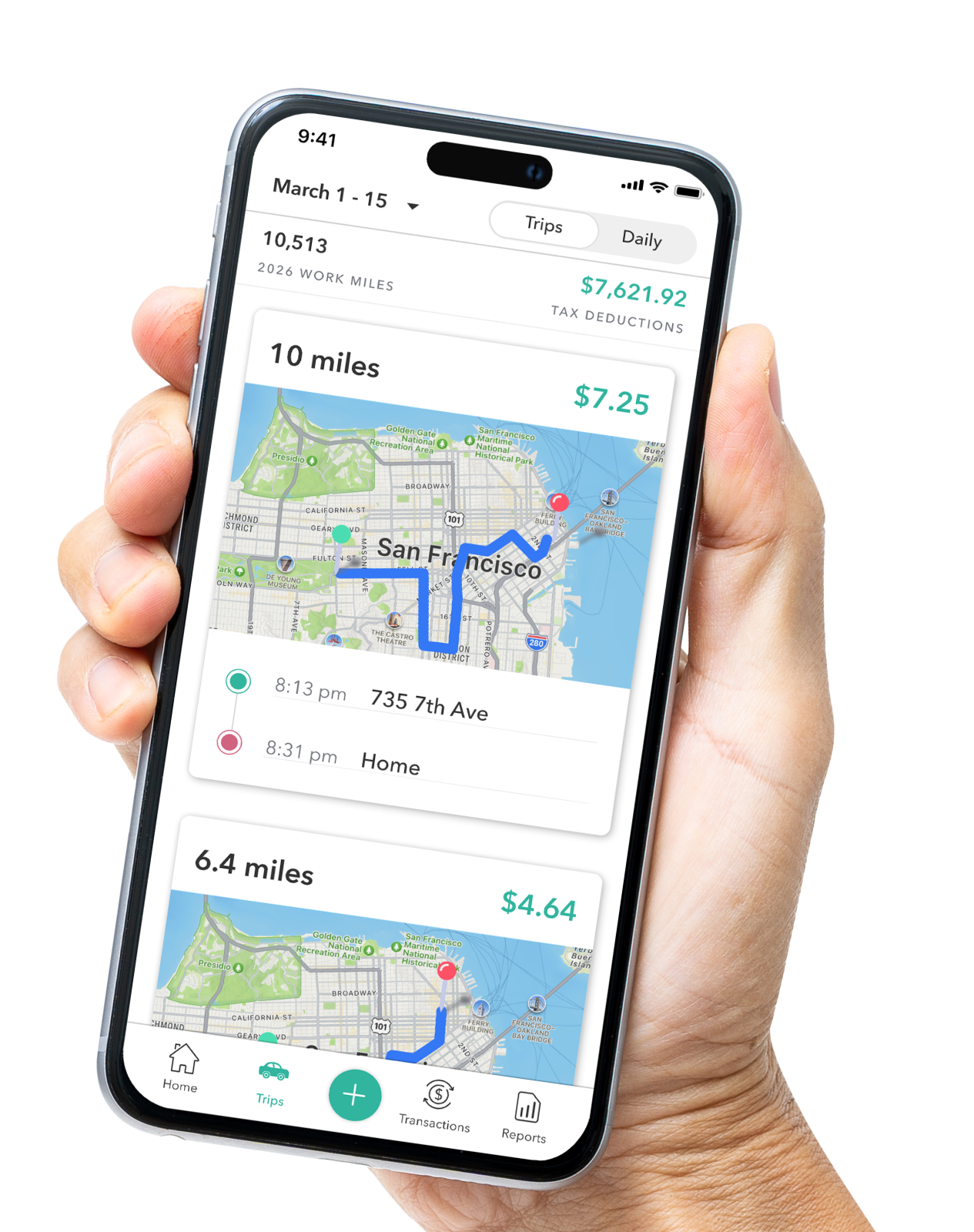
Tip: Everlance auto-tracks every business mile, ensuring your Schedule C reflects accurate QBI - and your deduction is as large as possible.
Real estate agents and brokers are explicitly carved out of the SSTB designation - a significant advantage. Even at higher income levels, real estate professionals face the standard income limitations rather than the stricter SSTB phase-out rules that eliminate the deduction entirely for certain professionals.
Agents who operate as sole proprietors or through an S-corp both qualify, and commission-based income that passes through to your personal return is eligible QBI. Real estate investors who own rental properties may also qualify if their rental activity meets the IRS safe harbor (250 hours of rental services per year, maintained with separate books and records).
Example: A real estate agent with $85,000 in net commission income gets a $17,000 QBI deduction - saving approximately $3,740 in federal taxes (22% bracket).
Insurance agents - selling life, health, property, or casualty insurance - generally fall outside the SSTB definition. While financial services and brokerage are classified as SSTBs, insurance agency work is treated differently under IRS guidance. Most insurance agents filing Schedule C or through an S-corp qualify for the full 20% QBI deduction below the income thresholds, with standard phase-out rules applying above them.
Graphic designers, web developers, photographers, copywriters, and other creative freelancers are not classified as SSTBs. Your income from client projects qualifies as QBI, and as long as your taxable income stays below the 2026 thresholds, you receive the full 20% deduction with no W-2 wage or property limitations to worry about.
Any worker receiving 1099-NEC income and filing a Schedule C is a pass-through business owner for tax purposes. Cleaning professionals, handymen, tutors, personal trainers, and countless other independent workers all qualify - as long as the income flows through a pass-through entity and your business type is not classified as an SSTB.
The following workers are generally NOT considered SSTBs and qualify for the full deduction without the harsh phase-out restrictions:
• Engineers and architects (explicitly excluded from SSTB by Congress)
• Plumbers, electricians, and trade contractors
• Truck drivers and logistics contractors
• Property managers and landlords (with sufficient rental activity)
• Salespersons and commissioned reps
• IT consultants and software developers (in most cases)
The most important update for 2026 is the expansion of both the income thresholds and the phase-out ranges. The One Big Beautiful Bill Act (OBBBA) increased the phase-in range from $50,000 to $75,000 for single filers and from $100,000 to $150,000 for married filing jointly. This means more workers qualify for a full or partial deduction.
For most rideshare drivers, delivery drivers, and other gig workers - whose net incomes typically fall well below these thresholds - the 2026 rules are a straightforward win: calculate 20% of your net business profit and take the deduction. No complicated W-2 wage tests, no property calculations.
NEW: Starting in 2026, if your QBI is at least $1,000, you receive a guaranteed minimum deduction of $400 - even if the standard calculation results in less. This benefit was indexed for inflation after 2026.
The basic calculation for most self-employed workers below the income thresholds is simple:
• Step 1: Start with your gross business revenue
• Step 2: Subtract all deductible business expenses (mileage, phone, supplies, home office, etc.)
• Step 3: The result is your Net Business Income - your QBI
• Step 4: Multiply QBI by 20%
• Step 5: Your deduction cannot exceed 20% of your total taxable income minus net capital gains
• Step 6: Report on Form 8995 (below threshold) or Form 8995-A (above threshold)
• Step 7: Enter the deduction on Line 13 of your Form 1040
*Estimates assume all income is below the 2026 threshold for single filers ($201,775). Actual savings vary based on total taxable income, deductions, and filing status.
The IRS designates certain service businesses as Specified Service Trades or Businesses (SSTBs). These professions face stricter rules: once their income exceeds the threshold, the QBI deduction phases out completely. The SSTB categories include health care providers, attorneys, accountants, financial advisors, and consultants.
The critical point for this guide's audience: rideshare drivers, delivery drivers, real estate agents, insurance agents, and most trade contractors are NOT SSTBs. They face the standard income phase-out, not the harsher elimination that hits service professionals.
Key reminder: Real estate agents, insurance agents, rideshare drivers, and delivery drivers are explicitly NOT classified as SSTBs. Your QBI deduction phases out gradually above the threshold - it does not disappear all at once.
Every legitimate business deduction you claim reduces your net income - and your net income is your QBI. That means every mile you track with Everlance, every phone bill you log, every work-related expense you record directly increases the value of your QBI calculation by reducing the base your deduction is applied to.
Wait - doesn't reducing QBI reduce the deduction? Only in the math of 20% of a smaller number. The net benefit is still positive because every dollar of business deduction saves you both income tax AND self-employment tax (15.3%). The QBI deduction on top of that is a bonus.
The practical lesson: meticulous mileage and expense tracking is the single most impactful habit you can build as a self-employed worker. Everlance automates the tracking, ensures your Schedule C is accurate, and gives you the documentation needed to support your QBI calculation if the IRS ever asks.
Millions of self-employed workers qualify for the QBI deduction. Everlance makes sure you never miss a deduction.




.webp)

.svg)


.svg)
