
Mileage Tracker for Sales Professionals close more deals. lose fewer miles.
Every client call, every prospect visit, every drive across your territory is a qualifying business mile. A mileage tracker for sales professionals captures the full picture automatically, so your mileage log is complete and accurate whether you are submitting for employer reimbursement, filing your taxes, or both.
$6,500+
30,000+
30%
4.8/5
Miles, money, and taxes: what every sales professional needs to know about mileage tracking
Outside sales is a driving profession. Every client visit, territory run, and business development call carries real dollar value that belongs in your mileage log. Whether you're a regional account executive, a medical sales rep working a hospital circuit, or an independent contractor filing your own taxes, getting mileage tracking right is one of the highest-leverage financial decisions you can make. The miles are already being driven — the only question is whether they're being counted.
What is a mileage tracker for sales representatives and why does it matter?
A mileage tracker for sales representatives records every business mile driven across client visits, prospect meetings, territory coverage, and product demonstrations — capturing the date, locations, distance, and purpose of each trip in a format that satisfies IRS requirements and employer reimbursement policies.
For outside sales reps, driving isn't incidental — it's the job. Field sales professionals routinely accumulate 20,000 to 40,000 business miles annually. At the IRS standard mileage rate, that translates into substantial deductions for self-employed reps or significant reimbursement entitlements for W-2 employees. Every undocumented mile is money left on the table.
Most sales reps undercount mileage not from lack of qualifying drives, but from poor documentation. IRS Publication 463 requires contemporaneous records — not logs reconstructed from a CRM or calendar at quarter's end.
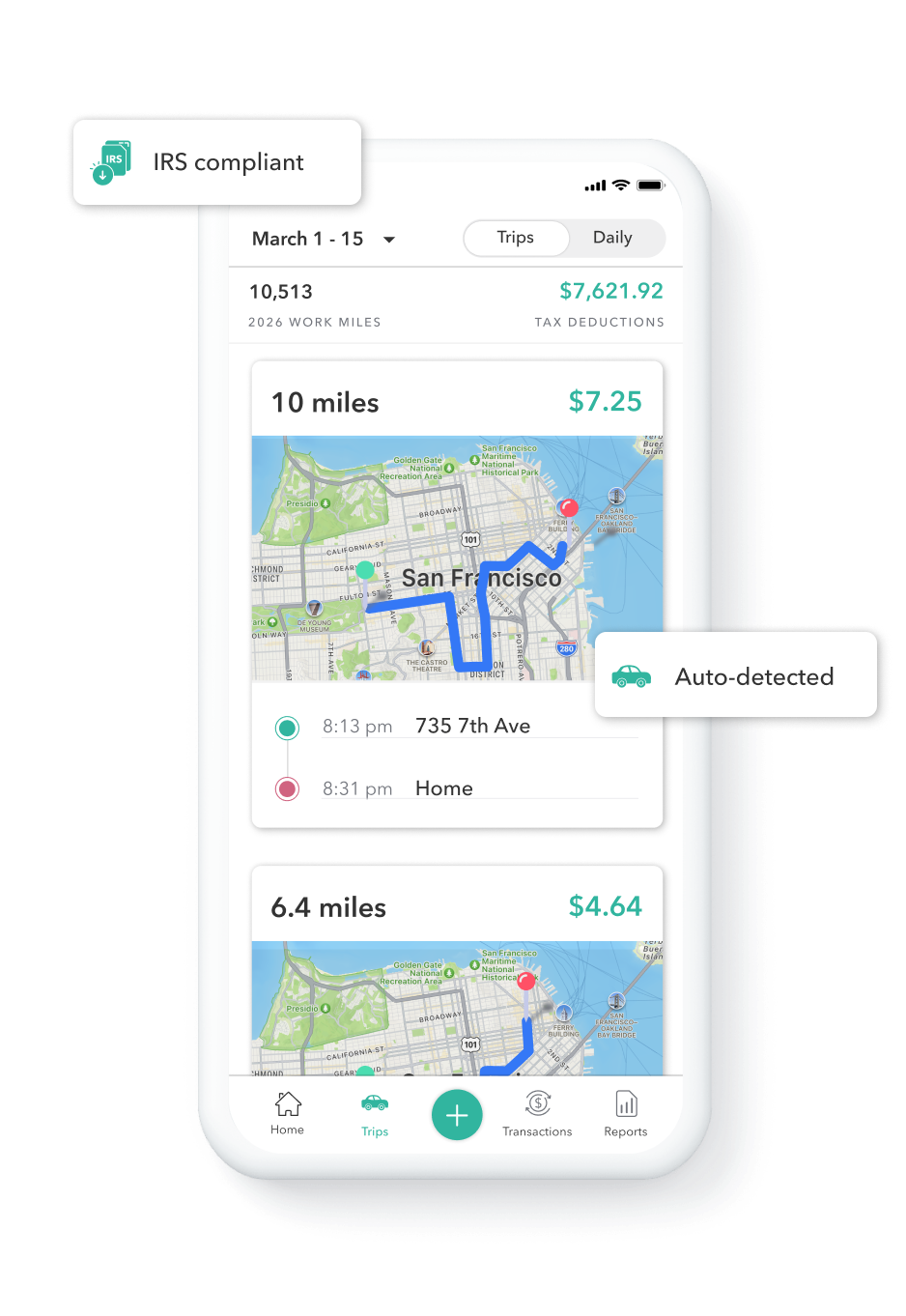
An automatic GPS mileage tracker solves this instantly. It detects motion, opens a trip record automatically, and by day's end every territory run and client visit is already logged and ready for reimbursement or tax filing.
How an automatic mileage tracker works for sales professionals
A GPS mileage tracker uses your smartphone's location and motion sensors to automatically record every drive the only reliable method for sales reps constantly moving between appointments without adding friction to their day.
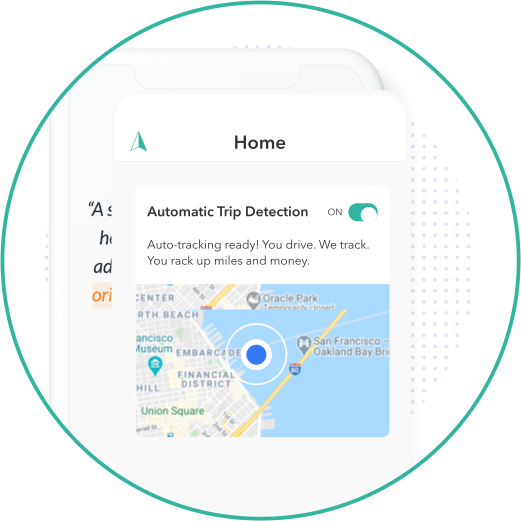
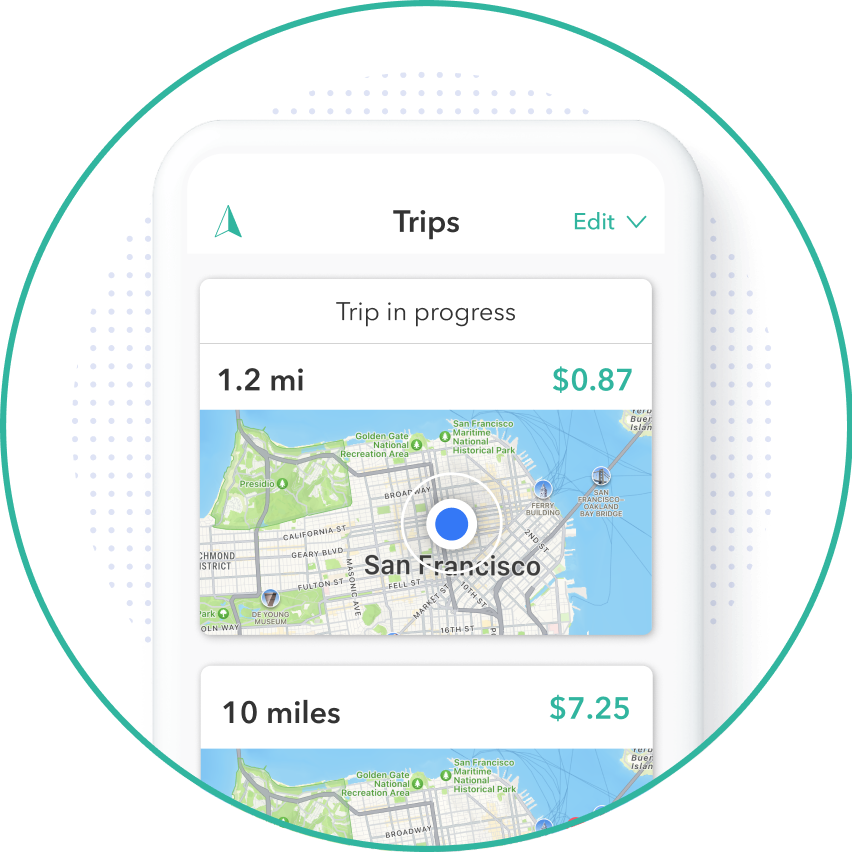
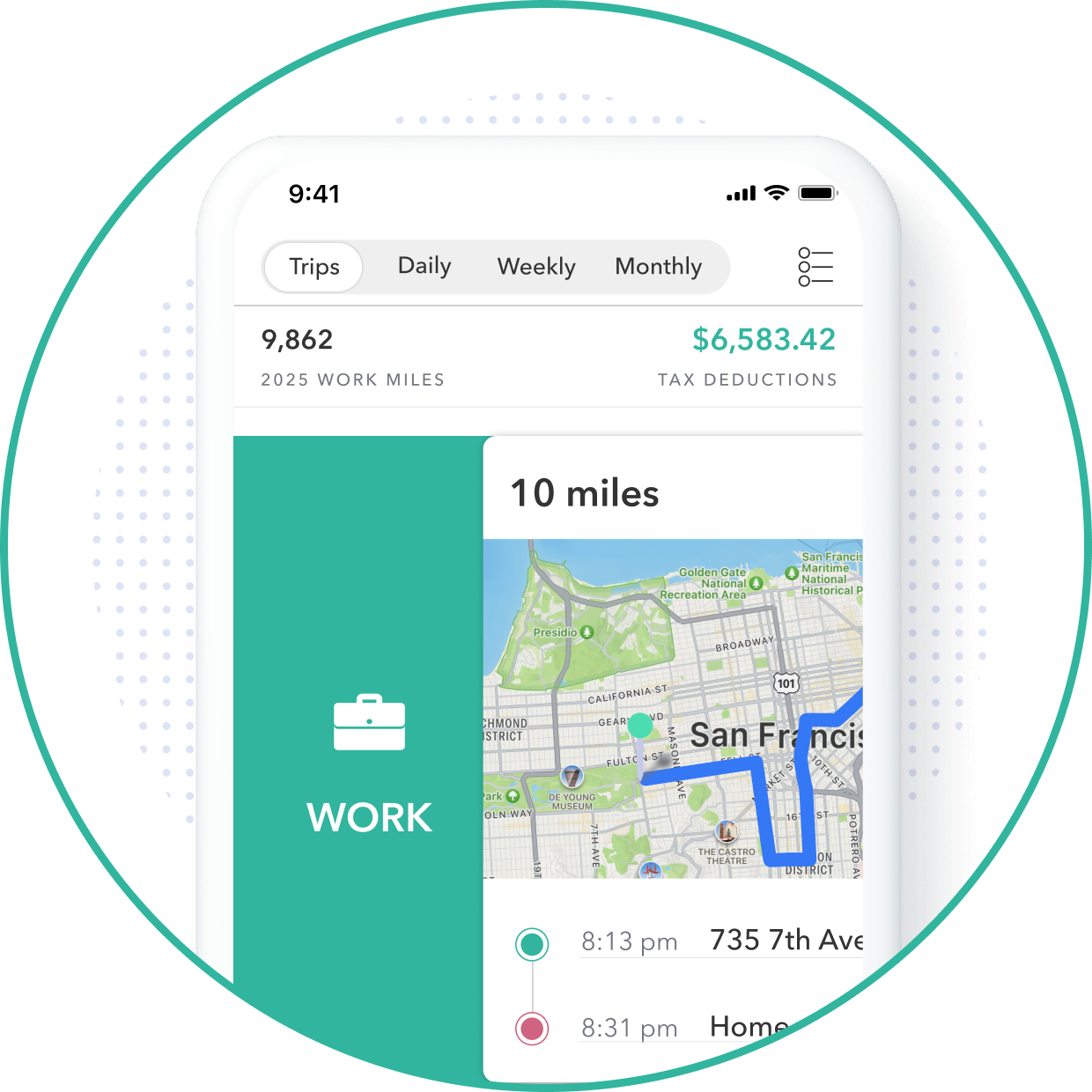
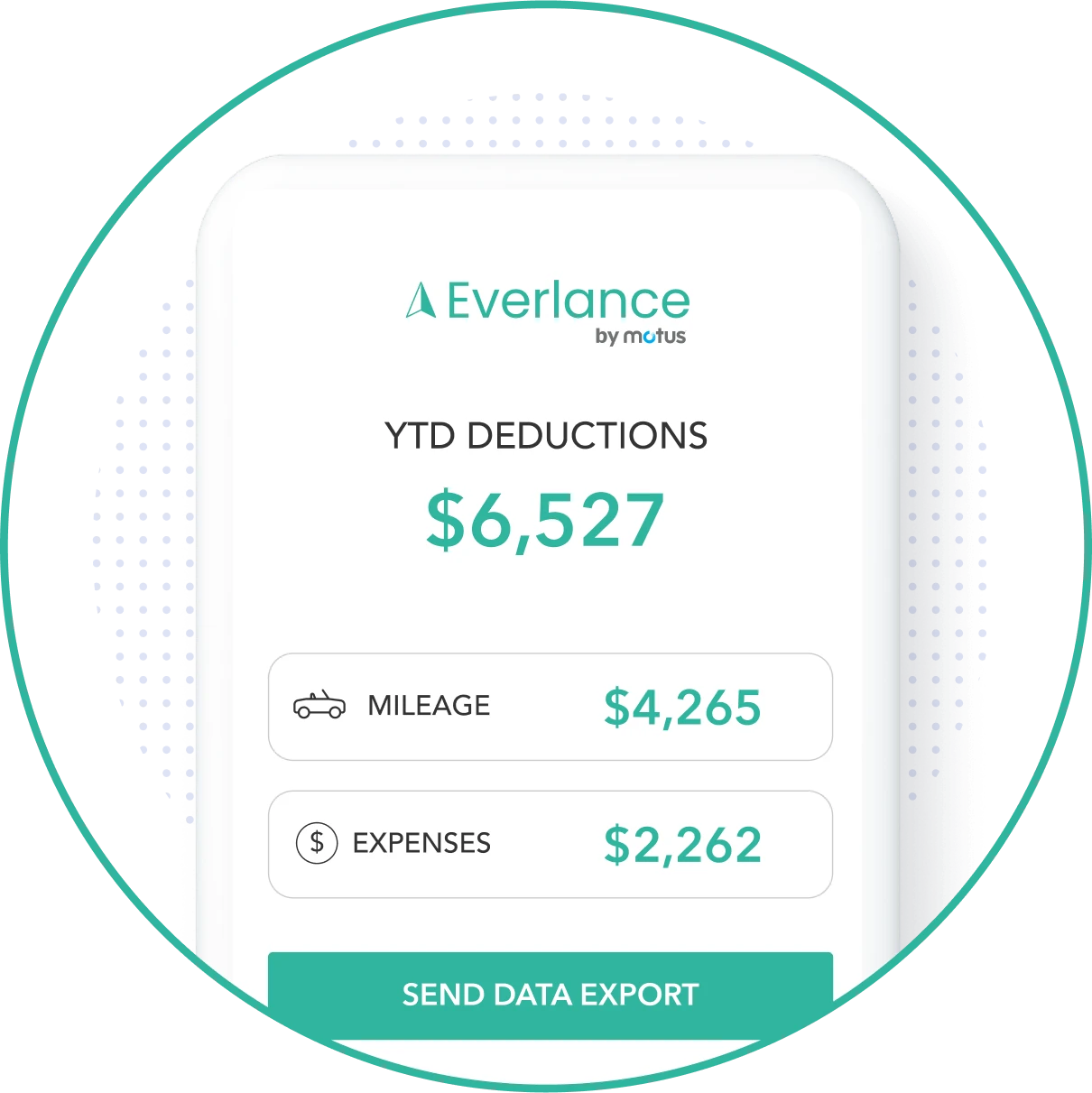
Your territory, tracked. Your reimbursement, maximized.
This is what automatic mileage tracking looks like in the app for a sales professional on the road, and what your annual deduction or reimbursement value could look like. Adjust the sliders to reflect your territory coverage and tax bracket.
Your 2026 mileage savings estimate
Estimated total tax savings or reimbursement value
$6,888
Federal and state combined
Sales reps log more business miles than almost any other profession — yet most are leaving money on the road.
Field sales reps are among the highest-mileage professionals in the workforce, often driving 25,000 to 40,000 business miles annually across client visits, demos, and territory coverage. Those miles carry significant financial value, yet most sales professionals collect only a fraction because their mileage log is incomplete..

Your CRM tracks deals. It does not track your mileage

Every mile between client calls has a real dollar value

Quarterly expense reports rely entirely on the accuracy of your mileage log
Sales reps who track every mile protect their earnings and stay audit-ready
Professionals using automatic GPS tracking capture 30% more deductible miles than those relying on manual logs. For a field sales rep driving 25,000 annual miles, that gap represents thousands in unclaimed value every year. The reason manual tracking fails is simple, the job never stops. You finish one call and drive straight to the next. Automatic tracking closes that gap without changing your workflow.
Qualifying trip types:

Property showings — each leg is a separate deductible trip
Listing appointments and CMA presentations
Open house setup, signage, and hosting runs
Neighborhood farming and prospecting drives
Client meetings at any location
Home inspections, appraisals, and photo shoots
Continuing education and broker training
Title company, lender, and escrow visits
Qualifying trip types for sales professionals:

Your paycheck and your tax bill both change when mileage tracking for sales professionals is done right
Sales professionals interact with mileage in two ways. Independent contractors deduct vehicle miles on Schedule C, reducing net profit before income and self-employment tax. W-2 employees submit expense reports for employer reimbursement. In both cases, the financial outcome depends entirely on the quality of the mileage log.
The IRS standard mileage rate for sales reps: the right method for most
Sales professionals can deduct vehicle costs using either the IRS standard mileage rate or the actual expense method. For most sales reps, the standard mileage rate is the better choice — simpler to apply and typically producing a larger deduction without tracking every fuel and maintenance receipt.
Under this method, total qualifying business miles are multiplied by the IRS-published rate, which covers fuel, maintenance, insurance, and depreciation in a single figure. A compliant mileage log is the only record required.
One critical rule: the standard mileage rate must be elected in the first year you use a vehicle for business. Starting with actual expenses locks you into that method for that vehicle's entire business life — making it essential to begin tracking mileage from your very first business drive.
Sales reps operating through a business entity, driving a company vehicle, or receiving a car allowance alongside reimbursement should consult a tax professional, as treatment varies significantly by arrangement.
Updated each year by the IRS
Covers gas, insurance, depreciation & maintenance. Applies to all qualifying business drives.
A field sales professional averaging 575 business miles per week accumulates roughly 28,750 miles over a full year of active selling. At the current IRS standard mileage rate, that volume produces a mileage deduction or reimbursement value that ranks among the most significant financial benefits available to any sales professional. Every mile that goes unlogged is permanently forfeited, whether as a tax deduction or a reimbursement claim.
Sales mileage reimbursement: how it works and what the records need to show
Most outside sales professionals are entitled to mileage reimbursement for personal vehicle use on company business. Regardless of the program structure, documentation must meet the same standard: contemporaneous, trip-level records with dates, locations, distances, and business purposes. Accurate logs mean full reimbursement and no tax complications. Incomplete ones leave money unclaimed.
Employer reimbursement programs take several forms. Under a standard accountable plan, documented mileage is reimbursed at or below the IRS rate and excluded from taxable income. Reimbursements above the IRS rate or lacking proper documentation are treated as taxable wages.
Flat car allowances are typically included in taxable income unless paired with a mileage reporting requirement that qualifies them as an accountable plan arrangement.
In every structure, the mileage log is the foundation. Without it, no reimbursement or deduction can be fully claimed or defended.





IRS Compliance Checklist


Date of the trip
The IRS requires a specific date for every mileage log entry. Aggregated weekly or monthly totals invite disallowance.

Starting & ending location
GPS-verified start and end coordinates provide objective, timestamped evidence independent of the driver's own records and extremely difficult to dispute.

Total miles per trip
GPS-calculated mileage eliminates estimation error and the inconsistencies between estimated and actual distance that frequently draw examiner attention in manual logs.

Specific business purpose
'Client consultation, [client name] office' or 'materials pickup for renovation project' satisfies the IRS requirement. Entries labeled 'work' or 'business' do not.
What sales professionals need to know about mileage compliance

Your CRM is not a mileage log
CRM activity records confirm a meeting happened, not the route driven or miles accumulated. A dedicated mileage tracking app creates the contemporaneous, trip-level documentation that no CRM can substitute for.

Multi-territory and multi-client driving needs unified tracking
Sales professionals covering multiple territories or splitting time across roles need one log capturing all business driving. Custom trip categories enable per-territory or per-client breakdowns for expense reports requiring that level of detail.
IRS-compliant report format for expense submissions
Export IRS Publication 463-compliant reports in PDF, Excel, or CSV ready for monthly reimbursement submissions or annual tax filing, with zero additional data entry required.

Audit protection for self-employed and independent sales contractors
For 1099 sales reps claiming vehicle deductions on Schedule C, a GPS-verified mileage log is your strongest audit defense far more credible than reconstructed estimates or CRM-based mileage records.
Mileage tracking FAQs for sales professionals and sales representatives
Answers to the questions outside sales reps, account executives, territory managers, and independent sales contractors ask most often about mileage tracking, expense reimbursement, and IRS compliance. For advice specific to your tax or employment situation, consult a qualified CPA or tax professional.
.svg)
Still have questions?

Every territory mile tracked and working for you.
Automatic GPS tracking captures every client call and territory drive. Expense-ready and IRS-ready instantly.


.svg)
