Tax season hits different when you're self-employed. There's no employer withholding taxes for you, no neat W-2 arriving in January, and no HR department to answer your questions. You're on your own, staring down a pile of 1099s, business receipts, and deduction categories that seem designed to confuse.
So the big question facing freelancers, gig workers, and independent contractors right now is whether AI tax prep or a real CPA is the better fit for their situation. The good news: both options have gotten significantly better in recent years. AI-powered tax tools have become surprisingly capable, while many CPAs have modernized their practices to serve solo operators and small business owners more efficiently.
The bad news: choosing the wrong one can cost you real money - either through overpaying for services you don't need, or missing deductions you didn't know existed. A self-employed driver who misses the 2026 IRS standard mileage rate of 72.5 cents per mile, for example, could leave thousands of dollars on the table. This guide breaks down exactly where each option shines, where it falls short, and how to figure out which path matches your specific financial picture.
Before diving into the details, here's a side-by-side snapshot of how the two options compare across the factors that matter most to self-employed filers.
Table 1: Key comparison across cost, speed, complexity handling, and liability for self-employed filers (2026).
The tax prep industry has changed dramatically in just the last five years. What used to require a face-to-face meeting with an accountant can now happen on your phone in under an hour. AI-driven tax platforms like TurboTax, TaxAct, and newer entrants have captured a growing share of the market, with the IRS reporting that over 100 million returns were e-filed in recent years. For self-employed workers, these tools promise to handle the complexity of Schedule C, estimated quarterly payments, and business deductions without the cost of hiring a professional.
But "AI tax prep" isn't one thing. Some platforms use basic decision trees that simply ask you questions and plug answers into forms. Others use actual machine learning to scan your bank transactions, categorize expenses, and flag potential deductions you might have missed. Understanding the difference matters because the quality gap between a basic online filing tool and a genuinely intelligent tax platform is enormous.
Modern AI tax tools work by connecting directly to your financial accounts: bank accounts, credit cards, payment processors like PayPal or Stripe, and expense tracking apps. Once connected, the software scans every transaction and attempts to categorize it. A $47.99 charge at Staples gets tagged as office supplies. A recurring $14.99 Zoom subscription gets flagged as a software expense.
The best platforms learn from your corrections. If you re-categorize a gas station charge from personal to business, the system remembers and applies that logic to future transactions. Some tools can even distinguish between business and personal use of a single expense, like a cell phone bill that's 60% business.
Where AI really earns its keep is in identifying deductions that self-employed workers commonly miss. The home office deduction, for instance, trips up a lot of people. AI can calculate both the simplified method ($5 per square foot, up to 300 square feet) and the regular method, then recommend whichever saves you more. That kind of comparison used to require an accountant's time and judgment.
Cost is the most obvious advantage. A basic AI tax filing for a self-employed worker typically runs between $50 and $200, depending on the platform and complexity level. Compare that to the national average CPA fee for a Schedule C filing, which the National Society of Accountants pegs at around $457.
Speed is the second big win. Most AI platforms can generate a completed return in under two hours if your financial data is already connected. There's no scheduling a meeting two weeks out, no waiting for your accountant to finish other clients' returns first. You open the app, answer some questions, review the output, and file.
For a rideshare driver or freelance designer with relatively straightforward income and expenses, this combination of low cost and fast turnaround is hard to beat. If you earned $45,000 driving for a gig platform, tracked your 18,000 business miles (worth $13,050 at the 2026 rate of 72.5 cents per mile), and had a few other standard deductions, AI can handle that without breaking a sweat.
Cost Comparison: Filing Options for Self-Employed Workers
Table 2: Approximate filing costs by option. Bar length reflects relative cost. Based on 2026 national averages.
AI is great at processing data, but it can't think strategically. It doesn't know that you're planning to buy a work vehicle next year and should accelerate some deductions this year to offset the income spike. It can't tell you whether forming an S-corp would save you $4,000 in self-employment taxes based on your projected earnings. These are judgment calls that require understanding your full financial picture, your goals, and the tax code's gray areas.
A CPA brings something no algorithm can replicate: professional judgment shaped by experience with hundreds of clients in situations similar to yours. They've seen what triggers audits. They know which deductions are aggressive versus standard. And they can represent you if something goes wrong.
The biggest difference between AI and a CPA isn't the tax return itself: it's everything that happens before and after filing. A good CPA for self-employed workers functions more like a financial strategist than a form-filler.
Consider this scenario. You're a freelance consultant earning $120,000 annually. A CPA might recommend setting up a Solo 401(k), which lets you contribute up to $70,000 in 2026 as both employee and employer. That single move could reduce your taxable income by a third. An AI tool will ask if you have retirement contributions to report, but it won't proactively suggest the strategy.
Year-round advisory also means quarterly check-ins on estimated tax payments. Underpaying estimated taxes triggers a penalty from the IRS, and many self-employed workers get hit with this because their income fluctuates. A CPA adjusts your quarterly payments based on actual earnings, while AI tools typically just divide last year's liability by four.
Here's something most people don't think about until it's too late: what happens if you get audited? AI software companies offer "audit support," which usually means they'll help you understand the IRS notice and maybe walk you through your response. That's not the same as representation.
A CPA or enrolled agent can actually represent you before the IRS, attend meetings on your behalf, and negotiate on your behalf. They carry professional liability insurance. If their advice causes you to underpay, they have a legal and financial responsibility. An algorithm has neither.
The IRS audited roughly 0.4% of individual returns in recent years, but audit rates for self-employed filers with Schedule C income above $100,000 are notably higher. If your return includes aggressive deductions, unusual income patterns, or large business losses, having a CPA's name on your return adds a layer of credibility and protection that software simply cannot match.
The right choice between AI tax tools and a human CPA depends almost entirely on how complicated your financial life is. A single-income freelancer with one 1099 and standard deductions has very different needs than a self-employed consultant with rental properties, stock options, and international clients.
Think of it as a spectrum. On one end, you have straightforward filings where AI excels. On the other, you have multi-layered tax situations where human expertise pays for itself many times over. Most self-employed workers fall somewhere in between, and knowing where you land is the key to making the right call.
For 2026, the standard deduction is approximately $15,000 for single filers and $30,000 for married couples filing jointly (adjusted for inflation). If your itemized deductions don't exceed those thresholds, the math is simple and AI handles it perfectly. But self-employed workers often have business expenses that go on Schedule C, separate from the standard deduction question on Schedule A.
The table below shows exactly which deductions each option handles well, so you can assess which tool matches your situation.
Table 3: Deduction and scenario coverage by filing method. ✓ = Full support, ~ = Partial support, ✗ = Not supported.
A good example of the gap: say you bought a $35,000 vehicle for your delivery business. AI will ask you for the percentage of business use and apply the standard mileage rate. A CPA might instead recommend the actual expense method with bonus depreciation, potentially yielding a much larger first-year deduction. That's the kind of analysis that requires understanding your total tax picture.
If your financial life includes cryptocurrency transactions, rental income, or foreign bank accounts, you've crossed into territory where AI tools start to struggle. Crypto tax reporting alone is a maze: every swap, sale, and staking reward is potentially a taxable event, and cost basis calculations can be nightmarish if you've been trading across multiple exchanges.
Rental property owners face their own complexity. Depreciation schedules, passive activity loss rules, and the qualified business income (QBI) deduction under Section 199A all interact in ways that require careful planning. AI can fill in the forms if you provide the numbers, but it won't tell you whether a cost segregation study could accelerate $50,000 in depreciation.
Foreign assets trigger additional reporting requirements like FBAR (FinCEN Form 114) and Form 8938. The penalties for failing to file these forms are severe: up to $10,000 per violation for FBAR. This is not an area where you want to rely on an algorithm's best guess.
When you use an AI tax platform, you're handing over your Social Security number, bank account details, income records, and a complete picture of your financial life to a technology company. That's a lot of sensitive data sitting on someone else's servers.
Major platforms invest heavily in encryption and security, but breaches do happen. The IRS has warned about increased phishing attacks targeting users of popular tax filing services. The question isn't just whether the platform is secure today, but how comfortable you are with your financial data being stored indefinitely in a cloud environment.
CPAs are bound by strict confidentiality rules under IRS Circular 230 and state licensing boards. They're required to maintain secure records and can face license revocation for data mishandling. That doesn't make them immune to breaches, but it does create a layer of personal accountability that a software company's terms of service can't match.
One practical step regardless of which option you choose: enable two-factor authentication on every account connected to your tax data. Use a dedicated email address for tax-related communications. And never share your tax documents over unsecured email - something that still happens far too often.
Here's the option that doesn't get enough attention: you don't have to choose one or the other. A growing number of CPA firms now use AI tools internally to process data faster, catch errors, and identify deductions - then layer human review and strategic advice on top.
This hybrid model gives you the best of both worlds. The AI handles the tedious data processing and categorization work, which reduces the CPA's billable hours (and your bill). The CPA then reviews the output, applies professional judgment, and handles the nuanced decisions that software can't make.
Some firms offer tiered pricing where AI does the initial return preparation and a CPA reviews it for a flat fee of $300 to $600. That's more than pure AI but less than a fully manual CPA engagement. For self-employed workers with moderate complexity - like those earning between $75,000 and $200,000 with multiple income streams - this middle path often delivers the highest value per dollar spent.
Look for firms that specifically advertise serving freelancers and independent contractors. They'll be familiar with the common deductions, the quarterly payment rhythm, and the specific forms you need. A CPA who primarily serves large corporations won't have the same instincts around gig economy tax issues.
The question of AI tax prep versus a real CPA for self-employed workers doesn't have a universal answer, but it does have a clear framework:
• If your self-employment income is under $75,000, you have one or two income sources, and your deductions are straightforward - AI tax software will serve you well at a fraction of the cost.
• If your income is higher, your financial life includes investments, property, or international elements, or you need ongoing tax strategy advice - a CPA's expertise will likely save you more than it costs.
• If you fall in between, a hybrid AI-plus-CPA-review engagement gives you accuracy, speed, and professional oversight at a reasonable price.
Whatever your situation, the foundation of a good tax filing is accurate records. Tracking your mileage, categorizing your expenses, and keeping receipts throughout the year makes everything easier - whether you're feeding that data into an app or handing it to an accountant.
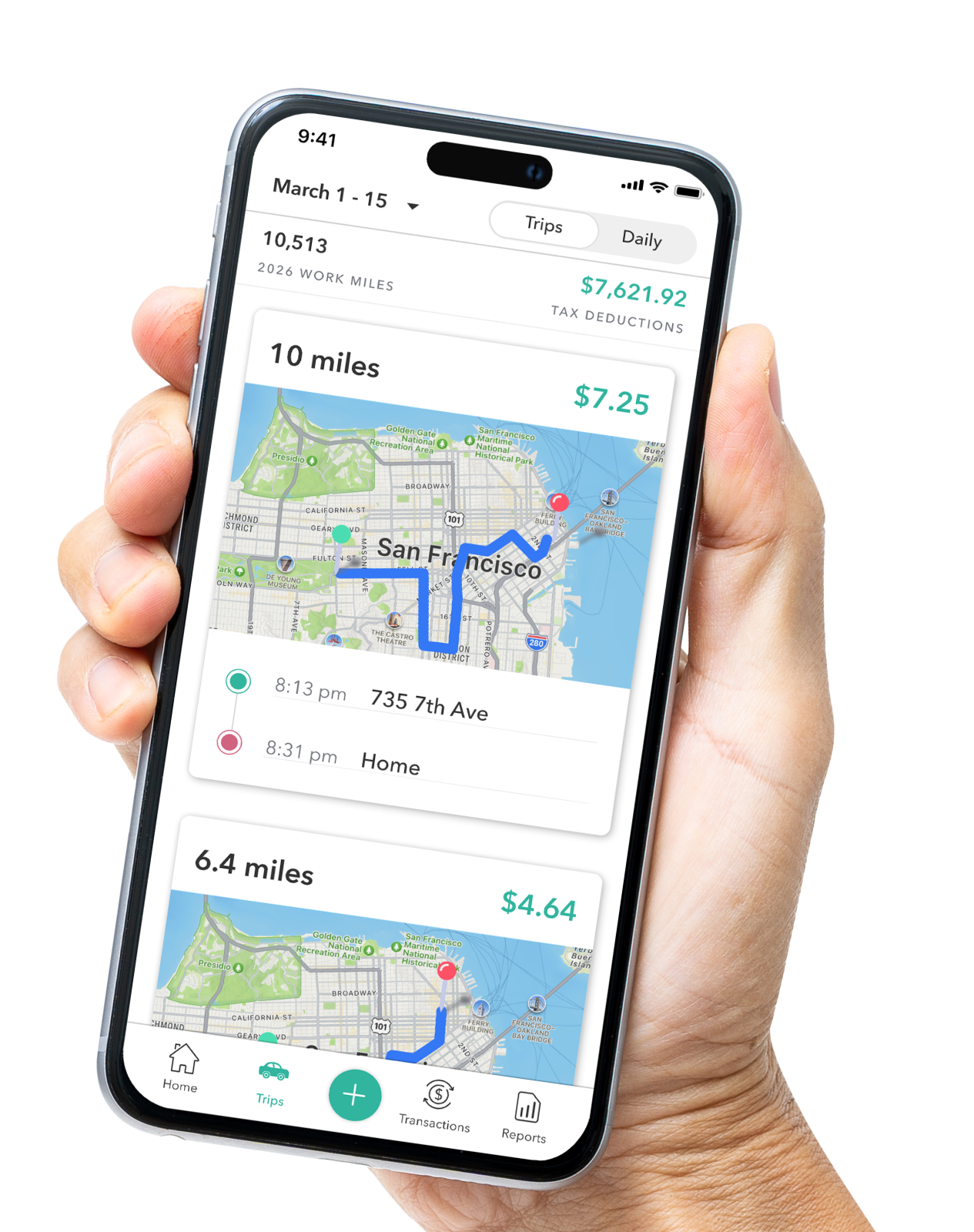
If you're a self-employed driver or contractor looking for an easier way to track business miles and expenses, Everlance is worth checking out. Over 3 million drivers use it to automatically log miles and organize expenses, which means less scrambling at tax time regardless of who prepares your return.
Can AI tax software handle Schedule C for self-employed workers?
Yes, most major AI tax platforms support Schedule C filing. They can calculate business income, apply common deductions like mileage and home office expenses, and generate the form automatically. For straightforward self-employment situations, they perform well.
How much does a CPA charge for self-employed tax returns?
The national average is around $457 for a return that includes Schedule C, according to the National Society of Accountants. Rates vary widely by region and complexity, ranging from $300 in smaller markets to $800 or more in major cities.
Is it worth hiring a CPA if I only have one 1099?
Probably not, unless you have other complicating factors like rental income, investments, or significant assets. A single 1099 with standard business deductions is well within AI software's capabilities.
What is the current IRS standard mileage rate?
The IRS standard mileage rate for business driving is 72.5 cents ($0.725) per mile for 2026. Always verify the current rate on IRS.gov before calculating your deduction, as the rate is periodically updated.
What self-employment deductions do people miss most often?
The home office deduction, self-employed health insurance premiums, retirement plan contributions, and the employer-equivalent portion of self-employment tax (which is deductible on Form 1040) are among the most commonly overlooked.
Can I switch from AI tax prep to a CPA mid-year?
Absolutely. Many self-employed workers start with AI software and transition to a CPA as their income or complexity grows. A CPA can review prior returns and sometimes find missed deductions worth amending.
Does using AI tax software increase my audit risk?
No. The IRS doesn't flag returns based on which software prepared them. Audit risk is driven by the content of your return: high deductions relative to income, large cash transactions, and inconsistent reporting are the real triggers.
What is the hybrid AI + CPA approach and who is it best for?
The hybrid model uses AI to process and categorize your financial data, then has a licensed CPA review and finalize the return. It's best suited for self-employed workers earning $75,000-$200,000 with multiple income streams, giving you professional oversight at a lower cost than a fully manual engagement.
Whether you file with AI or a CPA, Everlance automatically tracks your miles and expenses all year, so your numbers are always accurate and ready.



.webp)

.svg)


.svg)
