

4.8/5 on App Store
Driving to clients, gyms, or outdoor sessions? Every mile is a mileage tax deduction for personal trainers. Most trainers leave thousands unclaimed each season. Track miles and keep what’s yours.




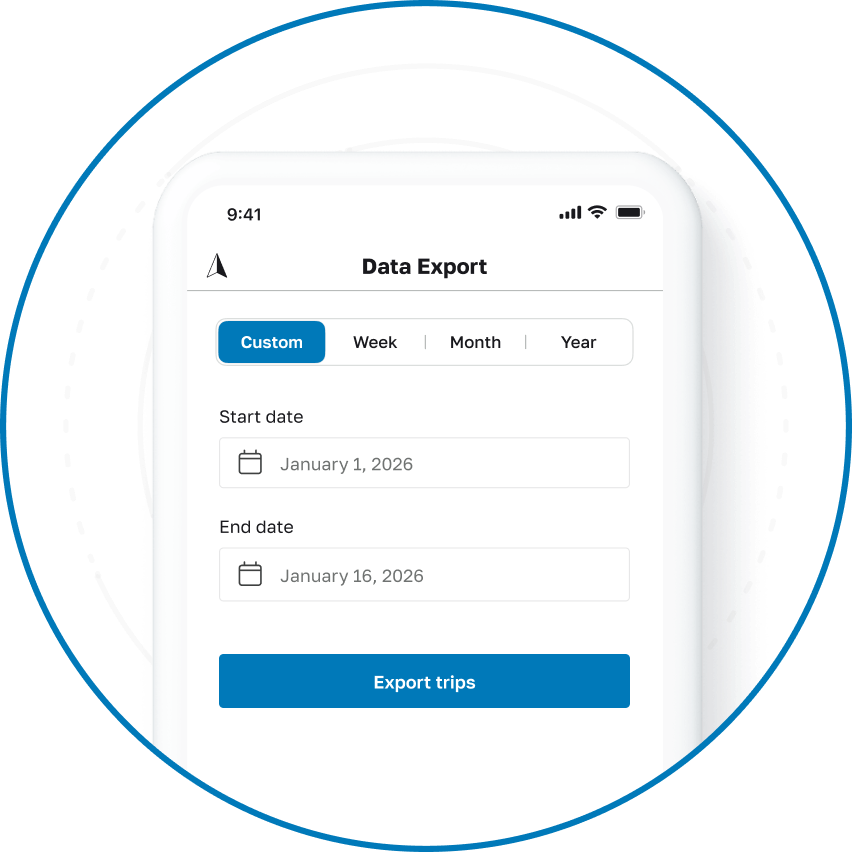
The IRS requires logging mileage tax deductions for personal trainers as trips happen, not reconstructing them later at tax time. Every business trip must capture four specific details.

Every drive from your home office or studio to a shoot qualifies as a mileage deduction, including each leg of multi-location days. If you're shooting a wedding with a ceremony followed by a reception across town, every mile between venues counts. Multi-stop days, early morning drives, and late-night returns all qualify as legitimate business mileage.
Scouting potential shoot locations, parks, beaches, barns, rooftops, is fully deductible, whether the location is booked or not, including portfolio scouting trips.
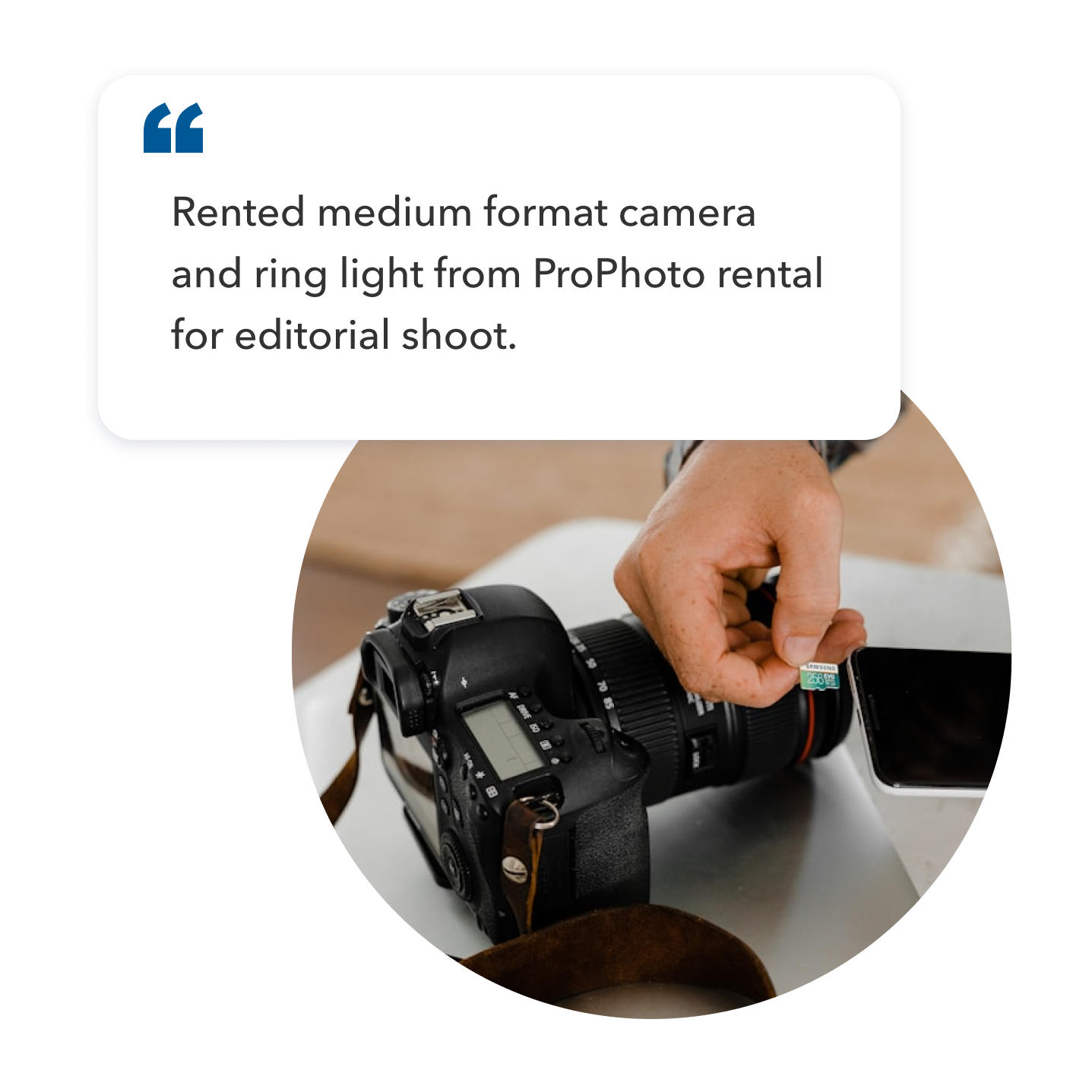
Driving to rent, return, or buy gear, cameras, lenses, lighting, or even batteries at a big-box store is fully deductible if business-related
Drives to repair or service your camera body, lenses, flash units, or other gear are fully deductible, maintenance miles count just like shoot miles.
Meeting clients to plan shoots, sign contracts, review proofs, or deliver albums all count as deductible business mileage at 72.5¢ per mile.
Driving to workshops, conferences like WPPI or PhotoPlus, industry meetups, or vendor showcases qualifies as deductible professional development mileage, growing your craft is business too




Every drive from your home to a client’s location qualifies as a mileage tax deduction for personal trainers, including each leg of multi-client days. If you’re training three clients across different neighborhoods, every mile between stops counts. Back-to-back sessions, early morning drives to home gyms, and evening outdoor bootcamps all qualify as legitimate business mileage.
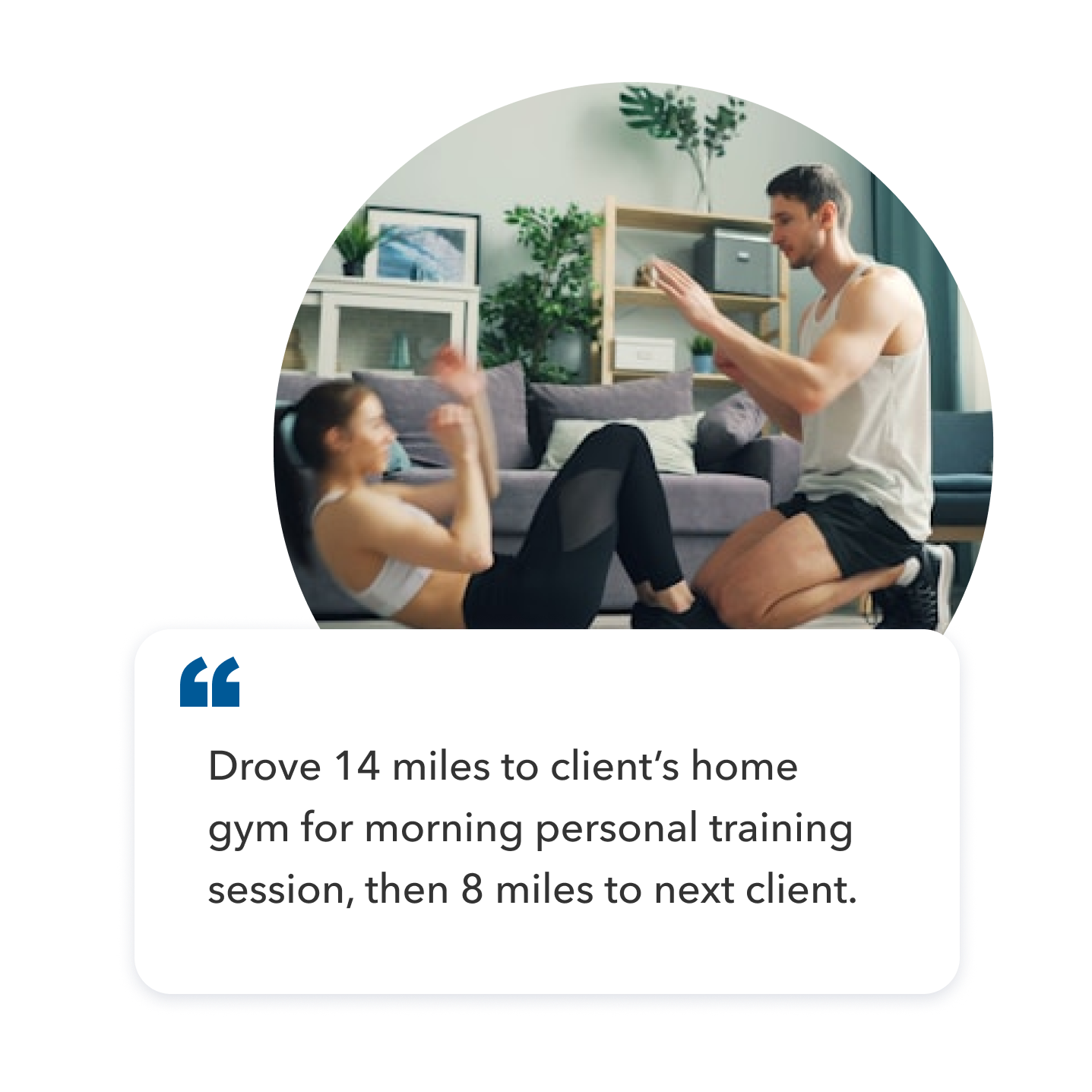
Scouting outdoor training spots parks, tracks, fields, or recreation areas is fully deductible whether or not the location gets used. Even exploratory drives to find new session venues count. If you drove there for business, the IRS considers it a valid mileage tax deduction for personal trainers, so log every scouting trip when you leave.

Driving to purchase or return fitness equipment resistance bands, dumbbells, foam rollers, or supplement supplies at a big-box store is fully deductible as a mileage tax deduction for personal trainers, provided the trip is business-related. This includes specialty fitness retailers, warehouse clubs, or supplier pickup locations that directly serve your training business needs.

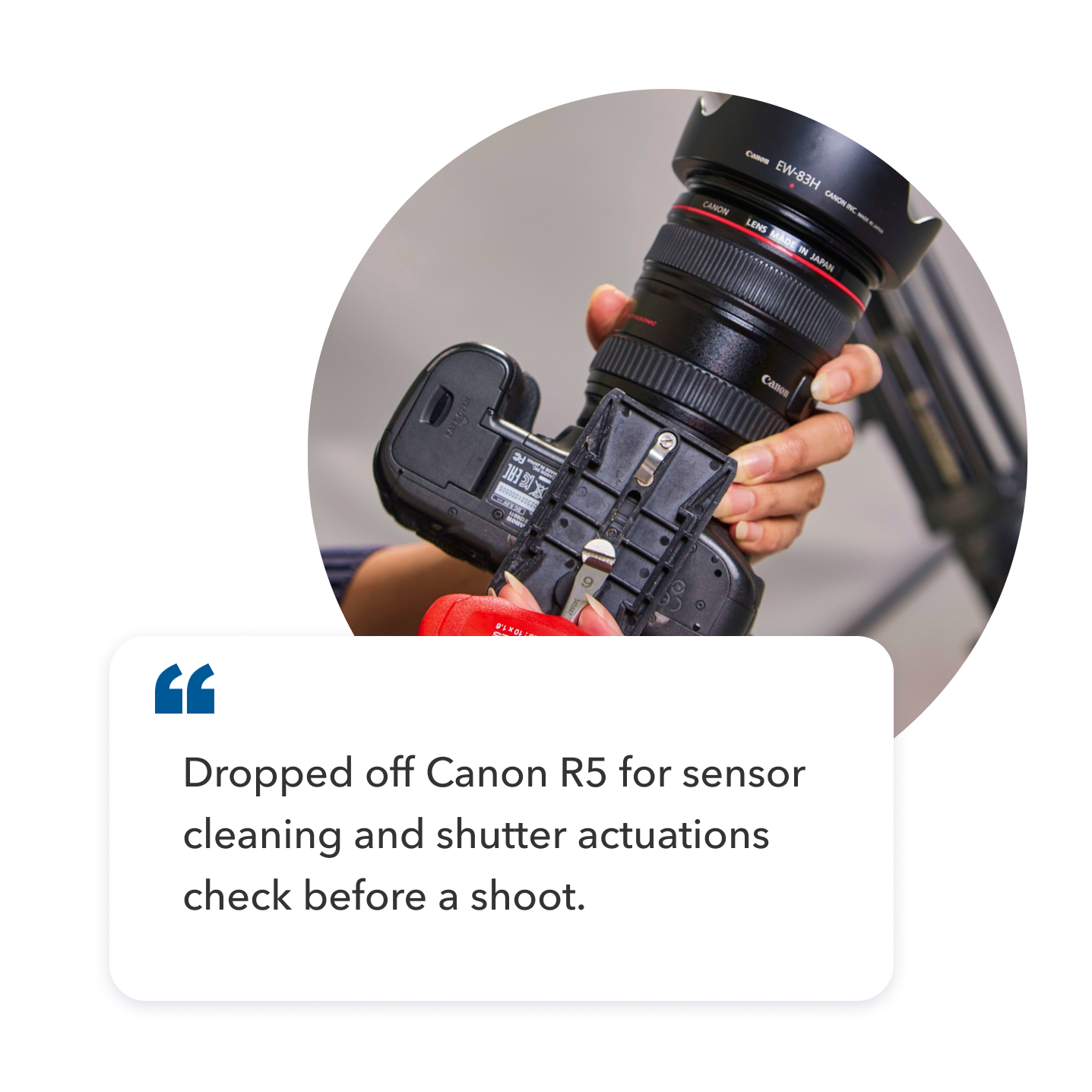
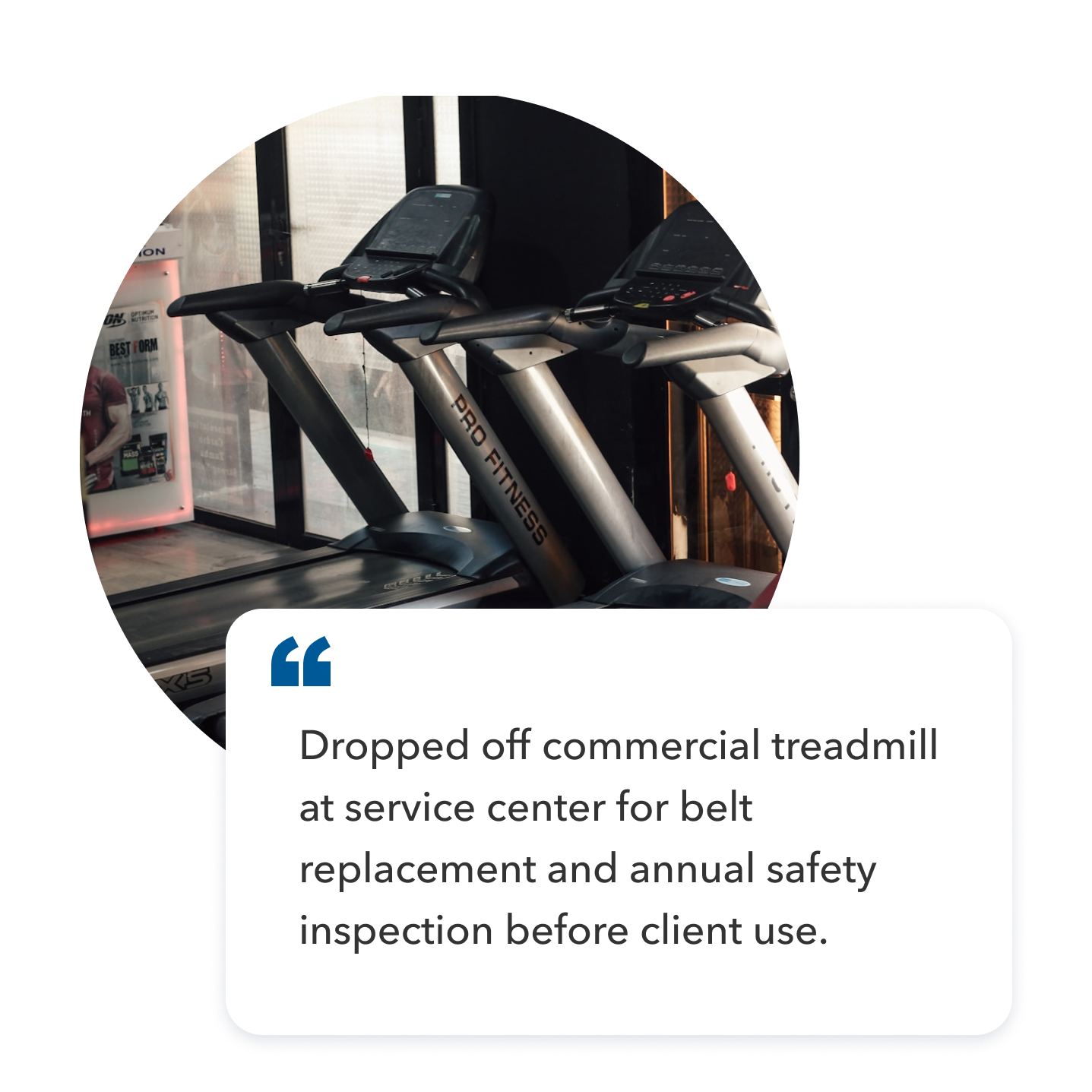
Drives to repair or service your fitness equipment are fully deductible mileage tax deductions for personal trainers. Maintenance miles count the same as session miles. Whether dropping off equipment for servicing, picking up repaired gear, or visiting a supplier for warranty work, every mile to and from that particular location is a legitimate business write-off.
As a self-employed personal trainer, mileage tax deductions extend beyond sessions driving to meet clients for consultations, fitness assessments, program reviews, or goal-setting meetings all count at the current IRS rate. Whether at a café, their home, or a gym, consistent logging ensures every client mile gets captured.

Every mile driven to grow your fitness career is a mileage tax deduction for personal trainers. Driving to CE courses, NASM or ACE recertification workshops, fitness conferences, nutrition seminars, or specialty coaching clinics all qualify as deductible professional development mileage. The IRS recognizes that growing your expertise is growing your business, so whether attending a performance workshop across town or a multi-day summit, log every mile. Your certifications are your edge, and every drive to earn them is a legitimate write-off.

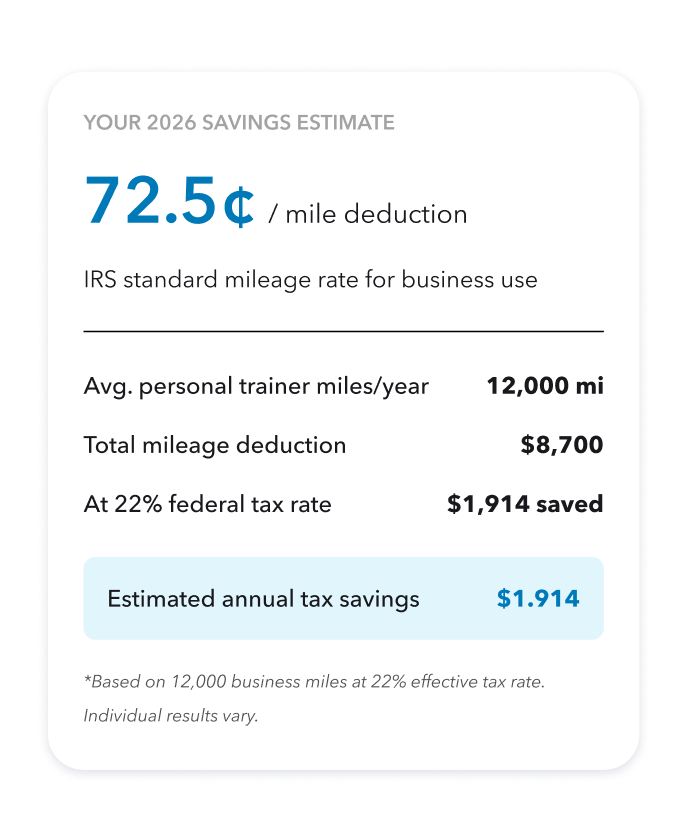
Mileage tax deductions for personal trainers add up faster than most self-employed fitness professionals realize. A mobile trainer averaging six client sessions per day can easily log 12,000+ business miles annually a significant deduction at the current IRS rate. But sessions are just the start. Factor in equipment runs, location scouting, fitness conferences, and consultations, and your deductible mileage climbs even higher. Every trainer’s situation differs, so we built the calculator to make it personal. Enter your annual business miles and federal tax rate to see exactly what your drives are worth then start tracking so none of it slips through.
Estimate my savings
The IRS requires logging mileage tax deductions for personal trainers as trips occur, not reconstructing them later at tax time. Every business drive must capture four specific details.

Log total miles for every trip. GPS apps like Everlance capture mileage automatically; manual logs require start and end readings for each drive.

Note the specific purpose: ‘client training session’ or ‘equipment pickup.’ Vague entries like ‘work’ or ‘gym’ won’t hold up in an IRS audit.

Log the exact date of every session drive as it happens retroactive estimates won’t hold up under an IRS audit.

Record start and end locations with full addresses or city and trip purpose. GPS-captured addresses are timestamped and completely audit-proof.
The IRS routinely cross-references claimed trips against agency assignment records, facility schedules, and contract dates. Every trip in your log needs a specific date.

GPS-captured coordinates carry the most weight in an audit because they are objective and difficult to dispute. Log the specific address for every trip origin and destination.
Write a specific note: "shift at St. Mary's ICU on travel assignment." Vague entries like "work" will not survive IRS scrutiny.
Total miles per trip. Automatic GPS tracking captures this precisely — no odometer readings or manual input required.
Answers to the most common questions personal trainers ask about mileage tax deductions and the IRS mileage rate. Each answer gives you a clear, actionable response — not legal jargon. For advice specific to your situation, always consult a qualified CPA or tax professional.
The IRS standard mileage rate for business use in 2026 is 72.5 cents per mile — the highest rate in recent years. As a self-employed photographer, you can deduct this amount for every mile driven for business purposes, including travel to client shoots, location scouting, equipment pickup, studio visits, and client meetings. The rate applies to sole proprietors filing Schedule C and to single-member LLCs treated as sole proprietorships. This is one of the most valuable and commonly overlooked deductions available to freelance photographers, and using it correctly can reduce your taxable income by thousands of dollars each year.
Yes. Travel from your home office or studio to client shoot locations is fully deductible at the 2026 IRS rate of 72.5 cents per mile. This includes weddings, portrait sessions, commercial shoots, events, headshots, newborn sessions, and any other client-related photography travel. If you’re shooting multiple locations in a single day — for example, a church ceremony followed by a reception venue — every leg of that trip is deductible. The IRS requires a contemporaneous mileage log documenting the date, destination, business purpose, and miles driven for each trip. A GPS tracking app like Everlance handles all of this automatically.
Yes. Location scouting trips are considered ordinary and necessary business expenses and qualify for the standard mileage deduction. As long as the primary purpose of the drive is business-related scouting for a client project or portfolio development, those miles are deductible at 72.5 cents per mile in 2026 — even if you ultimately don’t use the location. Log the trip with a note such as “scouted waterfront park for upcoming engagement session” and you’re covered. The key test the IRS applies is whether the expense was ordinary for someone in your profession and necessary for conducting your business. Scouting clearly meets both criteria.
The average freelance photographer drives between 8,000 and 20,000 business miles per year, depending on their specialty and market area. At the 2026 IRS rate of 72.5 cents per mile, that translates to a total deduction of $5,800 to $14,500. At a 22% federal tax rate, that saves $1,276 to $3,190 annually in federal taxes alone, plus any applicable state tax savings. Wedding and commercial photographers who serve a wide geographic area and frequently travel between venues, studios, and client meetings tend to accumulate mileage at the higher end of this range. Portrait and studio-based photographers typically fall somewhere in the middle. Every mile you fail to track is money you’re giving back to the IRS.
Yes. Driving to pick up or return rented equipment, purchase supplies at a camera store, or transport gear to a repair shop all qualify as deductible business mileage. This includes trips to specialty photography retailers, big-box stores for batteries or memory cards, or online order pickup locations when the purchase is for your photography work. Keep a log noting the date, the store or vendor you visited, the purpose (e.g., “equipment rental pickup for corporate headshot session”), and the miles driven. Everlance auto-captures all of this via GPS and lets you add a note to each trip in seconds directly from your phone — no spreadsheets required.
Commuting from your home to a regular studio location you rent does not qualify as deductible mileage — the IRS treats this as a personal commute, the same as any employee driving to a fixed workplace. Personal errands run during a business trip also do not qualify for the portion of the drive that is personal. If you have a legitimate home office that qualifies under IRS rules, however, travel from your home directly to a client location is generally deductible. It’s also worth noting that meals and entertainment expenses are separate deductions subject to different rules and limits, and should not be included in your mileage log.
Yes, absolutely. The IRS requires contemporaneous records for mileage deductions. This means you must log each trip at or near the time it happens — not reconstruct them weeks or months later at tax time. Your log must include the date, starting and ending location, business purpose, and total miles for every trip. Without these records, your entire mileage deduction can be disallowed in an audit, even if the trips were 100% legitimate. A mileage tracking app like Everlance automatically captures all of this data using GPS the moment your vehicle starts moving. At year-end, you can generate a complete IRS-compliant mileage report in PDF or Excel format — ready to hand directly to your accountant or attach to your tax return.
Most freelance photographers benefit more from the standard mileage rate (72.5 cents per mile in 2026) because it requires significantly less record-keeping and often produces a larger deduction than tracking actual gas, insurance, depreciation, and maintenance costs individually. The actual expense method can sometimes yield a higher deduction for photographers who drive an expensive vehicle with high operating costs, but the administrative burden is considerably greater. There is one critical rule to know: you must choose the standard mileage method in the first year you use a vehicle for business. If you choose actual expenses first, you generally cannot switch back to the standard mileage rate for that vehicle in future years. When in doubt, consult your tax professional in the first year to choose the method that makes the most sense for your situation.
Track every client drive and equipment run automatically. Generate an IRS-compliant mileage report at tax time, in one tap. Never miss a deduction again.
Get the current IRS mileage rate, see how it has changed over time, and learn how mileage tax deductions for personal trainers can reduce your tax bill.

Explore the top 11 tax deductions for personal trainers, from mileage to equipment costs, and keep more of what you earn.

Use the personal trainer 1099 income tax calculator to estimate what you owe and plan smarter for tax season every year.
 595 Pacific Ave, 4th Fl


.svg)

Traveling nurses miss hundreds in mileage deductions every tax season. Every commute to a facility, agency meeting, and supply run qualifies, but only if you're tracking it.





The IRS allows traveling nurses to deduct any drive that's ordinary and necessary for business, from commuting to a temporary facility to picking up medical supplies. If it serves your assignment and your career, it's deductible.
Every drive from your home office or studio to a shoot qualifies as a mileage deduction, including each leg of multi-location days. If you're shooting a wedding with a ceremony followed by a reception across town, every mile between venues counts. Multi-stop days, early morning drives, and late-night returns all qualify as legitimate business mileage.
Scouting potential shoot locations, parks, beaches, barns, rooftops, is fully deductible, whether the location is booked or not, including portfolio scouting trips.
Driving to rent, return, or buy gear, cameras, lenses, lighting, or even batteries at a big-box store is fully deductible if business-related
Drives to repair or service your camera body, lenses, flash units, or other gear are fully deductible, maintenance miles count just like shoot miles.
Meeting clients to plan shoots, sign contracts, review proofs, or deliver albums all count as deductible business mileage at 72.5¢ per mile.
Driving to workshops, conferences like WPPI or PhotoPlus, industry meetups, or vendor showcases qualifies as deductible professional development mileage, growing your craft is business too
Every drive to a hospital, clinic, or care facility where you're on assignment counts toward your mileage deduction — whether it's your first day on the unit or a recurring shift throughout the contract. You don't need a permanent desk or a set schedule for each drive to qualify. As long as the trip serves your assignment, it belongs in your log.
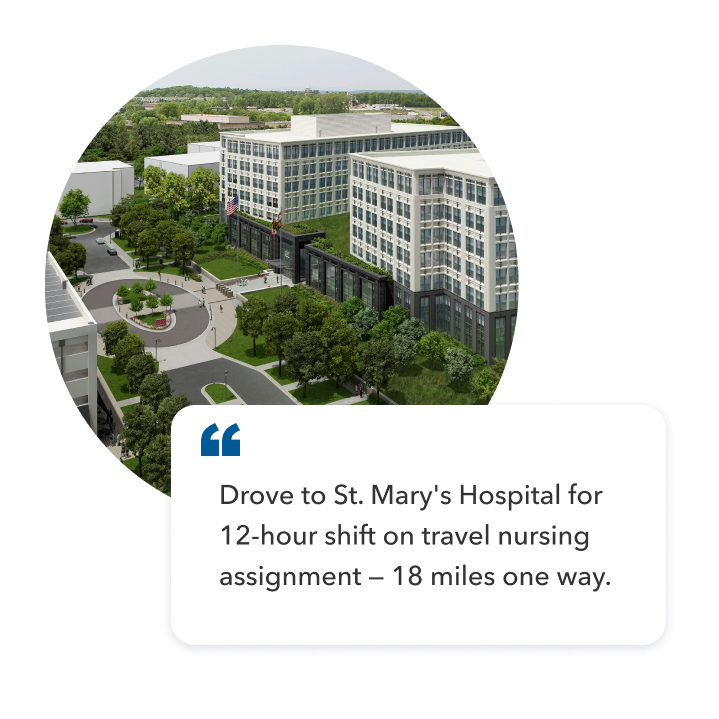
Driving to meet with a staffing agency, sign contract paperwork, or attend an onboarding session for a new assignment is fully deductible. These trips sit at the core of your business activity as an independent contractor, and the IRS recognizes them as such. Every mile driven to secure or manage a travel nursing contract belongs in your mileage log.

Every drive to purchase or pick up supplies, equipment, or materials required for your assignment qualifies for a mileage deduction — from a pharmacy run for patient-care essentials to a medical supply store for specialty items. If you're making multiple supply stops during the same trip, each leg of the route counts as deductible business mileage, stacking your total logged miles meaningfully.

Driving to tour temporary housing, sign a short-term lease, or scout the area near your assignment location all qualify as deductible drives under IRS rules. The IRS recognizes relocation activity as a legitimate part of the traveling nurse business model, meaning every mile you put into securing your living situation for a new contract is just as deductible as the shifts themselves.

The location of your licensing or credentialing appointment doesn't affect deductibility — whether you're driving to a state nursing board office, a testing center, or a hospital credentialing department, every mile counts. Any drive made to maintain, renew, or obtain a license required for your assignments is a fully deductible business expense.
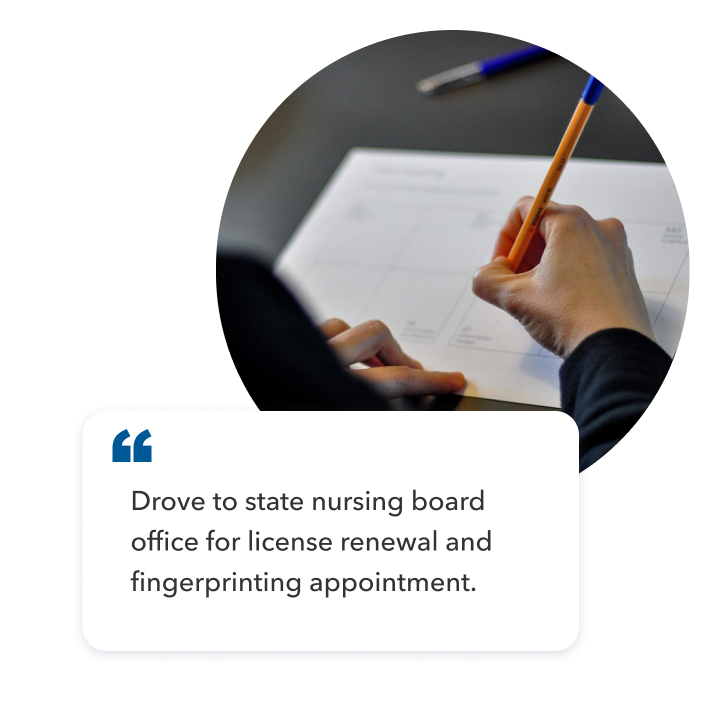
Attending a continuing education class, skills training session, or certification renewal course as a working nurse is considered ordinary and necessary business activity by the IRS. Every mile driven to maintain your qualifications and stay placement-ready fully qualifies for a deduction — because without current credentials, your next assignment simply doesn't happen.

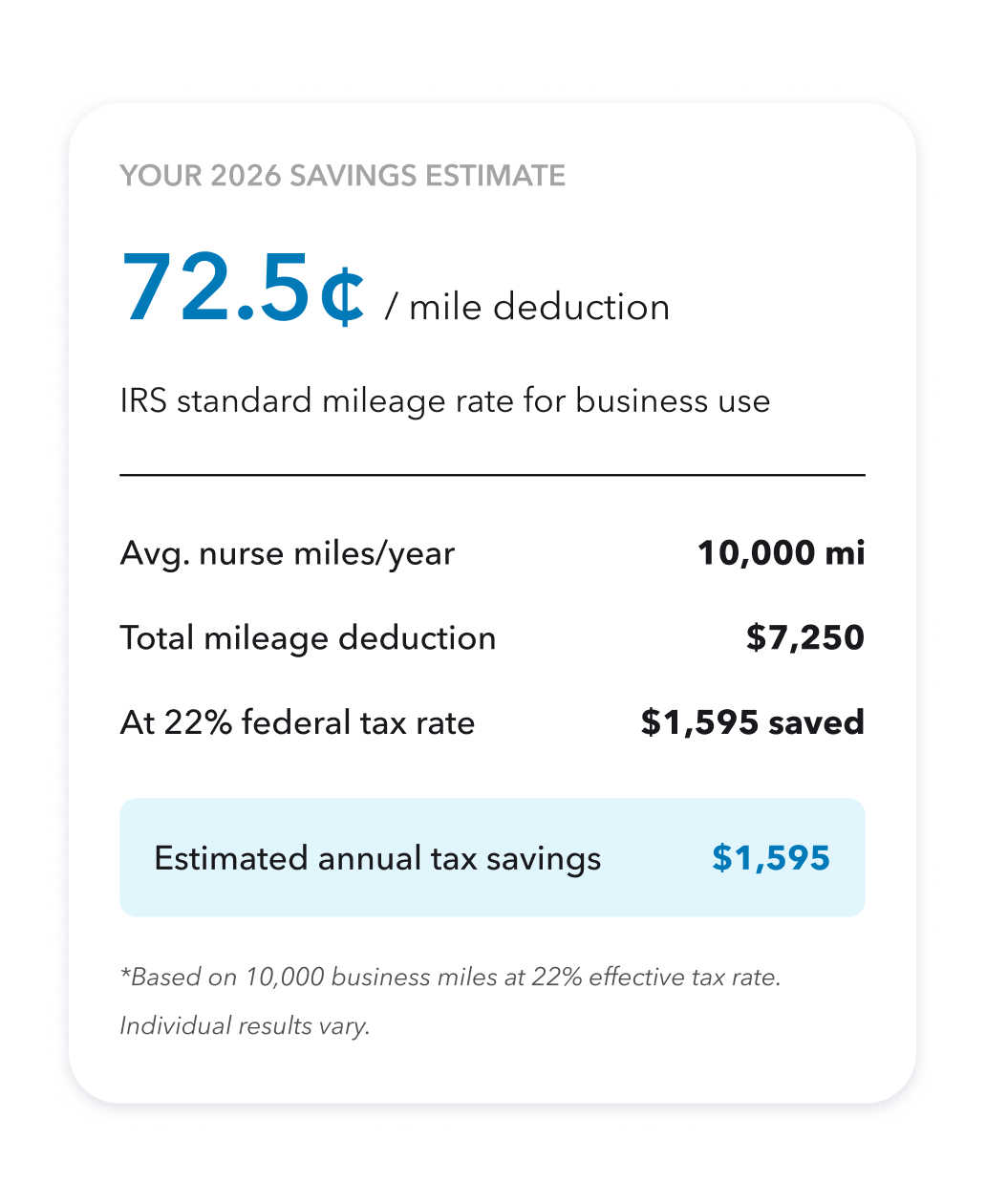
At the current IRS standard mileage rate, traveling nurses who move between assignments consistently are sitting on a significant deduction — and most don't realize how large it actually is. A full-time traveling nurse working back-to-back 13-week contracts across different facilities can realistically log 12,000 to 18,000 business miles in a year, balancing facility commutes, agency meetings, supply runs, and credentialing appointments. At the current rate, that translates to a deduction worth $8,700 to $13,050. For a high-volume traveler managing multiple state licenses and frequent relocations, that figure climbs closer to $18,125 — real money that belongs in your pocket, not overlooked at tax time.
Estimated annual tax savings
$1,914
($8,700 total deduction)
✓ 2026 IRS Rate: 72.5¢ per mile · Traveling nurses typically log 8,000–20,000 business miles per year.
Traveling nurses lose mileage deductions in audits for one reason more than any other — records pieced together after the fact rather than captured in the moment. The IRS calls this the contemporaneous record requirement, and it applies to every trip you claim.

Total miles per trip. Automatic GPS tracking captures this precisely — no odometer readings or manual input required.

Write a specific note: "shift at St. Mary's ICU on travel assignment." Vague entries like "work" will not survive IRS scrutiny.

The IRS routinely cross-references claimed trips against agency assignment records, facility schedules, and contract dates. Every trip in your log needs a specific date.

GPS-captured coordinates carry the most weight in an audit because they are objective and difficult to dispute. Log the specific address for every trip origin and destination.
The IRS routinely cross-references claimed trips against agency assignment records, facility schedules, and contract dates. Every trip in your log needs a specific date.
GPS-captured coordinates carry the most weight in an audit because they are objective and difficult to dispute. Log the specific address for every trip origin and destination.
Write a specific note: "shift at St. Mary's ICU on travel assignment." Vague entries like "work" will not survive IRS scrutiny.
Total miles per trip. Automatic GPS tracking captures this precisely — no odometer readings or manual input required.
Answers to the most common questions traveling nurses and travel healthcare workers ask about IRS mileage deductions. Each answer is written to give you a clear, actionable response — not tax jargon. For advice specific to your situation, consult a qualified CPA or tax professional.
The IRS standard mileage rate for business use in 2026 is 72.5 cents per mile — the highest rate in recent years. As a self-employed photographer, you can deduct this amount for every mile driven for business purposes, including travel to client shoots, location scouting, equipment pickup, studio visits, and client meetings. The rate applies to sole proprietors filing Schedule C and to single-member LLCs treated as sole proprietorships. This is one of the most valuable and commonly overlooked deductions available to freelance photographers, and using it correctly can reduce your taxable income by thousands of dollars each year.
Yes. Travel from your home office or studio to client shoot locations is fully deductible at the 2026 IRS rate of 72.5 cents per mile. This includes weddings, portrait sessions, commercial shoots, events, headshots, newborn sessions, and any other client-related photography travel. If you’re shooting multiple locations in a single day — for example, a church ceremony followed by a reception venue — every leg of that trip is deductible. The IRS requires a contemporaneous mileage log documenting the date, destination, business purpose, and miles driven for each trip. A GPS tracking app like Everlance handles all of this automatically.
Yes. Location scouting trips are considered ordinary and necessary business expenses and qualify for the standard mileage deduction. As long as the primary purpose of the drive is business-related scouting for a client project or portfolio development, those miles are deductible at 72.5 cents per mile in 2026 — even if you ultimately don’t use the location. Log the trip with a note such as “scouted waterfront park for upcoming engagement session” and you’re covered. The key test the IRS applies is whether the expense was ordinary for someone in your profession and necessary for conducting your business. Scouting clearly meets both criteria.
The average freelance photographer drives between 8,000 and 20,000 business miles per year, depending on their specialty and market area. At the 2026 IRS rate of 72.5 cents per mile, that translates to a total deduction of $5,800 to $14,500. At a 22% federal tax rate, that saves $1,276 to $3,190 annually in federal taxes alone, plus any applicable state tax savings. Wedding and commercial photographers who serve a wide geographic area and frequently travel between venues, studios, and client meetings tend to accumulate mileage at the higher end of this range. Portrait and studio-based photographers typically fall somewhere in the middle. Every mile you fail to track is money you’re giving back to the IRS.
Yes. Driving to pick up or return rented equipment, purchase supplies at a camera store, or transport gear to a repair shop all qualify as deductible business mileage. This includes trips to specialty photography retailers, big-box stores for batteries or memory cards, or online order pickup locations when the purchase is for your photography work. Keep a log noting the date, the store or vendor you visited, the purpose (e.g., “equipment rental pickup for corporate headshot session”), and the miles driven. Everlance auto-captures all of this via GPS and lets you add a note to each trip in seconds directly from your phone — no spreadsheets required.
Commuting from your home to a regular studio location you rent does not qualify as deductible mileage — the IRS treats this as a personal commute, the same as any employee driving to a fixed workplace. Personal errands run during a business trip also do not qualify for the portion of the drive that is personal. If you have a legitimate home office that qualifies under IRS rules, however, travel from your home directly to a client location is generally deductible. It’s also worth noting that meals and entertainment expenses are separate deductions subject to different rules and limits, and should not be included in your mileage log.
Yes, absolutely. The IRS requires contemporaneous records for mileage deductions. This means you must log each trip at or near the time it happens — not reconstruct them weeks or months later at tax time. Your log must include the date, starting and ending location, business purpose, and total miles for every trip. Without these records, your entire mileage deduction can be disallowed in an audit, even if the trips were 100% legitimate. A mileage tracking app like Everlance automatically captures all of this data using GPS the moment your vehicle starts moving. At year-end, you can generate a complete IRS-compliant mileage report in PDF or Excel format — ready to hand directly to your accountant or attach to your tax return.
Most freelance photographers benefit more from the standard mileage rate (72.5 cents per mile in 2026) because it requires significantly less record-keeping and often produces a larger deduction than tracking actual gas, insurance, depreciation, and maintenance costs individually. The actual expense method can sometimes yield a higher deduction for photographers who drive an expensive vehicle with high operating costs, but the administrative burden is considerably greater. There is one critical rule to know: you must choose the standard mileage method in the first year you use a vehicle for business. If you choose actual expenses first, you generally cannot switch back to the standard mileage rate for that vehicle in future years. When in doubt, consult your tax professional in the first year to choose the method that makes the most sense for your situation.
The IRS sets a standard mileage rate for business use each year, and as a self-employed traveling nurse or independent contractor healthcare worker, you can deduct that rate for every mile driven for business purposes — including shifts at temporary facilities, agency meetings, supply runs, licensing appointments, and continuing education drives. The rate applies to sole proprietors filing Schedule C and to single-member LLCs treated as sole proprietorships. Most traveling nurses qualify as independent contractors rather than employees, which makes the full standard mileage deduction available to you on your federal return. Check the IRS website or consult your CPA each January for the current year's rate.
Yes. Travel from your temporary housing or tax home to any facility where you're on assignment is fully deductible at the current IRS standard mileage rate. This includes every shift commute during the contract period — whether it's a 13-week ICU assignment or a short-term per diem placement. When you're traveling between multiple facilities in a single day, each leg of the route counts as deductible business mileage. You're not required to return to your housing between facility stops. Automatic GPS tracking captures each segment of a multi-stop drive, so no mileage is missed even on your busiest days.
Yes. Driving to tour temporary housing, visit short-term rental properties, or scout the neighborhood near your assignment location is considered an ordinary and necessary business activity under IRS Publication 463, and it qualifies for the standard mileage deduction. Log each housing search drive with a brief note: "drove to three furnished apartment options near assignment hospital to evaluate proximity and cost." That level of specificity is sufficient for IRS purposes and protects your deduction in the event of an audit.
The average traveling nurse drives between 8,000 and 20,000 business miles per year, depending on contract frequency, facility locations, housing proximity, and the number of assignments per year. Applied to the current IRS standard mileage rate, that range represents a substantial deduction — and at a 22% federal tax rate, the resulting tax savings can reach into the thousands annually, plus any applicable state deductions. Nurses managing multiple state licenses and consecutive contracts tend to accumulate mileage at the higher end. Every mile you fail to track is a deduction you're giving back to the IRS unnecessarily.
Yes. Driving to a state nursing board office, testing center, hospital credentialing department, or fingerprinting location to obtain, renew, or maintain a license required for your travel assignments is fully deductible. The same applies to continuing education classes and skills certification renewals that are required to remain placement-eligible. These trips are often overlooked but represent real deductible miles — particularly for nurses who maintain active licenses in multiple states to maximize their placement options across markets.
Personal errands run between shifts or during commutes do not qualify for the portion of the drive that is personal in nature. Driving from a permanent home address to a local part-time job that is not part of a travel assignment also does not qualify. However, if you maintain a qualifying home office under IRS rules — a space used regularly and exclusively for business — then travel from your home directly to a facility, agency, or any other business location is generally deductible from the moment you leave your driveway. Setting up a legitimate home office is one of the most impactful tax moves an independent contractor traveling nurse can make.
Yes — and this is non-negotiable. The IRS requires contemporaneous mileage records, meaning each trip must be logged at or near the time it occurs, not reconstructed later. Your log must include the date, starting and ending location, business purpose, and total miles for every trip. Without these records, your entire mileage deduction is at risk of disallowance during an audit, even when the underlying trips were completely legitimate. Traveling nurses are particularly vulnerable here because large deductions across multiple states invite added scrutiny. Automatic GPS tracking eliminates this risk by capturing every drive the moment your car starts moving. Each trip is timestamped and geo-verified, giving you an audit-proof log that fully satisfies IRS contemporaneous documentation standards.
Most traveling nurses benefit more from the standard mileage rate because it requires far less record-keeping and typically produces a larger deduction than tracking actual vehicle operating costs like gas, insurance, registration, and depreciation. The actual expense method can occasionally yield a higher deduction for nurses who drive a newer, high-cost vehicle with significant depreciation, but the administrative complexity is considerably greater.
There is one important rule: you must choose the standard mileage method in the first year you use a vehicle for business. Once you use the actual expense method for a vehicle, you generally cannot switch back to the standard mileage rate for that vehicle in future years. Consult your CPA in year one to choose the method that best fits your vehicle and contract situation.
Automatic GPS tracking captures every deductible mile , generate your IRS-compliant report instantly.
Get the latest 2026 IRS mileage rate, see how it compares to prior years, and learn how to apply it to your deductions correctly.

Healthcare workers drive more deductible miles than most realize. Here's what qualifies, what the IRS requires, and how much you could save.

Nurses leave significant tax deductions unclaimed every year. Here's a complete breakdown of what qualifies and how to capture every dollar.
595 Pacific Ave, 4th Fl