
Every mile on the clock
Multiple Clients, Real Deductions, and Staying Ahead All Year
Freelancing gives you the freedom to work on your own terms but it also means handling taxes that your employer used to manage for you. This guide covers what makes freelancer taxes unique: managing income from multiple clients, the deductions that actually apply to how you work, and how to avoid the cash flow crunch that catches most freelancers off guard.

Freelancer Taxes Are Different Here’s How
When you’re on a company payroll, your employer quietly handles a lot: withholding federal and state income taxes from every paycheck, paying half your Social Security and Medicare taxes, and issuing one clean W-2 at the end of the year.
As a freelancer, none of that happens. Your income arrives in irregular chunks from multiple clients, with no withholding attached. The IRS still expects its share and so does your state on a schedule that doesn’t wait for April.
That’s not as daunting as it sounds, but it does require understanding four things that most employees never have to think about:

You pay self-employment (SE) tax: 15.3% of your net earnings, covering both the employee and employer portions of Social Security and Medicare.
No one withholds for you: The IRS expects quarterly estimated tax payments four times a year not just in April.

Your income is irregular: Feast-or-famine cash flow makes tax planning both more important and more challenging.
Your deductions are real and significant: Freelancers have access to a range of legitimate business deductions that can substantially reduce what they owe.
The sections below walk through each of these realities in depth focused on the freelancer experience, not the filing mechanics. When you’re ready for the step-by-step process of actually completing your return, the filing guide covers that separately.
Multiple Clients, Multiple 1099s:
How to Track and Report All Your Freelance Income
One of the defining characteristics of freelance work is that your income doesn’t come from one employer it comes from many clients, in different amounts, at different times. That creates a tax documentation challenge that’s easy to underestimate.
The 1099-NEC: What It Is and Why It Matters
If a client pays you $600 or more during the tax year, they’re required by the IRS to send you a Form 1099-NEC (Nonemployee Compensation) by January 31st of the following year. This form reports what they paid you directly to you and to the IRS.
As a freelancer with multiple clients, you’ll typically receive several of these forms. Each one represents an income stream that flows onto Schedule C of your personal tax return (Form 1040), where you report all business income and expenses.
Three things worth knowing about the 1099-NEC:
When You Don’t Receive a 1099 You Still Owe the Tax
Here’s the rule that surprises most new freelancers: you are legally required to report all self-employment income, even when no 1099 arrives.
This happens more often than you’d think:
- A client pays you less than $600 below the 1099-NEC reporting threshold
- You receive payments through platforms that aren’t yet at the 1099-K reporting threshold
- A client simply forgets to file the form
None of these situations change your obligation. The IRS doesn’t track tax liability through forms it expects you to report everything you earned, regardless of what paperwork shows up. Keeping your own income records is non-negotiable.
PRO TIP If you file your return and a 1099 arrives after you've already submitted, that income should still be on your return (since you kept your own records). If it wasn't, you may need to file an amended return.

Build Your Own Income Ledger
Because your income arrives from multiple sources at irregular times, a personal income ledger is one of the most practical tools a freelancer can maintain. It doesn’t have to be elaborate a spreadsheet tracking client name, invoice amount, payment date, and payment method covers the essentials.
A consistent income ledger lets you:
Cross-reference incoming 1099-NECs against what you actually received
Catch missing or incorrect forms before you file
Substantiate income in the event of an audit
Know your YTD earnings at any point during the year essential for accurate quarterly estimates
Apps like Everlance can connect to your accounts and automatically categorize income transactions as they happen, turning this into a passive, always-current record instead of an end-of-year reconstruction.
Irregular Income and the Freelancer Tax Challenge
Seasonal slowdowns. A big project followed by two slow months. Waiting 60 days on a client invoice. This is the normal rhythm of freelance cash flow and it creates a real tax planning challenge that salaried workers never face.
Why Freelance Income Makes Taxes Harder to Manage
When you’re an employee, your employer withholds taxes from every paycheck automatically. By April, the math is mostly done.
As a freelancer, nothing is withheld. Two things follow from that:
Miss a quarterly payment, or underpay, and the IRS charges an underpayment penalty even if you pay the full balance by April 15th. The penalty is calculated based on what you underpaid during the year, not just the final balance.
The Set-Aside Strategy That Experienced Freelancers Use
The approach that works: treat taxes as a non-negotiable line item from every payment you receive not as a bill you deal with when the deadline arrives.
Here’s a practical framework:
After every client payment, transfer 25–30% of the net amount to a dedicated tax savings account immediately
This percentage covers your 15.3% SE tax plus your federal income tax bracket
If you’re in a higher income bracket or live in a high-tax state, increase this to 30–35%
Keep that account untouched until each quarterly deadline
KEY PRINCIPLE “Set it aside immediately” is the operative phrase. Waiting until a quarterly deadline creates the risk that the money has already been spent. A separate savings account clearly labeled as your tax account makes this automatic.
The Safe Harbor Rule: Your Backstop in Slow Quarters
A challenge unique to freelancers: a slow quarter might mean less income and fewer funds set aside but your quarterly payment may still be required to stay penalty-free.
This is where IRS safe harbor protection matters. Safe harbor means: if you pay at least 100% of what you owed in taxes last year (or 110% if your prior-year AGI exceeded $150,000), the IRS won’t charge underpayment penalties even if you end up owing more at filing due to a strong year.
This makes safe harbor an important backstop during slow periods: you know the minimum payment that keeps you penalty-free, regardless of what this year’s income actually looks like.
If a significant portion of your freelance income comes through Upwork, specialized tools can help you estimate taxes on platform earnings and fees specifically.
Freelancer Tax Deductions: What You Can Actually Write Off
Every legitimate business expense reduces both your taxable income and your self-employment tax. For a freelancer earning $80,000, properly tracking deductions can realistically reduce the tax bill by several thousand dollars but only if you’re capturing them.
The IRS standard is “ordinary and necessary”: the expense must be common in your type of work and helpful to running your freelance business. Here’s what that looks like in practice.
Software and SaaS Subscriptions
Most freelancers spend money every month on the tools that make their work possible. These are fully deductible when used for business:
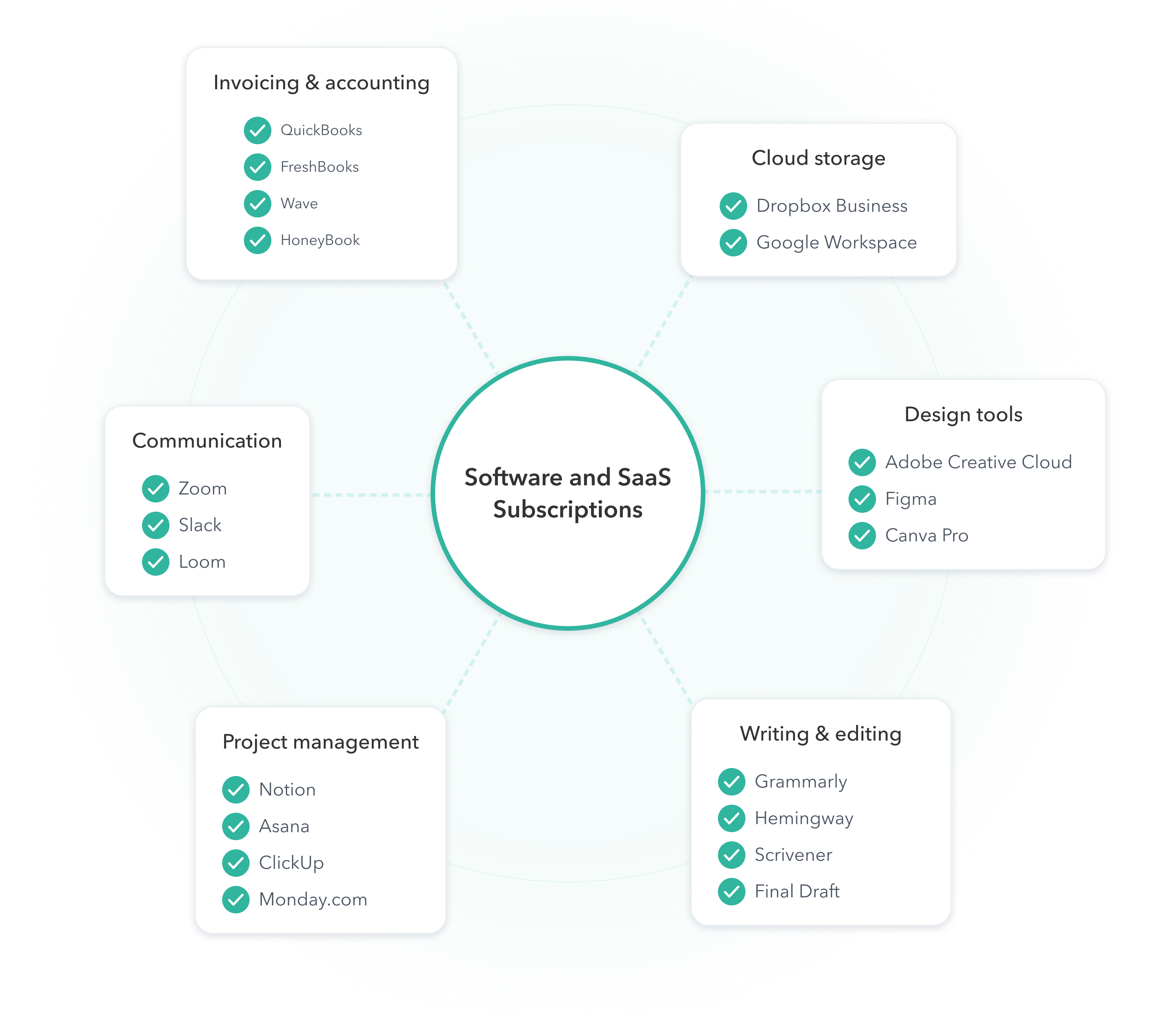
If a subscription serves both personal and business purposes, deduct the business-use percentage. If it’s exclusively for work, it’s 100% deductible.
Coworking Space Memberships
If you pay for a coworking space a dedicated desk, a private office in a shared facility, or even a regular day-pass arrangement the full cost is deductible as a business expense.
This deduction is particularly clean for freelancers: there’s no personal-use percentage to calculate (unlike a home office), and documentation is simple your membership receipts and monthly statements.
Monthly or annual coworking memberships
Day passes or drop-in fees at shared workspaces
Conference room bookings used for client meetings
Home Office Deduction
If you regularly and exclusively use a portion of your home as your primary place of business, you may qualify for the home office deduction. This is one of the most misunderstood deductions among freelancers many skip it and leave real savings on the table, or claim it incorrectly and create audit risk.
Two calculation methods:
The key requirement: the space must be used regularly and exclusively for business. A spare room used only as your office qualifies. A kitchen table where you work and eat does not.
IMPORTANT If you already deduct a coworking space as your primary workplace, the home office deduction may not apply. If you use both, consult a tax professional to determine what’s defensible for your situation.
Portfolio and Website Costs
Your online presence is a business asset and the costs to build and maintain it are deductible:
Domain registration and annual renewal fees
Web hosting and server costs
Website design or development work (including one-time redesign projects)
Portfolio platform subscriptions (Dribbble Pro, Behance Pro, Contently, Muck Rack)
Professional directory listings and profile subscriptions
Professional Development and Education
Staying current in your field is a legitimate business expense. Deductible items include:
Online courses, workshops, or bootcamps directly related to your current freelance work
Industry books, publications, and trade subscriptions
Conference registration fees and related travel if the primary purpose is business
Professional association memberships
The qualification: the education must maintain or improve skills used in your current freelance practice. Courses for a career pivot training you for a new field generally don’t qualify.
Other Deductions Worth Tracking

If you do freelance writing specifically, a dedicated calculator can help you estimate deductions and taxes based on writing income and expenses.
Irregular Income and the Freelancer Tax Challenge
Seasonal slowdowns. A big project followed by two slow months. Waiting 60 days on a client invoice. This is the normal rhythm of freelance cash flow and it creates a real tax planning challenge that salaried workers never face.
Why Freelance Income Makes Taxes Harder to Manage
When you’re an employee, your employer withholds taxes from every paycheck automatically. By April, the math is mostly done.
As a freelancer, nothing is withheld. Two things follow from that:
Miss a quarterly payment, or underpay, and the IRS charges an underpayment penalty even if you pay the full balance by April 15th. The penalty is calculated based on what you underpaid during the year, not just the final balance.
The Set-Aside Strategy That Experienced Freelancers Use
The approach that works: treat taxes as a non-negotiable line item from every payment you receive not as a bill you deal with when the deadline arrives.
Here’s a practical framework:
After every client payment, transfer 25–30% of the net amount to a dedicated tax savings account immediately
This percentage covers your 15.3% SE tax plus your federal income tax bracket
If you’re in a higher income bracket or live in a high-tax state, increase this to 30–35%
Keep that account untouched until each quarterly deadline
KEY PRINCIPLE “Set it aside immediately” is the operative phrase. Waiting until a quarterly deadline creates the risk that the money has already been spent. A separate savings account clearly labeled as your tax account makes this automatic.
The Safe Harbor Rule: Your Backstop in Slow Quarters
A challenge unique to freelancers: a slow quarter might mean less income and fewer funds set aside but your quarterly payment may still be required to stay penalty-free.
This is where IRS safe harbor protection matters. Safe harbor means: if you pay at least 100% of what you owed in taxes last year (or 110% if your prior-year AGI exceeded $150,000), the IRS won’t charge underpayment penalties even if you end up owing more at filing due to a strong year.
This makes safe harbor an important backstop during slow periods: you know the minimum payment that keeps you penalty-free, regardless of what this year’s income actually looks like.
If a significant portion of your freelance income comes through Upwork, specialized tools can help you estimate taxes on platform earnings and fees specifically.
Sales reps log more business miles than almost any other profession — yet most are leaving money on the road.
Field sales reps are among the highest-mileage professionals in the workforce, often driving 25,000 to 40,000 business miles annually across client visits, demos, and territory coverage. Those miles carry significant financial value, yet most sales professionals collect only a fraction because their mileage log is incomplete..

Your CRM tracks deals. It does not track your mileage

Every mile between client calls has a real dollar value

Quarterly expense reports rely entirely on the accuracy of your mileage log
Sales reps who track every mile protect their earnings and stay audit-ready
Professionals using automatic GPS tracking capture 30% more deductible miles than those relying on manual logs. For a field sales rep driving 25,000 annual miles, that gap represents thousands in unclaimed value every year. The reason manual tracking fails is simple, the job never stops. You finish one call and drive straight to the next. Automatic tracking closes that gap without changing your workflow.
Qualifying trip types:

Property showings — each leg is a separate deductible trip
Listing appointments and CMA presentations
Open house setup, signage, and hosting runs
Neighborhood farming and prospecting drives
Client meetings at any location
Home inspections, appraisals, and photo shoots
Continuing education and broker training
Title company, lender, and escrow visits
Qualifying trip types for sales professionals:
Your paycheck and your tax bill both change when mileage tracking for sales professionals is done right
Sales professionals interact with mileage in two ways. Independent contractors deduct vehicle miles on Schedule C, reducing net profit before income and self-employment tax. W-2 employees submit expense reports for employer reimbursement. In both cases, the financial outcome depends entirely on the quality of the mileage log.
The IRS standard mileage rate for sales reps: the right method for most
Sales professionals can deduct vehicle costs using either the IRS standard mileage rate or the actual expense method. For most sales reps, the standard mileage rate is the better choice — simpler to apply and typically producing a larger deduction without tracking every fuel and maintenance receipt.
Under this method, total qualifying business miles are multiplied by the IRS-published rate, which covers fuel, maintenance, insurance, and depreciation in a single figure. A compliant mileage log is the only record required.
One critical rule: the standard mileage rate must be elected in the first year you use a vehicle for business. Starting with actual expenses locks you into that method for that vehicle's entire business life — making it essential to begin tracking mileage from your very first business drive.
Sales reps operating through a business entity, driving a company vehicle, or receiving a car allowance alongside reimbursement should consult a tax professional, as treatment varies significantly by arrangement.
Updated each year by the IRS
Covers gas, insurance, depreciation & maintenance. Applies to all qualifying business drives.
A field sales professional averaging 575 business miles per week accumulates roughly 28,750 miles over a full year of active selling. At the current IRS standard mileage rate, that volume produces a mileage deduction or reimbursement value that ranks among the most significant financial benefits available to any sales professional. Every mile that goes unlogged is permanently forfeited, whether as a tax deduction or a reimbursement claim.
Sales mileage reimbursement: how it works and what the records need to show
Most outside sales professionals are entitled to mileage reimbursement for personal vehicle use on company business. Regardless of the program structure, documentation must meet the same standard: contemporaneous, trip-level records with dates, locations, distances, and business purposes. Accurate logs mean full reimbursement and no tax complications. Incomplete ones leave money unclaimed.
Employer reimbursement programs take several forms. Under a standard accountable plan, documented mileage is reimbursed at or below the IRS rate and excluded from taxable income. Reimbursements above the IRS rate or lacking proper documentation are treated as taxable wages.
Flat car allowances are typically included in taxable income unless paired with a mileage reporting requirement that qualifies them as an accountable plan arrangement.
In every structure, the mileage log is the foundation. Without it, no reimbursement or deduction can be fully claimed or defended.





IRS Compliance Checklist


Date of the trip
Every mileage log entry requires a specific date. Monthly or quarterly summaries are not sufficient for IRS substantiation or employer accountable plan compliance.

Starting & ending location
GPS-verified start and end coordinates provide objective, timestamped evidence for each trip, independent of your CRM, calendar, or recollection.

Total miles per trip
Automatic GPS calculation eliminates the estimation, rounding, and inconsistency that frequently draw scrutiny in manual expense reports and IRS examinations.

Specific business purpose
Entries such as "client visit, renewal meeting" or "prospect call, new territory expansion" satisfy the IRS business purpose requirement. Generic labels like "sales" or "work" do not.
What sales professionals need to know about mileage compliance

Your CRM is not a mileage log
CRM activity records confirm a meeting happened, not the route driven or miles accumulated. A dedicated mileage tracking app creates the contemporaneous, trip-level documentation that no CRM can substitute for.

Multi-territory and multi-client driving needs unified tracking
Sales professionals covering multiple territories or splitting time across roles need one log capturing all business driving. Custom trip categories enable per-territory or per-client breakdowns for expense reports requiring that level of detail.
IRS-compliant report format for expense submissions
Export IRS Publication 463-compliant reports in PDF, Excel, or CSV ready for monthly reimbursement submissions or annual tax filing, with zero additional data entry required.

Audit protection for self-employed and independent sales contractors
For 1099 sales reps claiming vehicle deductions on Schedule C, a GPS-verified mileage log is your strongest audit defense far more credible than reconstructed estimates or CRM-based mileage records.
Sales mileage reimbursement: how it works and what the records need to show
Most outside sales professionals are entitled to mileage reimbursement for personal vehicle use on company business. Regardless of the program structure, documentation must meet the same standard: contemporaneous, trip-level records with dates, locations, distances, and business purposes. Accurate logs mean full reimbursement and no tax complications. Incomplete ones leave money unclaimed.
Employer reimbursement programs take several forms. Under a standard accountable plan, documented mileage is reimbursed at or below the IRS rate and excluded from taxable income. Reimbursements above the IRS rate or lacking proper documentation are treated as taxable wages.
Flat car allowances are typically included in taxable income unless paired with a mileage reporting requirement that qualifies them as an accountable plan arrangement.
In every structure, the mileage log is the foundation. Without it, no reimbursement or deduction can be fully claimed or defended.
Freelancer Tax Questions, Answered
Direct answers to the questions freelancers ask most structured to surface in featured snippets, AI search summaries, and voice results.


.svg)
