
The Independent Contractor Tax Guide:
Obligations, Deductions, and Staying Compliant All Year
Working as an independent contractor means you're operating a business, whether you think of it that way or not. This guide explains the tax obligations, 1099 paperwork, worker classification rules, deductions, and planning strategies every independent contractor needs to understand.

You're Running a Business - Whether You Think of It That Way or Not
When a company hires an independent contractor, it doesn't withhold taxes from payments, doesn't pay the employer portion of Social Security and Medicare, and doesn't issue a W-2 at year-end. That's a deliberate arrangement - one that shifts significant tax responsibility to you.
That responsibility covers four things most new independent contractors underestimate:

Self-employment tax
As an independent contractor, you pay the full 15.3% SE tax - the employee and employer halves of Social Security and Medicare. Employees split this with their employer; you cover both sides yourself.

Quarterly estimated payments
With no employer withholding taxes from your payments, the IRS expects you to make four estimated payments throughout the year. Missing them triggers penalties.

The paperwork layer
Every engagement starts with a W-9, eventually produces a 1099-NEC, and involves a contract that defines the relationship. These documents directly affect how income is reported and what records you need to keep.

Significant deduction opportunities
Independent contractors can deduct a wide range of genuine business expenses that employees cannot - which can meaningfully reduce both income tax and SE tax.
This guide covers each of these in depth, focused on the independent contractor experience in practice. When you're ready for the step-by-step process of completing your return, the Self-Employed Tax Filing Guide covers that separately.
The Paperwork Ecosystem of Independent Contractor Work
Unlike employees who receive a single W-2, independent contractors manage a documentation layer that affects both how income is reported to the IRS and how protected they are in a dispute or audit. Understanding this paperwork - before you start an engagement - prevents problems that are difficult to fix after the fact.
The W-9: How Every Engagement Starts
Before paying you, most legitimate business clients will request a Form W-9. This is not a form you file with the IRS - it's a form you complete for the payer. It provides:

Your full legal name (or business name if operating as an LLC or other entity)
Your Tax ID number: your Social Security Number (SSN) or Employer Identification Number (EIN)

Your federal tax classification: sole proprietor, LLC, S-Corp, or other entity type
Your business address
The payer keeps the W-9 on file and uses it to generate your 1099-NEC at year-end. If you provide incorrect information - especially a wrong TIN - the IRS may require the client to impose backup withholding (24% of your payments) until it's corrected.
PRO TIP If you have an EIN, use it on the W-9 instead of your SSN. This separates your personal Social Security Number from your business income documents, reducing your SSN's exposure across multiple clients and platforms.
The 1099-NEC: What It Reports and What You Do With It
If a client pays you $600 or more during the tax year, they're required to file a Form 1099-NEC with the IRS and send you a copy by January 31st of the following year. Box 1 of this form reports the total payments made to you for nonemployee compensation.
Three things contractors frequently get wrong about the 1099-NEC:
- It reports gross payments, not net earnings. If a client paid you $5,000 but charged back a $200 platform fee, the 1099-NEC will often still show $5,000. Keep your own income records and know your actual net received.
- Multiple clients mean multiple forms. You'll receive a separate 1099-NEC from each client who paid you $600 or more. All of them feed into your Schedule C on your tax return.
- The IRS cross-references 1099s against your return. Income reported on 1099-NECs filed by your clients is matched against your tax return. If they don't reconcile, it's a flag.

When You Don't Receive a 1099-NEC - You Still Owe the Tax
You are legally required to report all self-employment income, regardless of whether any form arrives. The $600 threshold determines when a client must file - it does not set your reporting floor. This catches contractors who:
Work with clients paying under $600 (below the reporting threshold)
Receive payments through platforms that haven't yet hit the 1099-K threshold
Have clients who fail to file the form by the deadline
Keep your own income records throughout the year. Your records are what matter if your return is ever questioned.
Contract Terms That Affect Your Taxes and Recordkeeping
The contract you sign with a client isn't just a legal document -- several of its provisions directly affect your tax position. Key clauses to understand:
Payment terms and timing: Net 30 or Net 60 terms affect when income actually arrives. A December invoice not paid until January shifts that income to the next tax year under the cash method of accounting, which most sole proprietors use. This affects quarterly estimates and year-end planning.
Expense reimbursements: If a client reimburses specific expenses (travel, equipment, supplies), those reimbursements are typically taxable income unless structured under a formal accountable plan. The expenses are deductible -- but confirm the tax treatment before assuming reimbursements are tax-free.
IC designation language: A contract that explicitly classifies you as an independent contractor supports your IC status, but the IRS evaluates the actual working relationship -- not just what the contract says. A clause alone doesn't settle the question.
Exclusivity and non-compete provisions: If a contract requires you to work exclusively with one client and prohibits other engagements, that's a factor the IRS may weigh toward employment -- and it limits your ability to build multiple income streams.
Employee vs. Independent Contractor: Why Classification Matters for Your Taxes
The distinction between an employee and an independent contractor isn't semantic - it determines who pays what taxes and carries significant legal and financial consequences when it's applied incorrectly. Understanding how the IRS makes this determination protects you.
How the IRS Determines Your Status
The IRS uses a multi-factor analysis organized into three categories. No single factor is determinative - the IRS weighs the full picture of the working relationship.
IMPORTANT Behavioral control is often the most revealing factor. If a company tells you exactly when to work, provides all your equipment, requires you to attend regular staff meetings, and supervises your daily output -- those are indicators of employment, regardless of what the contract says.
What Misclassification Means Financially
When a worker is misclassified as an independent contractor, the financial consequences primarily fall on the employer - back taxes, penalties, and interest for unpaid payroll taxes. For the worker, the practical impact includes:
Paying the full 15.3% SE tax when a properly classified employee would pay only 7.65%
Not receiving employee benefits (unemployment insurance, workers' comp) the worker may have been entitled to
The risk that deductions taken as a business owner could be challenged if the relationship is reclassified
What to Do If You Suspect Misclassification
If a client is treating you as an independent contractor when your working relationship functions like employment, you have options:
Form SS-8: File with the IRS to request an official determination of your worker status for a specific engagement. The IRS will evaluate the relationship and issue a ruling.
Form 8919: (Uncollected Social Security and Medicare Tax on Wages) Allows you to pay only the employee share of FICA taxes (7.65%) and have the employer portion assessed against the company.
Department of Labor: If the FLSA (minimum wage, overtime) may apply, contact the DOL Wage and Hour Division. The FLSA and IRS use slightly different tests - you could be an employee under one standard but not the other.
Consulting an employment attorney or CPA is advisable before filing SS-8, as the determination can have significant implications for both you and the client.
Your Core Tax Obligations as an Independent Contractor
As an independent contractor, your tax obligations flow directly from running a business. Here's a clear breakdown of what you owe and when.
Self-Employment Tax
Independent contractors pay self-employment tax -- 15.3% covering Social Security (12.4%) and Medicare (2.9%). Employees split this cost with their employer; contractors pay both halves.
Quarterly Estimated Tax Payments
Because no employer withholds taxes from contractor payments, the IRS requires quarterly estimated payments if you expect to owe $1,000 or more in federal taxes for the year.
Underpayment penalty: Missing a quarterly deadline or paying too little triggers an underpayment penalty calculated per quarter -- not assessed as a single lump sum at filing. The IRS safe harbor rule (paying 100% of last year's tax, or 110% if prior-year AGI exceeded $150,000) protects you from the penalty even if you underpay relative to your actual liability.
Schedule C: Where Business Income and Expenses Live
Independent contractors report business income and expenses on Schedule C (Profit or Loss from Business), which attaches to Form 1040. Net profit from Schedule C flows to two places: your Form 1040 for income tax purposes, and Schedule SE for the SE tax calculation.
Every legitimate business expense you deduct on Schedule C reduces both your income tax and your SE tax. This dual reduction is why tracking deductions throughout the year has an outsized impact on what you actually owe.
Tax Deductions Independent Contractors Can Claim
Every ordinary and necessary business expense reduces your taxable income and your SE tax. For a contractor earning $80,000 net, properly tracking deductions can realistically reduce the combined tax bill by thousands of dollars - but only if you're capturing them throughout the year.
Business Mileage
If you drive for client visits, project sites, supply runs, or other business purposes, the mileage deduction is often one of the largest available to contractors. The 2026 IRS standard mileage rate is 72.5 cents per business mile.
Requirements:
Maintain a contemporaneous mileage log recording date, destination, business purpose, and miles for each trip
You cannot use the standard rate if you've previously claimed depreciation on the vehicle
Commuting miles (home to your regular work location) are not deductible
Home Office Deduction
If you use a portion of your home regularly and exclusively for contracting work, you may qualify for the home office deduction. Two methods:
The space must be used regularly and exclusively for your business. A spare room used solely as a home office qualifies. A kitchen table where you also eat does not.
Equipment and Professional Tools
Computers, monitors, cameras, specialized tools, and equipment primarily used for contracting work are deductible. Section 179 allows full deduction in the year of purchase (rather than depreciating over several years), up to the annual Section 179 limit. For equipment costing above the threshold, standard depreciation schedules apply.
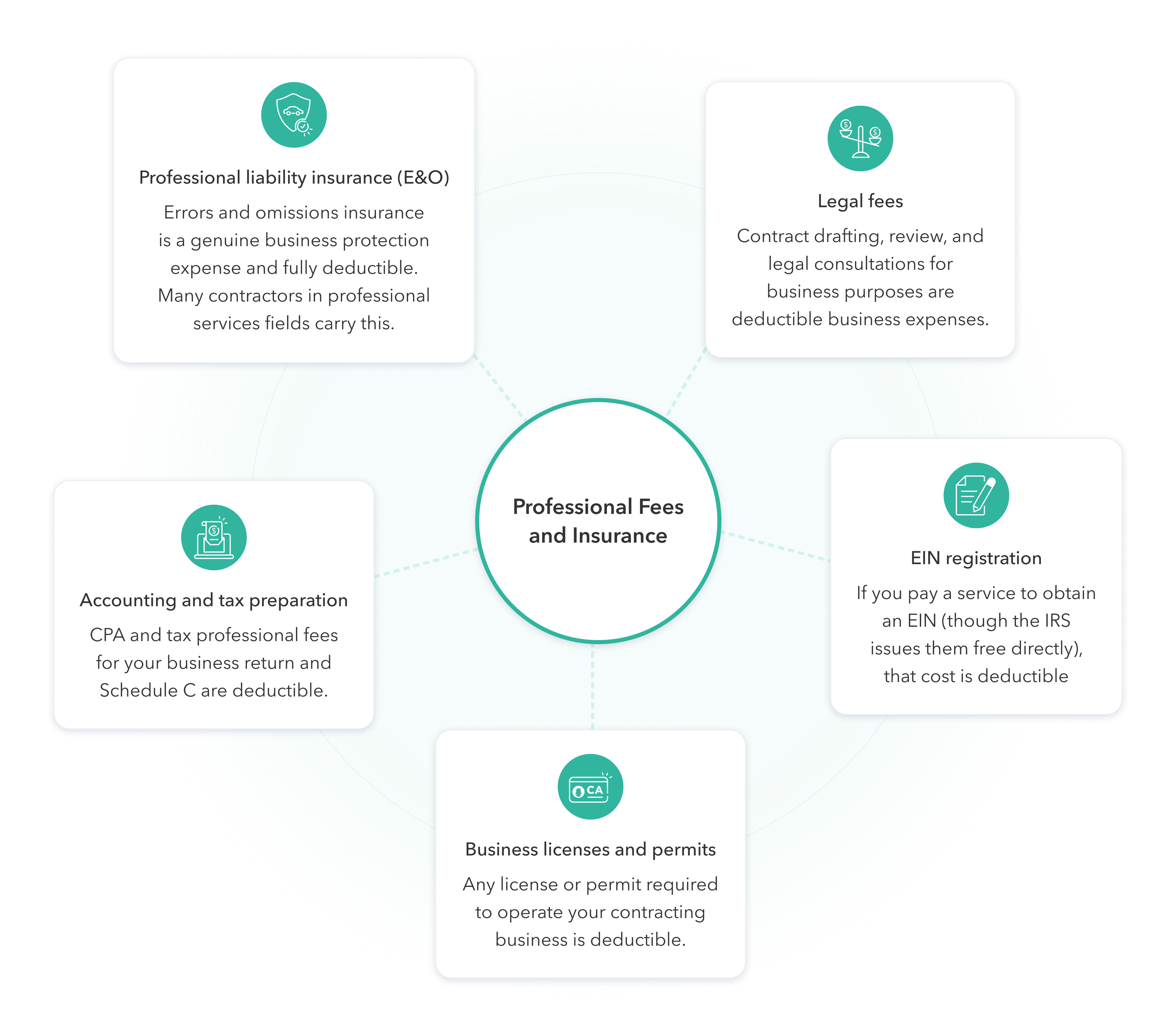
Professional Fees and Insurance
Several professional costs common to independent contractors are fully deductible:
Software and Technology Subscriptions
Any software or SaaS subscription used primarily for contracting work is deductible at the business-use percentage. This includes project management tools, communication platforms, design software, invoicing systems, cloud storage used for client work, and apps like Everlance for mileage and expense tracking.
Professional Development and Certification
Courses, certifications, conferences, and training that maintain or improve skills required in your current contracting work are deductible. The education must relate to your existing work -- courses preparing for a new career do not qualify. Industry conferences and travel to attend them (when the primary purpose is business) are deductible.
Health Insurance Premiums and Retirement Contributions
Two of the most valuable deductions available to independent contractors:
Keeping Records That Protect You
The IRS can audit independent contractor returns up to three years after the filing date - and up to six years if income was underreported by more than 25%. Good recordkeeping is your defense against both errors and audits.
What Records Independent Contractors Should Maintain
For every year you file as an independent contractor, maintain:
Income records: All 1099-NEC forms received, a personal income ledger tracking payments from every client, and any platform payment statements
Business expense records: Receipts or invoices for every business expense, bank and credit card statements for business accounts
Mileage logs: Contemporaneous records of every business trip: date, starting point, destination, business purpose, and miles driven
Contracts and W-9 copies: Keep a copy of every contract you've signed and every W-9 you've submitted to a client
Quarterly payment records: Confirmation of each quarterly estimated tax payment made (IRS IRS Direct Pay receipts or Form 1040-ES payment stubs)
Home office documentation: Square footage records, lease or mortgage statements, and utility bills if using the regular method
Equipment purchase records: Receipts and invoices for any business equipment, especially items claimed under Section 179
How Long to Keep Records
What the IRS Looks for in a Contractor Audit
For every deduction you claim, the IRS looks for three things: proof the expense occurred, proof it was paid by you (the business), and proof it served a legitimate business purpose. For significant deductions:

Receipt or invoice
Documents that the expense occurred and establishes the amount

Payment confirmation
A bank statement, credit card statement, or check confirming you paid

Business purpose note
Especially critical for meals, travel, client entertainment, and any expense that has obvious personal uses - a brief note at the time of the expense creates defensible documentation
This quarterly rhythm prevents the two most common freelancer tax surprises: a large April bill and missed mid-year deduction opportunities.
Tax Planning for Independent Contractors: What to Do and When
The contractors who face the smallest tax surprises share one characteristic: they manage taxes as an ongoing process, not a once-a-year event. Here are the practices that make the most difference.
Set Aside a Fixed Percentage After Every Payment
From every client payment, immediately transfer 25-30% to a dedicated tax savings account. This covers your 15.3% SE tax plus your federal income tax bracket. If your net income is consistently above $80,000 or you live in a high-tax state, increase to 30-35%.
"Set it aside immediately" is the critical discipline. Waiting until a quarterly deadline creates the real risk that the money has been spent. A dedicated account - labeled clearly as your tax account -- removes that temptation.
Keep Business and Personal Finances Completely Separate
Open a dedicated business checking account and use a business credit card exclusively for contractor expenses. This is the single highest-leverage organizational habit for independent contractors:
Your bank statement becomes a near-complete income and expense ledger
Schedule C preparation becomes straightforward -- every transaction is clearly business or personal
It eliminates the commingling that is one of the most common audit triggers for contractors
It creates a clean paper trail that supports your IC classification
Run a Quarterly Check-In Before Each Deadline
Before each quarterly deadline, spend 30-45 minutes reviewing:
Year-to-date net income versus prior year
Estimated quarterly payment due (and safe harbor minimum)
Large upcoming deductible expenses that could be timed before year-end
Whether your 25-30% set-aside percentage still matches your actual tax liability
The October to November Planning Window
October and November offer the best opportunity for year-end tax planning - enough of the year has passed to project your final income accurately, and there's still time to act:

Maximize a retirement contribution
SEP-IRA contributions can be made up until your filing deadline (including extensions). Solo 401(k) deferral elections must be made by December 31. For a high-earning contractor, contributing the maximum can reduce taxable income by tens of thousands of dollars.

Accelerate deductible purchases
If income was higher than expected, consider purchasing business equipment, prepaying software subscriptions, or making other business investments before December 31 to generate deductions in the current tax year.
Consider deferring income
If you're in a higher bracket this year than expected, invoicing in late December so payment arrives in January shifts that income to a potentially lower-bracket year.
Run a final tax estimate
Confirm your Q4 payment is sufficient or determine whether you should make a larger final payment to avoid any underpayment gap.
8 Tax Mistakes Independent Contractors Commonly Make
These are the patterns that cost independent contractors the most in extra taxes, penalties, and audit exposure - and what to do instead.
Best Practices for Staying Audit-Ready Year-Round
The IRS selects Schedule C returns for audit at higher rates than W-2 employees - partly because the self-employment deductions involve more judgment than wage income. Staying audit-ready doesn't mean expecting an audit; it means maintaining documentation that would make one completely manageable.
Keep Business and Personal Finances Completely Separate
Commingled finances -- business expenses on personal accounts, personal expenses on business cards -- are one of the most common triggers for IRS scrutiny of Schedule C returns. Separate accounts create a clean paper trail that defends every deduction without requiring you to reconstruct which transactions were business.
Document the Business Purpose at the Time of the Expense
Amount and date are not sufficient for the IRS - you must be able to explain the business purpose of each deduction. The critical habit: add a brief note at the time of purchase. "Client dinner, proposal discussion" takes five seconds and creates documentation that would hold up in a formal audit. Waiting to add purpose notes later creates reconstructed records that carry less weight.
Maintain Consistent, Dated Mileage Records
The IRS standard for mileage deductions is a contemporaneous log - one maintained at or near the time of each trip. The log must include: date, starting location, destination, business purpose, and miles driven. The IRS specifically targets reconstructed or estimated mileage records as a common audit issue.
PRO TIP Everlance creates an automatic audit trail with GPS track records, timestamps, and purpose notes for every trip. If your return is ever questioned, you have complete documentation that meets the IRS contemporaneous standard -- organized and ready to export.
Keep Contracts and W-9s on File for Every Client
Your contracts support your independent contractor classification and document the nature of each business relationship. The W-9s you've submitted confirm that payments were properly classified as nonemployee compensation. Keep these documents for at least 6 years beyond the last tax year in which the relationship was active.
Schedule C Patterns That Increase Audit Risk
These patterns on Schedule C are known to increase IRS scrutiny:
Claiming a home office for the full square footage of your home (personal use is rarely zero)
Reporting no profit -- or a loss -- for three or more consecutive years (triggers the "hobby vs. business" question)
Claiming 100% business use of a vehicle (personal use is almost never truly zero)
Reporting deductions significantly above average for your income level and industry
Inconsistency between reported income and the total 1099-NECs the IRS has on file for you
A CPA or enrolled agent can review your return before filing to flag items that could draw attention and suggest documentation strategies for any high-risk deductions.
Independent Contractor Tax Questions, Answered
Direct answers to the questions independent contractors ask most - structured for featured snippets, AI search summaries, and voice results.


.svg)
