
The Small Business Owner Tax Guide
Tax Obligations, Deductions, and Year-End Planning
Running a small business means managing taxes that employees never have to think about. This guide covers the complete picture for owner-operators: how your business structure determines what you owe, the deductions that reduce your bill, when payroll taxes become relevant, and the year-end moves that make tax season manageable.

What Qualifies as a Small Business for Tax Purposes?
"Small business" is a broad category rather than a precise IRS definition. What matters for tax purposes is your business structure, how your income flows to you, and what obligations that creates. This guide focuses on owner-operated businesses the structures and situations that apply to the vast majority of self-employed professionals and small business owners.
The Tax Common Thread: Pass-Through Entities
Most small businesses operate as pass-through entities. Rather than paying a corporate-level income tax on business earnings, income passes directly through to the owner's personal tax return, where it is taxed at individual income tax rates.
This means:

The IRS taxes the owner, not the business entity: Business profits and losses flow through to Form 1040
No double taxation: Unlike C-Corporations, income is only taxed once at the individual level

Business deductions directly reduce your personal tax bill: Every deductible expense lowers both your income tax and, often, your self-employment tax
Out of scope for this guide C-Corporations are subject to corporate-level income tax (Form 1120) and then shareholder-level tax on dividends a "double taxation" structure. C-Corps are generally not the right choice for owner-operated small businesses. They fall outside the scope of this guide and of Everlance's tools.
Who This Guide Is Written For
This guide is specifically written for:
Sole proprietors and single-person businesses
Single-member and multi-member LLCs
S-Corporations operated by the owner
Partnerships between a small number of active owners
Side businesses, freelancers, and independent contractors scaling toward full-time
Small businesses with one to a handful of employees
If you run an enterprise business, a publicly traded company, or a large corporation, this guide and Everlance's tools are not designed for your scale.
How Your Business Structure Determines Your Tax Obligations
The business structure you choose determines how your income is taxed, what forms you file, whether you pay self-employment tax, and what tax planning strategies are available to you. Understanding the connection between structure and tax treatment is the foundation of small business tax strategy.
Sole Proprietor vs. LLC vs. S-Corp vs. Partnership: At a Glance
Sole Proprietorship
The Default Structure
- Simplest possible structure: No registration, no annual fees, no separate return, no payroll
- Immediate loss utilization: Business losses directly offset other personal income
- Zero administrative overhead: The most efficient structure at lower income levels
- No liability protection: Personal assets are at risk for business debts and claims
- Full SE tax on all income: No ability to reduce SE tax through salary/distribution splitting
- Perceived as less formal: Some clients and vendors prefer contracting with an entity
Single-Member LLC
Liability Protection, Same Tax Treatment
- Personal liability protection: Business debts and legal claims are generally separated from personal assets
- Same tax simplicity as sole prop: Schedule C, no separate return, no payroll required
- Foundation for S-Corp election: The LLC structure makes an S-Corp election straightforward if income warrants it later
- Professional credibility: Some clients and corporate procurement processes prefer entities
- Formation and annual costs: State filing fees ($50–$800) and annual renewal fees (significant in some states, e.g., California's $800 minimum franchise tax)
- No SE tax savings by default: Many business owners form an LLC expecting tax savings; an LLC alone provides none
S-Corporation
SE Tax Savings at $75K+ Net Income
-
SE tax savings: At $100,000+ net income, the payroll tax savings on distributions typically exceed the administrative cost by thousands of dollars annually
-
Liability protection: Same as an LLC — personal assets are separated from business obligations
-
Professional structure: Useful for formal client relationships and business credibility
-
Payroll is required: You must run payroll, pay yourself a reasonable salary, and file quarterly payroll returns
-
Separate tax return: Form 1120-S (annual corporate return) adds $1,500–$3,000+ to accounting costs
-
Annual admin overhead: Total cost typically $2,000–$5,000/year, which must be exceeded by SE tax savings
-
Reasonable salary requirement: The IRS requires a market-rate salary for the owner's role — cannot be artificially low
Key Point This guide covers S-Corp tax treatment at a high level the mechanics of running payroll, filing quarterly payroll returns, and the S-Corp's annual corporate return are beyond scope. A CPA should guide the election and ongoing compliance.
Partnership / Multi-Member LLC
Two or More Active Owners
-
Flexible profit sharing: Partnerships can allocate income and losses differently from ownership percentage through a partnership agreement
-
Pass-through taxation: Like a sole proprietor, income is only taxed once
-
Liability protection: LLC partners have personal liability protection; general partners in a traditional partnership do not
-
Separate partnership return required: Form 1065 plus K-1s for each partner add to annual filing complexity
-
Each partner files and pays taxes independently: No central payroll or withholding; each partner manages their own quarterly estimated payments
-
Partnership disputes: Business and personal financial interests of multiple owners are connected, which requires a clear partnership agreement
Your Complete Tax Obligation Roadmap as a Small Business Owner
Small business taxes are not a single event they are a set of obligations that recur monthly, quarterly, and annually throughout the year. Understanding what you owe, when, and why is the foundation of staying current and avoiding penalties.
Self-Employment Tax
If you are a sole proprietor, single-member LLC owner, active partner, or S-Corp owner receiving a salary, you pay self-employment tax (SE tax). The rate is 15.3%: 12.4% for Social Security (up to the $176,100 wage base in 2026) and 2.9% for Medicare.
The SE tax is calculated on 92.35% of your net self-employment earnings. You can deduct 50% of the SE tax from your gross income on Form 1040, which reduces your income tax bill. An S-Corp owner pays the equivalent through payroll taxes on their salary; distributions are not subject to SE or payroll taxes.
Federal and State Income Tax
Net business income after deductions is taxed at ordinary federal income tax rates through your personal Form 1040. The rates are progressive 10%, 12%, 22%, 24%, 32%, 35%, or 37% applied to different portions of your taxable income.
State income taxes apply in most states, at rates that vary widely. Some states have flat rates; others have progressive brackets. A handful of states have no personal income tax. Sole proprietors and LLC owners report state business income on their state personal return; S-Corp owners may have additional state-level filing requirements.
Quarterly Estimated Tax Payments
If you expect to owe $1,000 or more in federal taxes for the year, the IRS requires quarterly estimated payments. Missing a deadline triggers an underpayment penalty calculated per quarter.
IRS safe harbor: paying 100% of last year's federal tax (110% if prior-year AGI exceeded $150,000) protects you from underpayment penalties regardless of this year's final bill.
Payroll Taxes (When You Have Employees)
As soon as you hire your first employee, payroll tax obligations begin. These are separate from your own SE tax obligations and require a different set of forms, deadlines, and deposit schedules. A high-level overview follows; see Section 6 for more detail.
FICA (employer share): You pay 7.65% of each employee's wages 6.2% for Social Security and 1.45% for Medicare
Federal income tax withholding: You withhold the employee's federal income tax from their wages and remit it to the IRS
FUTA: Federal Unemployment Tax Act; 6% on the first $7,000 in wages per employee per year (credit reduces effective rate to 0.6% for most employers)
Deposit schedule: Monthly or semi-weekly, depending on payroll tax liability amount
Quarterly reporting: Form 941 is due April 30, July 31, October 31, and January 31
Annual form: Form 940 (FUTA) is due January 31; W-2s must be issued to employees by January 31
Sales Tax Considerations
Sales tax is a state and local obligation, not a federal one. If your small business sells tangible goods or certain services, you may be required to collect and remit sales tax in states where you have nexus (an economic or physical presence). The 2018 Wayfair Supreme Court decision expanded economic nexus rules significantly many states now require sales tax registration once you exceed certain sales volume thresholds, even without a physical location.
Sales tax obligations vary considerably by state, product type, and service category. If you sell physical products or digital goods, confirm your nexus obligations with a CPA or state-specific resource. This guide provides a high-level overview only.
The Annual Filing Deadline
Sole proprietors and single-member LLCs: Schedule C + Schedule SE + Form 1040 by April 15
S-Corp owners: Form 1120-S by March 15 (or September 15 with extension); personal Form 1040 by April 15
Partnerships: Form 1065 by March 15 (or September 15 with extension); partners file personal returns by April 15
All: Extensions are available (Form 4868 for personal; Form 7004 for business returns) but extend the filing deadline only any balance owed is due on the original deadline
Track all business income: Record every payment received, from every source, as it arrivesCategorize every business expense: Log and categorize receipts in real time not at year-endMaintain your mileage log: Record every business trip: date, destination, purpose, milesReconcile business accounts: Monthly reconciliation prevents errors from accumulating and simplifies quarterly estimatesCalculate estimated tax payment: Use YTD net income to estimate your payment; confirm safe harbor minimumReview YTD income vs. prior year: Identify whether income is running higher or lower than expectedPay estimated taxes: IRS Direct Pay or Form 1040-ES by the applicable quarterly deadlinePayroll tax deposits (if applicable): Deposit employee withholding and employer share of FICA on required deposit scheduleFile Form 941 (if applicable): Quarterly payroll return due 30 days after each quarter-endYear-end tax planning (October-November): Final estimate, retirement contributions, deduction timing (see Section 8)Issue 1099-NECs to contractors: By January 31 for any contractor paid $600+ during the yearIssue W-2s to employees: By January 31File business returns (if applicable): Partnership Form 1065 and S-Corp Form 1120-S due March 15File personal return: Form 1040 with Schedule C and Schedule SE due April 15File Form 940: Annual FUTA return due January 31Small Business Tax Deductions: What You Can Write Off
Every ordinary and necessary business expense reduces your taxable income. For a small business owner, the range of deductible expenses is broad and tracking them throughout the year is one of the highest-return financial habits a small business owner can build.
Business Mileage
The 2026 IRS standard mileage rate is 72.5 cents per business mile. Client visits, site visits, supply runs, and other business travel qualify. You must maintain a contemporaneous mileage log; the IRS does not accept reconstructed records.
Home Office
If a portion of your home is used regularly and exclusively for business as your principal place of business:
Equipment, Technology, and Section 179
Computers, tools, machinery, and equipment primarily used for business are deductible. Section 179 allows full deduction in the year of purchase rather than depreciating over several years. For most owner-operated businesses purchasing standard equipment, the full cost is deductible in the year of purchase.
Employee Compensation and Benefits
If you have employees, their compensation is a direct business deduction:
Wages and salaries: All wages, salaries, and bonuses paid to employees are deductible as a business expense
Employer share of payroll taxes: Your 7.65% FICA contribution per employee and FUTA payments are deductible
Employee health insurance premiums: Premiums you pay toward employee health coverage are 100% deductible as a business expense
Employee retirement plan contributions: Employer contributions to SEP-IRAs, SIMPLE IRAs, or 401(k) plans for employees are fully deductible
Other employee benefits: Workers' compensation insurance, certain qualified fringe benefits, and disability insurance premiums paid for employees
Owner Health Insurance and Retirement Contributions
Key Insight At $100,000 net business income, a maximum SEP-IRA contribution of approximately $18,587 reduces taxable income by that full amount saving $4,600-$6,500 in combined federal income tax depending on your bracket. Maximizing retirement contributions before year-end is often the single most impactful tax move available to profitable small business owners.
Professional Services, Legal, and Business Insurance
Accounting and tax preparation fees: CPA and bookkeeper fees for your business return are deductible
Legal fees: Business-purpose legal consulting, contract drafting, and business formation costs are deductible
Business insurance: General liability, professional liability (E&O), business property, and workers' comp are all deductible
Business banking fees: Monthly account fees, payment processing fees, and transaction costs
Software, Subscriptions, and Marketing

Software and SaaS
Business tools accounting, invoicing, project management, communication, design, Everlance at the business-use percentage

Advertising and marketing
Digital ads, website costs, business cards, branded materials, and promotional content

Professional development
Courses, certifications, and conferences maintaining skills in your current business
Qualified Business Income (QBI) Deduction
The QBI deduction allows eligible small business owners to deduct up to 23% of qualified business income from taxable income (made permanent at 23% under the One Big Beautiful Bill Act, effective 2026). Most sole proprietors and single-member LLC owners below the income phase-out thresholds qualify for the full deduction.
For small businesses with employees, the QBI deduction calculation is more complex it may be limited based on W-2 wages paid or qualified property held by the business. Income phase-outs also apply for certain specified service businesses (law, consulting, financial services, etc.) above income thresholds. A CPA can optimize this deduction for businesses with employees or higher income levels.
Pro Tip Many small business owners overlook the QBI deduction or assume it doesn't apply to them. At $80,000 in qualified business income, the deduction can reduce taxable income by $18,400 saving $2,800-$4,600 in income tax. Confirm your eligibility before filing.
Payroll Taxes and Sales Tax for Small Business Owners
Two additional tax obligations become relevant as your small business grows: payroll taxes when you hire employees, and sales tax when you sell taxable goods or services. Neither is particularly complex at the small business scale, but both have specific deadlines and forms that require attention.
Your Payroll Tax Responsibilities as an Employer
The moment you hire your first employee, you take on a set of tax obligations as an employer. These are separate from your personal SE tax and operate on their own deadlines:
What you withhold from employee paychecks:
Federal income tax: Based on each employee's W-4 elections and the IRS withholding tables
Employee FICA (Social Security + Medicare): 6.2% Social Security (up to the wage base) + 1.45% Medicare from each paycheck
What you pay as the employer:
Employer FICA: A matching 6.2% Social Security + 1.45% Medicare on each employee's wages
FUTA: Federal Unemployment Tax Act 6% on the first $7,000 in wages per employee annually. If you pay state unemployment tax on time, your effective FUTA rate is typically 0.6%
State payroll taxes: Most states have their own unemployment tax and some have state income tax withholding requirements
Key deadlines and forms:
Tax deposits: FICA and withheld income tax must be deposited on a monthly or semi-weekly schedule based on your payroll tax liability
Form 941 (Quarterly): Reports wages paid and taxes withheld; due April 30, July 31, October 31, and January 31
Form 940 (Annual): Annual FUTA return; due January 31
W-2 forms: Issued to every employee by January 31
1099-NECs: Issued to every contractor paid $600+ by January 31
Pro Tip Most small business owners with employees use a payroll service (Gusto, QuickBooks Payroll, ADP, or similar) to handle withholding calculations, tax deposits, and quarterly filings automatically. The time saved and reduced error risk are worth the subscription cost for virtually all small businesses.
Sales Tax: State and Local Obligations
Sales tax is not a federal obligation it is administered at the state and local level. If your small business sells taxable goods or services, you may be required to collect sales tax from customers and remit it to the relevant state.
Key things small business owners need to know:
Nexus: You must collect sales tax in any state where you have nexus either a physical presence (office, warehouse, employee) or economic nexus (typically $100,000 in sales or 200 transactions in a state in a year, per the 2018 Wayfair decision)
Product and service taxability: Physical goods are generally taxable; services vary significantly by state. Digital goods have different rules by state.
Registration: You must register for a sales tax permit in each state where you have nexus before collecting tax
Filing frequency: Monthly, quarterly, or annual, depending on your sales volume in each state
Sales tax compliance varies significantly by state, product type, and business model. A CPA or a dedicated sales tax service (Avalara, TaxJar) can help if you sell across multiple states.
Tax Recordkeeping and Staying Audit-Ready
Small business owners file Schedule C or business returns with more judgment-based deductions than W-2 employees. The IRS audits these returns at higher rates. Strong records are your protection and they also ensure you capture every deduction you are entitled to.
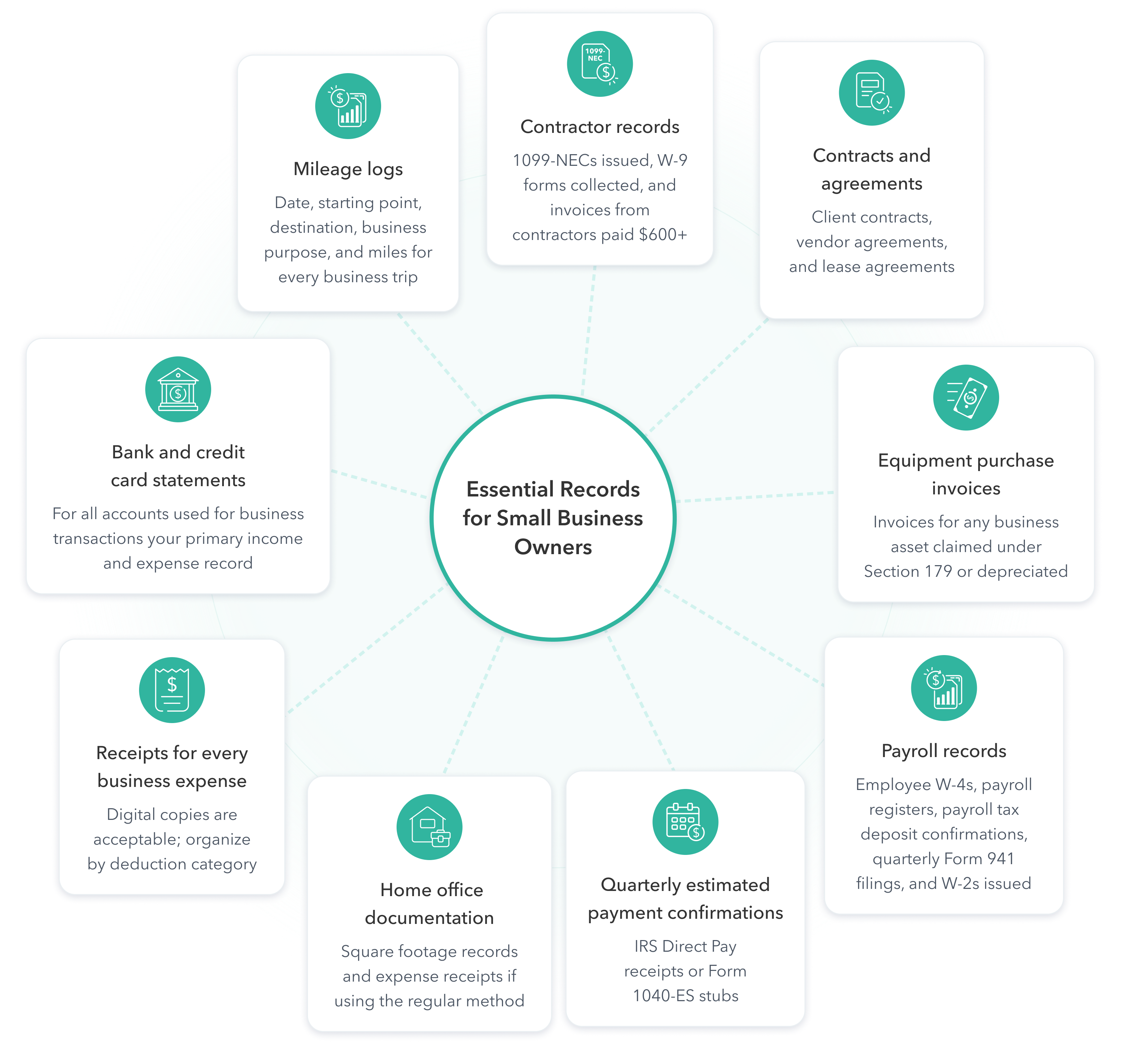
Essential Records for Small Business Owners
How Long to Keep Records
Schedule C Patterns That Draw IRS Attention
Claiming 100% business use of a vehicle (personal use is almost never truly zero)
Reporting a net loss for three or more consecutive years
Deduction amounts significantly above average for your income level and industry
Income on your return that doesn't match the 1099-NECs or 1099-Ks the IRS has received
A home office that represents a large percentage of total home area
Inconsistent income reporting year-over-year without clear explanation
Pro Tip A dedicated business checking account is the most effective audit protection a small business owner can have. Every business transaction stays in one place, deductions have clean paper trails, and personal and business expenses are clearly separated eliminating the most common trigger for Schedule C scrutiny.
Year-End Tax Planning: What to Do Before December 31
October and November are the most valuable tax planning months of the year. You have enough of the year behind you to accurately project your final income, and you still have time to act on moves that could save thousands of dollars. The actions you take before December 31 determine a significant portion of your tax bill not what you do in April.
Run a Final Tax Projection in October or November
Before you can take any meaningful planning action, you need to know where you stand. A year-end projection uses your actual YTD income and expenses to estimate your final tax bill. It answers three critical questions:
How much will I owe? Is your Q4 quarterly payment accurate, or do you need to adjust it upward?
Am I in a higher bracket than expected? Income significantly above what you projected at the start of the year may push you into a higher tax bracket, changing the value of certain deductions.
What actions would reduce my bill? The projection quantifies the tax value of each available planning move retirement contributions, equipment purchases, income deferral so you can prioritize the most impactful actions.
Accelerate Deductible Purchases Before Year-End
For businesses using cash-basis accounting (which includes most small businesses), an expense is deductible in the year you pay it. This creates a real planning window in November and December.
Purchase necessary equipment: Computers, tools, machinery, or other assets needed for the business. Under Section 179, the full cost is deductible in the year of purchase rather than depreciated over time. An item purchased December 31 reduces your current-year taxes; the same item purchased January 1 doesn't help until next year's return.
Prepay business subscriptions and services: Annual software subscriptions, professional memberships, and insurance premiums paid before December 31 are deductible this year. The 12-month rule generally allows prepayment of expenses that cover a period of 12 months or less.
Accelerate other deductible expenses: If you have business expenses you were planning to pay in January, consider paying them in December to shift the deduction into the current tax year.
Cash Basis Caution These strategies apply to cash-basis businesses. If you use accrual accounting, deductions are based on when expenses are incurred, not when they are paid. Confirm your accounting method before planning deductions around payment timing.
Retirement Contributions: The Highest-Value Year-End Move
For profitable small business owners, retirement contributions are typically the single most impactful year-end tax move. Every dollar contributed reduces taxable income dollar-for-dollar, saving you the equivalent of your marginal tax rate on that contribution.
SEP-IRA:
Contribution deadline: Until your filing deadline, including extensions (October 15 with an extension). This makes the SEP-IRA uniquely flexible you can calculate your optimal contribution after seeing your final numbers.
2026 limit: Up to 25% of net self-employment income or $70,000, whichever is less
Simplicity: No plan documents required; open and fund with your brokerage
Solo 401(k):
Deferral election deadline: The plan must exist and the deferral election must be made by December 31 of the tax year
Contribution deadline: Employee deferral contributions can be made until April 15; employer contributions can be made until your filing deadline
2026 limits: Employee deferral up to $23,500; total combined (employee + employer) up to $70,000
Advantage over SEP-IRA: At equivalent income levels, a solo 401(k) allows larger total contributions due to the separate employee deferral component
If you have employees:
SIMPLE IRA: Employee and employer contributions must generally be made within 30 days after year-end
401(k) plans with employees: Plan-specific deadlines apply; your plan administrator will provide them
Planning Example A small business owner with $120,000 in net income who contributes $22,420 to a SEP-IRA (the maximum at that income level) reduces taxable income by that amount saving approximately $5,600-$7,900 in federal income tax depending on their bracket. This contribution also reduces adjusted gross income, which can affect QBI deduction calculations and other income-sensitive thresholds.
Timing Income: When You Invoice Matters
For cash-basis businesses, income is taxable in the year you receive it not the year you earn it. This creates an opportunity to shift income between tax years in some situations.
Consider deferring a December invoice to January: If this year's income is higher than next year is likely to be, invoicing at the end of December so that payment arrives in January shifts that income to a lower-bracket year. Note: this strategy requires a client willing to pay in January, and it defers it doesn't eliminate the tax.
Conversely, accelerate outstanding income if next year is expected to be higher: If you anticipate higher income next year (a new contract, price increase, business growth), collecting outstanding payments before December 31 locks in this year's lower rate.
Income timing is most valuable when your income genuinely spans a bracket threshold. If your income is solidly within one bracket regardless of timing, the tax impact is minimal.
Reconcile and Organize Before Year-End
Getting organized before December 31 rather than in March ensures you don't miss deductions and makes tax preparation faster and less expensive:
Reconcile all business accounts: Bank accounts, credit cards, and any payment platforms should be reconciled through year-end
Review income against 1099s: Identify clients who paid you $600+ and confirm you have records matching what they'll report to the IRS
Verify expense categories: Review your expense record and confirm deductions are properly categorized
Confirm mileage log is complete: Your business mileage log should be current through December 31. Any gaps are lost deductions.
Gather payroll records: If you have employees, confirm all payroll records are complete and quarterly returns have been filed
Pro Tip Everlance continuously tracks mileage and categorizes expenses throughout the year. If you've been using it, your year-end records are already organized no December scramble required.
Confirm Your QBI Deduction Before Filing
The Qualified Business Income deduction (up to 23% of net qualified business income) is one of the most valuable available to small business owners and one of the most frequently missed or miscalculated.
Before year-end, confirm:
Whether you qualify: Most sole proprietors and LLC owners below the income phase-out thresholds qualify for the full 23% deduction. Certain specified service businesses face phase-outs above income thresholds.
Whether W-2 wages affect your deduction: For businesses with employees, the QBI deduction may be limited based on W-2 wages paid. In some cases, increasing employee wages before year-end can increase your allowable QBI deduction.
How retirement contributions interact: Retirement contributions reduce net SE income, which reduces the QBI deduction base. The net effect is still favorable in nearly all cases, but a CPA can optimize the interaction.
Was This the Right Year to Change Your Structure?
Year-end is a natural time to evaluate whether your current business structure is still the most efficient one for your income level and risk profile:
If net income exceeded $75,000-$80,000 for the second year in a row: Model the S-Corp election with a CPA. The S-Corp election for the following year must be filed on Form 2553 by March 15 of that year (or within two months and 15 days of the year's beginning).
If you have meaningful personal liability exposure: If you are still operating as a sole proprietor without an LLC, a year-end review is a good time to evaluate whether the liability protection of an LLC is worth the formation cost.
If you brought on partners or co-owners: A multi-member LLC is automatically taxed as a partnership, which requires Form 1065 filing. Confirm your structure reflects your actual ownership arrangement.
8 Tax Mistakes Small Business Owners Commonly Make
These are the patterns that cost small business owners the most in extra taxes, penalties, and audit exposure and what to do instead.
Small Business Tax Questions, Answered
Direct answers to the questions small business owners ask most, structured for featured snippets, AI search summaries, and voice results.


.svg)
