
The Sole Proprietor Tax Guide:
Tax Obligations, Deductions, and When to Change Your Structure
Sole proprietorship is the simplest business structure and the default status for self-employment in the United States. This guide covers your complete tax picture from self-employment tax and quarterly payments to the deductions that reduce your bill plus a practical framework for knowing when your income has grown to the point where a structure change could save you real money.

What Is a Sole Proprietor and Are You One?
A sole proprietor is a person who owns and operates a business as an individual, with no legal separation between themselves and the business. There is no registration required, no separate business tax return to file, and no corporate formalities to maintain. It is the simplest business structure that exists and it is the automatic default for anyone who earns self-employment income without registering a formal business entity.
If you freelance, consult, drive for a gig platform, run a small business under your own name, or sell products without forming an LLC or corporation you are a sole proprietor, whether or not you think of yourself that way.
Who Operates as a Sole Proprietor?
Sole proprietorship covers a wide range of working arrangements:

Freelancers and independent contractors receiving 1099-NEC income
Consultants and professional service providers working under their own name

Gig economy workers (rideshare, delivery, task-based platforms)
Small business owners operating under their own name or a DBA (doing business as)
Side-income earners who haven't formed a separate entity
Operating under a trade name or DBA does not change your tax classification. You are still a sole proprietor for tax purposes.
The Key Tax Characteristic: Pass-Through Taxation
The defining tax feature of a sole proprietorship is pass-through taxation. All business income and expenses flow directly through to your personal Form 1040 via Schedule C. The business itself is not a taxable entity you and your business are one and the same in the eyes of the IRS.
This means:
No separate business income tax return: Schedule C attaches to your personal Form 1040. One filing covers everything
No double taxation: Unlike corporations, income is only taxed once at the individual level
Immediate loss utilization: If your business has a loss in a given year, it can offset other income on your personal return (subject to at-risk and passive activity rules)
Full SE tax responsibility: As a sole proprietor, you pay the full 15.3% self-employment tax yourself there is no employer to split it with
How Sole Proprietorship Taxation Works
As a sole proprietor, you face two primary federal tax obligations: self-employment tax and income tax. Understanding how each is calculated and how they interact is essential for estimating your bill and making smart tax planning decisions throughout the year.
Self-Employment Tax: The Sole Proprietor's FICA
Self-employment tax exists because sole proprietors are both the employer and the employee. When you work for a company, your employer pays 7.65% of FICA and you pay 7.65%. As a sole proprietor, you pay the full 15.3% yourself.
The breakdown:
Pro Tip The SE deduction is easy to overlook. At $80,000 net income, your SE tax is approximately $11,304. You deduct $5,652 from gross income before calculating income taxes saving roughly $1,000-$1,500 in income tax depending on your bracket.
Income Tax: Your Net Profit Flows Through to Your Personal Return
Net profit from Schedule C is added to your other income (wages, interest, capital gains) on Form 1040 and taxed at ordinary income tax rates. The federal income tax brackets for 2026 are progressive you pay a lower rate on the first portion of your income and higher rates as income increases.
Your taxable income after business deductions is lower than your gross revenue often significantly so for sole proprietors who track expenses carefully.
The Forms a Sole Proprietor Files
Schedule C (Profit or Loss from Business): Lists all business income and expenses; calculates net profit or loss
Schedule SE (Self-Employment Tax): Calculates your SE tax obligation based on Schedule C net profit
Form 1040 (Personal Tax Return): Where Schedule C and Schedule SE attach; calculates your total federal tax
Form 1040-ES (Quarterly Estimated Payments): Used to submit four estimated tax payments throughout the year
Form 8829 (Home Office): Required if you claim the regular method home office deduction
Your Tax Responsibilities Throughout the Year
The tax calendar for a sole proprietor doesn't end in April. Managing taxes well means maintaining habits throughout the year that make each quarterly deadline and the final filing straightforward.
What to Do Every Month

Track all income
Record every payment received, from every client or source, as it arrives

Categorize every business expense
Log receipts and categorize expenses in real time not at year-end

Maintain your mileage log
Record every business trip contemporaneously: date, destination, purpose, and miles

Reconcile accounts
Monthly reconciliation of your business bank account prevents errors from accumulating
Quarterly Estimated Tax Payments
Because no employer withholds taxes from your business income, the IRS requires quarterly estimated payments if you expect to owe $1,000 or more in federal taxes for the year. Missing a deadline triggers an underpayment penalty calculated per quarter, not just assessed once at filing.
IRS safe harbor rule: paying at least 100% of your prior year's tax (110% if prior-year AGI exceeded $150,000) protects you from underpayment penalties regardless of this year's final bill. This is your floor during slow quarters.
Year-End Tax Preparation
October and November are the most valuable planning window:
Run a year-end tax projection: Estimate your final income, compare to prior year, confirm your Q4 payment is accurate
Consider a retirement contribution: SEP-IRA contributions can be made until your filing deadline; solo 401(k) deferrals must be elected by December 31
Accelerate deductible purchases: If income was higher than expected, purchase equipment or prepay subscriptions before December 31
Review your business structure: If net income exceeded $75,000-$80,000 this year, evaluate whether an S-Corp election for next year would be beneficial
Annual Filing
Sole proprietors file their complete return Schedule C, Schedule SE, and Form 1040 by April 15. Any balance owed is due on April 15 regardless of whether you file an extension. An extension (Form 4868) moves the filing deadline to October 15 but does not extend the payment deadline.
Tax Deductions Available to Sole Proprietors
Every legitimate business expense you deduct on Schedule C reduces both your income tax and your self-employment tax. For a sole proprietor earning $80,000 in gross revenue, disciplined expense tracking can realistically reduce taxable income by $15,000 or more, saving $3,000-$6,000 in combined taxes.
Business Mileage
The standard mileage deduction for 2026 is 72.5 cents per business mile. If you drive for client visits, site visits, supply runs, or other business purposes, this is typically one of the largest deductions available. You must maintain a contemporaneous mileage log the IRS does not accept reconstructed or estimated records.
Home Office
If a portion of your home is used regularly and exclusively as your principal place of business, you may deduct:
Equipment, Tools, and Section 179
Computers, equipment, tools, and other business assets are deductible. Section 179 lets you deduct the full cost of qualifying equipment in the year of purchase rather than depreciating it over several years up to the annual limit. For most sole proprietors purchasing standard business equipment, the full cost is deductible in the year of purchase.
Retirement Contributions
Contributions to a SEP-IRA or solo 401(k) are fully deductible from gross income and reduce your income tax bill dollar-for-dollar. This is also an above-the-line deduction, not a Schedule C deduction. 2026 contribution limits:
Key Insight At $100,000 net income, a maximum SEP-IRA contribution of roughly $18,587 reduces taxable income by that full amount saving approximately $4,000-$6,000 in federal income tax depending on your bracket. This is often the single most impactful year-end tax move for profitable sole proprietors.
Qualified Business Income (QBI) Deduction
The QBI deduction allows eligible sole proprietors to deduct up to 23% of qualified business income from their taxable income. Made permanent and increased to 23% under the One Big Beautiful Bill Act (effective 2026), this deduction is one of the most valuable available to self-employed individuals and is often overlooked.
At $80,000 net business income (assuming the full deduction applies), the QBI deduction reduces taxable income by $18,400 saving approximately $2,800-$4,000 in income tax depending on your bracket. Income-based phase-outs and limitations apply at higher income levels for specified service businesses; consult a CPA to confirm your eligibility.
Other Common Sole Proprietor Deductions
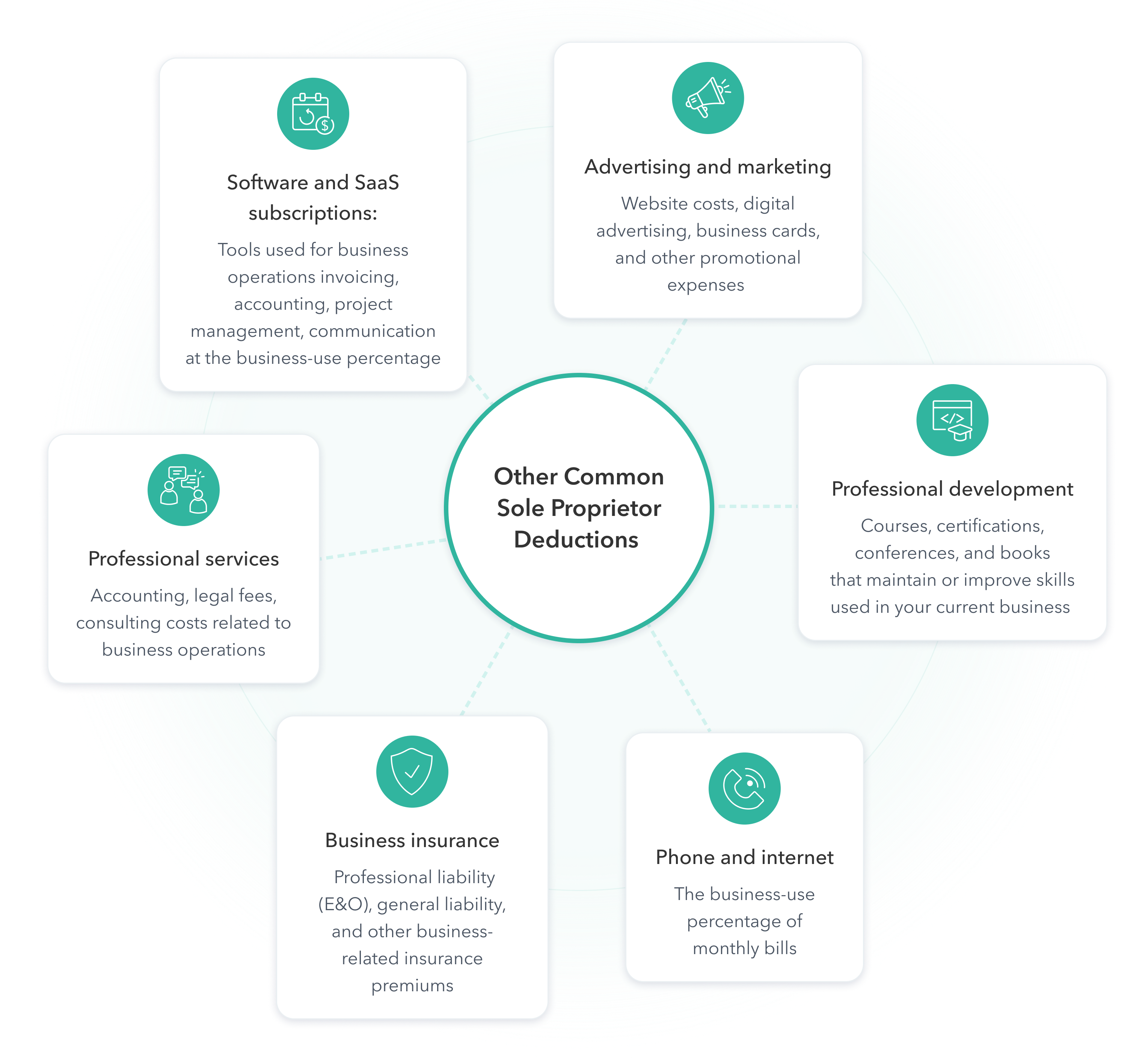
Health Insurance Premiums
Recordkeeping and Staying Audit-Ready
Schedule C returns are audited at higher rates than W-2 income returns. The audit rate rises with income and certain deduction patterns reliably attract IRS attention. Strong records protect you regardless of whether an audit occurs.
Essential Records for Sole Proprietors
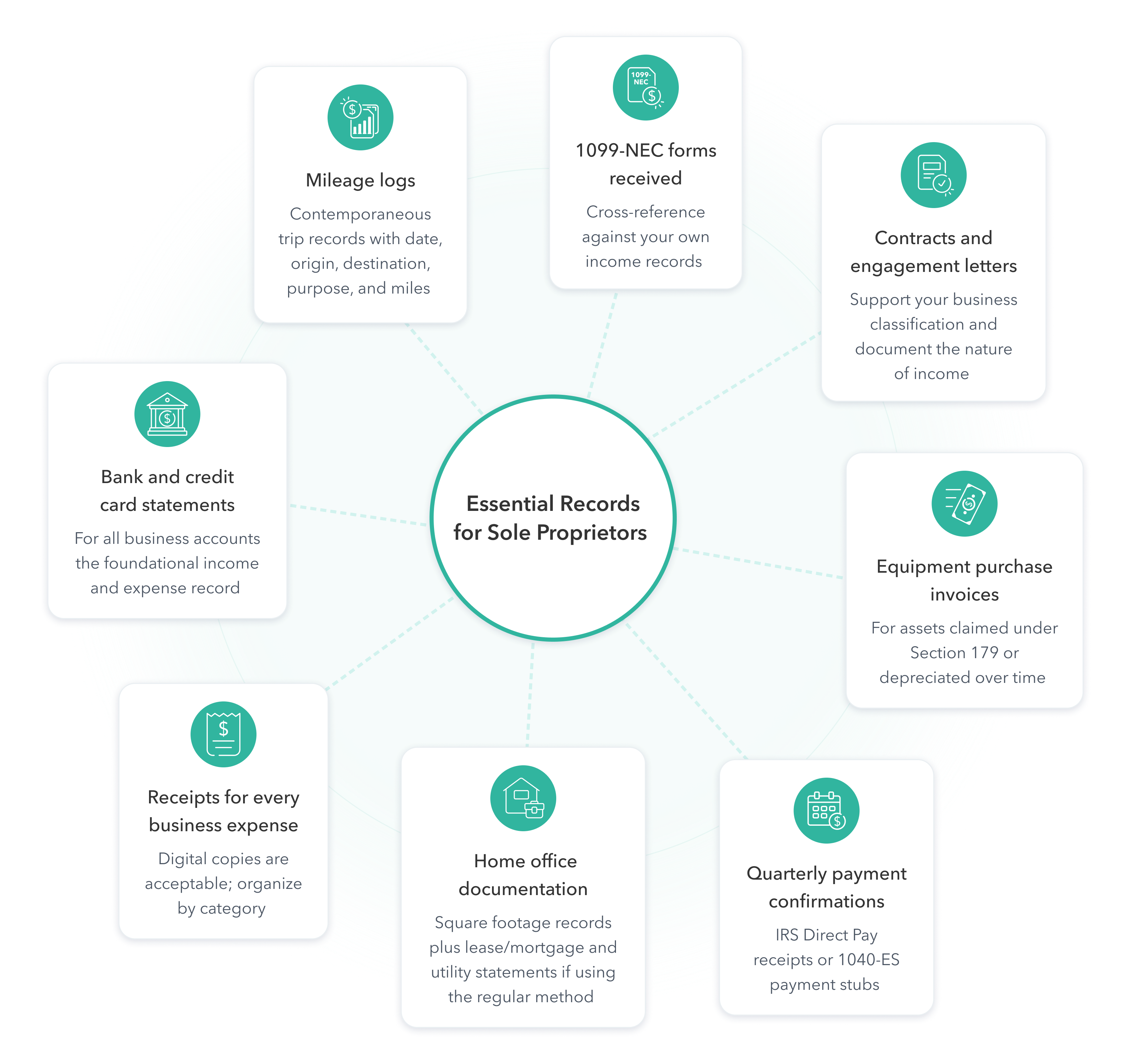
How Long to Keep Records
Deduction Patterns That Increase Audit Risk
Claiming 100% business use of a vehicle (personal use is almost never truly zero)
Reporting a loss for three or more consecutive years (triggers the hobby loss question)
Claiming a home office that represents a large percentage of total home square footage
Deduction amounts that are significantly above-average for your income level and industry
Income on your return that doesn't reconcile with 1099s the IRS has received from clients
Pro Tip A dedicated business checking account is the single most effective audit protection habit for sole proprietors. Every business income deposit and expense payment creates a clean, automatic paper trail that makes deductions straightforward to substantiate.
Tax Planning for Sole Proprietors: What to Do and When
The sole proprietors who navigate tax season without surprises manage taxes as a continuous process, not a once-a-year event. These four practices make the biggest difference.
Set Aside 25-30% After Every Payment
From every business payment received, immediately transfer 25-30% to a dedicated tax savings account. This covers your 15.3% SE tax and your federal income tax bracket. In a higher bracket or a high-tax state, increase to 30-35%. Transfer the percentage immediately before the money can be spent on other priorities.
Use a Dedicated Business Account
A dedicated business checking account and business credit card turns your bank statement into an automatic income and expense ledger. Every transaction is clearly categorized, Schedule C preparation becomes straightforward, and the clean paper trail significantly reduces audit risk.
Pro Tip Everlance connects to your business bank and card accounts, categorizes expenses in real time, and tracks mileage automatically. Your deduction list builds itself throughout the year so every quarterly calculation and your final filing are based on complete, current records.
30-Minute Quarterly Check-In
Before each quarterly deadline: review year-to-date net income, confirm your estimated payment, verify your set-aside account is funded, and look for large upcoming deductible purchases that could be made before year-end.
October and November: The Year-End Planning Window
The critical October-November actions:

Maximize a retirement contribution
The single most impactful year-end move for most profitable sole proprietors
Accelerate deductible purchases
Equipment, software, or other business expenses before December 31
Evaluate your business structure
If this year's net income exceeded $75,000, model the S-Corp option with a CPA before year-end so you can elect for the following year

Confirm your final quarterly payment
Run an updated tax projection and adjust your Q4 payment if your income was higher or lower than expected
When to Remain a Sole Proprietor, When to Form an LLC, and When to Elect S-Corp Status
This is the question most sole proprietors ask as their business grows: does my structure still make sense? The answer depends primarily on two things how much you're earning and what level of liability protection your work requires. Here is a practical framework for making that decision.
The most important thing to understand upfront: changing your business structure is not a single action. It is a progression with distinct thresholds, administrative tradeoffs, and financial logic at each stage. Jumping ahead of the math or staying behind it both cost money.
The Income-Based Decision Framework
Sole Proprietor vs. Single-Member LLC vs. S-Corp: Complete Comparison
When to Remain a Sole Proprietor
Sole proprietorship is appropriate and often optimal in these situations:
Net income under $40,000: The SE tax savings from an S-Corp election would not exceed the administrative overhead ($2,000-$5,000/year). A sole proprietor structure is the highest-return option.
Early stage or validating a business: When you are still testing a business model or in the first one to two years of operation, sole proprietorship minimizes overhead while you build revenue.
Project-based or temporary work: If the income stream may not continue, the cost of forming and maintaining a more formal structure is not justified.
Minimal liability exposure: If your work does not create meaningful risk of client injury, property damage, or large contract disputes, the liability protection of an LLC may not be essential.
Key point Being a sole proprietor does not mean you are less professional or less protected in every sense. It means you have made a rational cost-benefit decision: for your income level and risk profile, the simplest structure is also the most efficient.
When to Form an LLC
The single-member LLC is the most frequently misunderstood business structure for one critical reason: by default, it does not reduce your self-employment taxes. A single-member LLC is treated by the IRS as a disregarded entity which means it is taxed identically to a sole proprietorship. The Schedule C structure, the SE tax rate, and the quarterly payment obligations are all unchanged.
What an LLC does provide:
Personal liability protection: An LLC separates your personal assets from business debts and obligations. If a client sues over a contract dispute or a deliverable causes harm, your personal savings, home, and non-business assets are generally protected (subject to the limits of proper LLC maintenance).
Professional credibility: Larger clients and corporate procurement processes sometimes prefer or require contracting with an entity rather than an individual.
The foundation for S-Corp election: If your income later grows to the S-Corp threshold, having an LLC in place makes the S-Corp election simpler.
The LLC formation case is about liability and structure not taxes. If your business has meaningful personal liability exposure and you're earning enough to justify the formation cost ($50-$800 depending on your state), an LLC is a reasonable choice at any income level.
Important California LLCs are subject to a minimum $800 annual franchise tax regardless of income. In some states, LLC fees can meaningfully affect the cost-benefit analysis at lower income levels. Confirm your state's LLC costs before forming.
When to Elect S-Corp Status and How It Works
The S-Corp election is where the structure change starts producing real tax savings. The mechanism: as an S-Corp, you split your business income into two categories that are taxed differently.
Salary (W-2 wages): You pay yourself a "reasonable salary" for your role. This salary is subject to payroll taxes both the employer and employee halves of FICA (effectively 15.3%, the same as SE tax).
Distributions: Profit above your salary can be taken as a shareholder distribution, which is NOT subject to payroll or SE tax.
The tax savings come from the portion of your income taken as a distribution rather than salary. The larger your profit above what constitutes a reasonable salary, the greater the annual savings.
The Math at Three Income Levels
The "Reasonable Salary" Rule: The Most Important S-Corp Constraint
The IRS requires that an S-Corp owner-employee pay themselves a "reasonable salary" for the work they perform for the business. This is not a number you can set arbitrarily low to maximize distributions. The IRS specifically audits S-Corps where the salary appears designed to minimize payroll taxes rather than reflect fair market compensation.
What constitutes reasonable salary:
Market rate for your role: What would you have to pay a third party to perform the same work? This is the benchmark.
Industry and geographic norms: A reasonable salary varies significantly by profession. A software developer in San Francisco has a higher market rate than a handyman in rural Tennessee.
Business profitability: A business with $500,000 in profit paying the owner a $40,000 salary will draw scrutiny. The IRS expects salary to reflect economic reality.
Critical Caution Setting an unreasonably low salary to inflate distributions is the most common S-Corp IRS audit trigger. The penalty for paying below-market wages is that the IRS can reclassify distributions as wages and assess back payroll taxes, interest, and penalties. A CPA should establish your reasonable salary range before you elect S-Corp status.
What the S-Corp Election Actually Requires
The S-Corp election adds real administrative obligations that the comparison math must account for:
Run payroll: You become your own W-2 employee. You must process payroll typically using a service like Gusto or ADP deposit payroll taxes on a regular schedule, and file quarterly Form 941 payroll tax returns.
File Form 1120-S: A separate annual S-Corporation tax return is required in addition to your personal Form 1040. This is typically prepared by a CPA, adding $1,500-$3,000 to your annual accounting cost.
Issue a K-1: The S-Corp issues you a Schedule K-1 showing your share of the corporation's income, deductions, and credits, which flows through to your personal return.
Maintain corporate formalities: An annual report in most states, proper documentation of any distributions, and keeping your S-Corp in good standing with your state.
Use This Checklist to Guide Your Decision
Is my net business income consistently above $75,000-$80,000? If yes: run the S-Corp numbers with a CPA. If no: sole proprietor or LLC is likely optimal.
Does my work create meaningful personal liability exposure? If yes: an LLC provides protection regardless of income. If no: sole proprietor may be sufficient.
Am I still validating or in early growth stages? If yes: remain a sole proprietor and minimize overhead. Revisit structure annually.
Do I have or am I willing to open a separate business bank account? If no: do this first. It is the foundation for any structure, including sole proprietorship.
Am I willing to run payroll and file a separate corporate tax return? If no: an S-Corp is not practical for you. An LLC or sole proprietorship is a better fit.
Is my reasonable salary substantially below my total business profit? If yes: the S-Corp produces the most savings when the salary-to-distribution split creates a significant tax differential. If your profit only slightly exceeds a reasonable salary, the savings narrow.
Have I modeled the state-specific implications? If no: some states tax S-Corps separately or have high LLC fees. Confirm your state's treatment before filing the election.
Always consult a CPA The S-Corp election must be filed with the IRS on Form 2553 no later than March 15 of the tax year in which you want the election to take effect, or within two months and 15 days of the beginning of the tax year. A CPA should advise on timing, reasonable salary benchmarking, and state-specific implications before you file.
8 Tax Mistakes Sole Proprietors Commonly Make
These are the patterns that cost sole proprietors the most in extra taxes, penalties, and audit exposure and what to do instead.
Sole Proprietor Tax Questions, Answered
Direct answers to the questions sole proprietors ask most structured for featured snippets, AI search summaries, and voice results.


.svg)
