
Freelancer Tax Guide, Every mile on the clock
Multiple Clients, Real Deductions, and Staying Ahead All Year
Freelancing gives you the freedom to work on your own terms but it also means handling taxes that your employer used to manage for you. This guide covers what makes freelancer taxes unique: managing income from multiple clients, the deductions that actually apply to how you work, and how to avoid the cash flow crunch that catches most freelancers off guard.

Freelancer Taxes Are Different Here’s How
When you’re on a company payroll, your employer quietly handles a lot: withholding federal and state income taxes from every paycheck, paying half your Social Security and Medicare taxes, and issuing one clean W-2 at the end of the year.
As a freelancer, none of that happens. Your income arrives in irregular chunks from multiple clients, with no withholding attached. The IRS still expects its share and so does your state on a schedule that doesn’t wait for April.
That’s not as daunting as it sounds, but it does require understanding four things that most employees never have to think about:

You pay self-employment (SE) tax: 15.3% of your net earnings, covering both the employee and employer portions of Social Security and Medicare.
No one withholds for you: The IRS expects quarterly estimated tax payments four times a year not just in April.

Your income is irregular: Feast-or-famine cash flow makes tax planning both more important and more challenging.
Your deductions are real and significant: Freelancers have access to a range of legitimate business deductions that can substantially reduce what they owe.
The sections below walk through each of these realities in depth focused on the freelancer experience, not the filing mechanics. When you’re ready for the step-by-step process of actually completing your return, the filing guide covers that separately.
Multiple Clients, Multiple 1099s:
How to Track and Report All Your Freelance Income
One of the defining characteristics of freelance work is that your income doesn’t come from one employer it comes from many clients, in different amounts, at different times. That creates a tax documentation challenge that’s easy to underestimate.
The 1099-NEC: What It Is and Why It Matters
If a client pays you $600 or more during the tax year, they’re required by the IRS to send you a Form 1099-NEC (Nonemployee Compensation) by January 31st of the following year. This form reports what they paid you directly to you and to the IRS.
As a freelancer with multiple clients, you’ll typically receive several of these forms. Each one represents an income stream that flows onto Schedule C of your personal tax return (Form 1040), where you report all business income and expenses.
Three things worth knowing about the 1099-NEC:
Every 1099-NEC you receive should match your own income records exactly. Discrepancies get noticed.
New clients should send you a W-9 before their first payment. This form collects your name, address, and Tax ID so they can generate your 1099 later.
Make sure your Tax ID whether your Social Security Number or an EIN is accurate on every W-9 you submit.
When You Don’t Receive a 1099 You Still Owe the Tax
Here’s the rule that surprises most new freelancers: you are legally required to report all self-employment income, even when no 1099 arrives.
This happens more often than you’d think:
- A client pays you less than $600 below the 1099-NEC reporting threshold
- You receive payments through platforms that aren’t yet at the 1099-K reporting threshold
- A client simply forgets to file the form
None of these situations change your obligation. The IRS doesn’t track tax liability through forms it expects you to report everything you earned, regardless of what paperwork shows up. Keeping your own income records is non-negotiable.
PRO TIP If you file your return and a 1099 arrives after you've already submitted, that income should still be on your return (since you kept your own records). If it wasn't, you may need to file an amended return.

Build Your Own Income Ledger
Because your income arrives from multiple sources at irregular times, a personal income ledger is one of the most practical tools a freelancer can maintain. It doesn’t have to be elaborate a spreadsheet tracking client name, invoice amount, payment date, and payment method covers the essentials.
A consistent income ledger lets you:
Cross-reference incoming 1099-NECs against what you actually received
Catch missing or incorrect forms before you file
Substantiate income in the event of an audit
Know your YTD earnings at any point during the year essential for accurate quarterly estimates
Apps like Everlance can connect to your accounts and automatically categorize income transactions as they happen, turning this into a passive, always-current record instead of an end-of-year reconstruction.
Irregular Income and the Freelancer Tax Challenge
Seasonal slowdowns. A big project followed by two slow months. Waiting 60 days on a client invoice. This is the normal rhythm of freelance cash flow and it creates a real tax planning challenge that salaried workers never face.
Why Freelance Income Makes Taxes Harder to Manage
When you’re an employee, your employer withholds taxes from every paycheck automatically. By April, the math is mostly done.
As a freelancer, nothing is withheld. Two things follow from that:


Miss a quarterly payment, or underpay, and the IRS charges an underpayment penalty even if you pay the full balance by April 15th. The penalty is calculated based on what you underpaid during the year, not just the final balance.
The Set-Aside Strategy That Experienced Freelancers Use
The approach that works: treat taxes as a non-negotiable line item from every payment you receive not as a bill you deal with when the deadline arrives.
Here’s a practical framework:
After every client payment, transfer 25–30% of the net amount to a dedicated tax savings account immediately
This percentage covers your 15.3% SE tax plus your federal income tax bracket
If you’re in a higher income bracket or live in a high-tax state, increase this to 30–35%
Keep that account untouched until each quarterly deadline
KEY PRINCIPLE “Set it aside immediately” is the operative phrase. Waiting until a quarterly deadline creates the risk that the money has already been spent. A separate savings account clearly labeled as your tax account makes this automatic.
The Safe Harbor Rule: Your Backstop in Slow Quarters
A challenge unique to freelancers: a slow quarter might mean less income and fewer funds set aside but your quarterly payment may still be required to stay penalty-free.
This is where IRS safe harbor protection matters. Safe harbor means: if you pay at least 100% of what you owed in taxes last year (or 110% if your prior-year AGI exceeded $150,000), the IRS won’t charge underpayment penalties even if you end up owing more at filing due to a strong year.
This makes safe harbor an important backstop during slow periods: you know the minimum payment that keeps you penalty-free, regardless of what this year’s income actually looks like.
If a significant portion of your freelance income comes through Upwork, specialized tools can help you estimate taxes on platform earnings and fees specifically.
Freelancer Tax Deductions: What You Can Actually Write Off
Every legitimate business expense reduces both your taxable income and your self-employment tax. For a freelancer earning $80,000, properly tracking deductions can realistically reduce the tax bill by several thousand dollars but only if you’re capturing them.
The IRS standard is “ordinary and necessary”: the expense must be common in your type of work and helpful to running your freelance business. Here’s what that looks like in practice.
Software and SaaS Subscriptions
Most freelancers spend money every month on the tools that make their work possible. These are fully deductible when used for business:
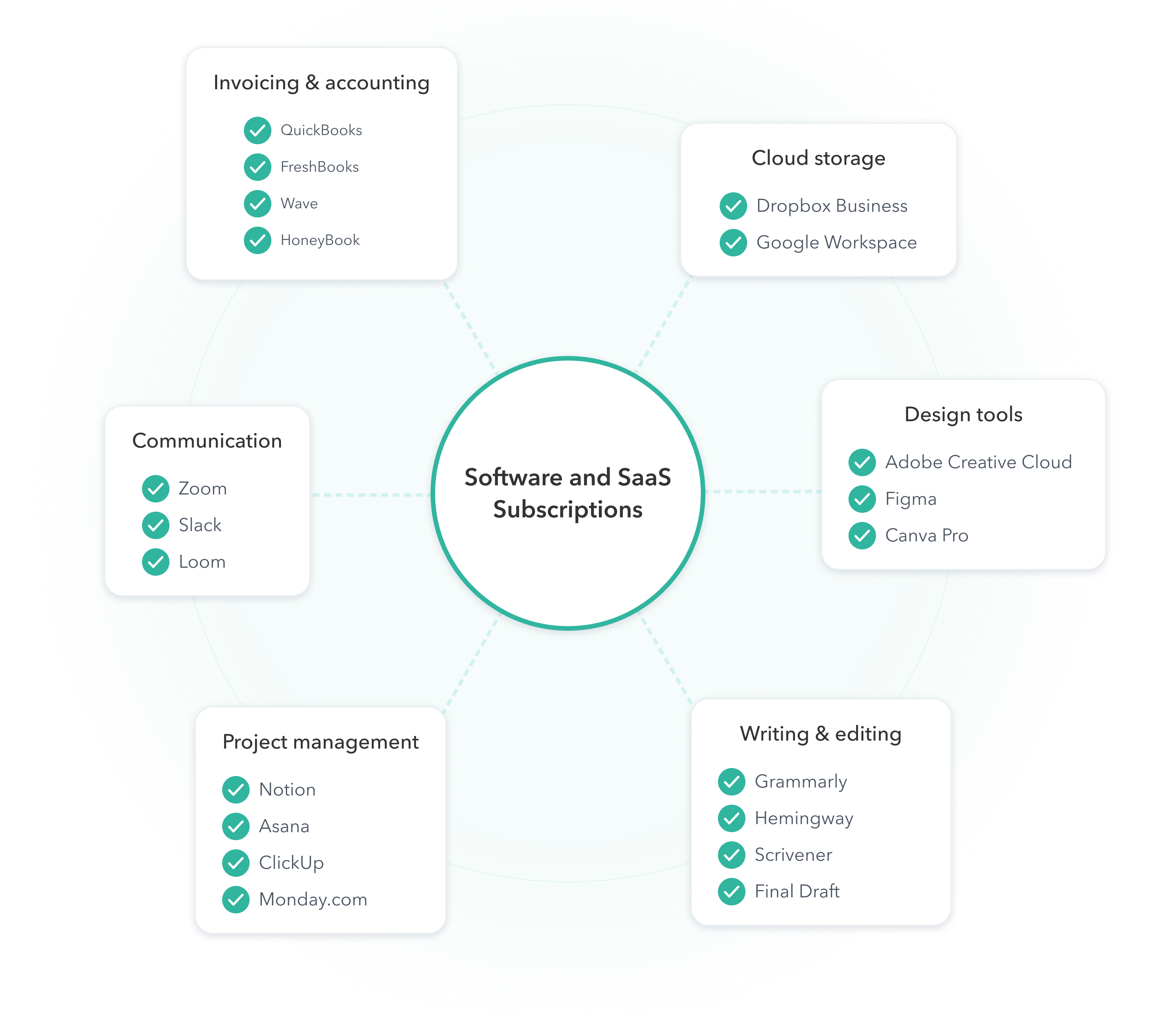
If a subscription serves both personal and business purposes, deduct the business-use percentage. If it’s exclusively for work, it’s 100% deductible.
Coworking Space Memberships
If you pay for a coworking space a dedicated desk, a private office in a shared facility, or even a regular day-pass arrangement the full cost is deductible as a business expense.
This deduction is particularly clean for freelancers: there’s no personal-use percentage to calculate (unlike a home office), and documentation is simple your membership receipts and monthly statements.
Monthly or annual coworking memberships
Day passes or drop-in fees at shared workspaces
Conference room bookings used for client meetings
Home Office Deduction
If you regularly and exclusively use a portion of your home as your primary place of business, you may qualify for the home office deduction. This is one of the most misunderstood deductions among freelancers many skip it and leave real savings on the table, or claim it incorrectly and create audit risk.
Two calculation methods:


The key requirement: the space must be used regularly and exclusively for business. A spare room used only as your office qualifies. A kitchen table where you work and eat does not.
IMPORTANT If you already deduct a coworking space as your primary workplace, the home office deduction may not apply. If you use both, consult a tax professional to determine what’s defensible for your situation.
Portfolio and Website Costs
Your online presence is a business asset and the costs to build and maintain it are deductible:
Domain registration and annual renewal fees
Web hosting and server costs
Website design or development work (including one-time redesign projects)
Portfolio platform subscriptions (Dribbble Pro, Behance Pro, Contently, Muck Rack)
Professional directory listings and profile subscriptions
Professional Development and Education
Staying current in your field is a legitimate business expense. Deductible items include:

Online courses, workshops, or bootcamps directly related to your current freelance work

Industry books, publications, and trade subscriptions

Conference registration fees and related travel if the primary purpose is business

Professional association memberships
The qualification: the education must maintain or improve skills used in your current freelance practice. Courses for a career pivot training you for a new field generally don’t qualify.
Other Deductions Worth Tracking

If you do freelance writing specifically, a dedicated calculator can help you estimate deductions and taxes based on writing income and expenses.
Should You Form an LLC or Elect S-Corp Status?
As your freelance income grows, you’ll eventually start wondering whether a different business structure would lower your tax bill. The answer depends on how much you’re earning and on understanding a distinction most online advice gets wrong.
The Single-Member LLC: More Protection, Same Taxes
Many freelancers form a single-member LLC primarily for liability protection. That’s a valid reason but it’s important to understand one thing clearly: a single-member LLC is treated by the IRS as a “disregarded entity.” By default, it is taxed identically to a sole proprietor.
That means:
You still pay 15.3% self-employment tax on your net business income
You still file Schedule C on your personal Form 1040
Forming an LLC alone does not reduce your tax bill
What an LLC does provide: separation between personal and business assets (liability protection), a more professional structure for client contracts and invoicing, and the option to elect S-Corp taxation if your income reaches the threshold.
The S-Corp Election: Where Real Tax Savings Begin
When your net freelance income consistently reaches roughly $75,000–$80,000 per year, electing S-Corp status can generate meaningful self-employment tax savings.
Here’s how the math works: as an S-Corp, you split your business income into two buckets:
A reasonable salary subject to payroll taxes (FICA). This amount should be defensible for your role and industry
Distributions not subject to self-employment tax
At $120,000+ in net income, the savings typically exceed the administrative costs by a wide margin. Below $75,000, the math often doesn’t work in your favor.
IMPORTANT The S-Corp structure requires ongoing compliance to stay valid. The right “reasonable salary” also varies by industry and geography. Talk to a CPA before making this election the savings are real, but so is the complexity.
Year-Round Tax Planning: How Freelancers Stay Ahead
The freelancers who never panic at tax time share one trait: they’re not trying to reconstruct their finances in March. Here are the habits that make the biggest difference.
Separate Business and Personal Finances Immediately
Open a dedicated business checking account and run all client payments and business expenses through it. This single habit does more for your tax situation than almost anything else:
Your bank statement becomes your income ledger automatically
Business expenses are easy to identify and document
Schedule C preparation becomes straightforward whether you do it yourself or hand it to an accountant
The clean paper trail significantly reduces audit risk
A dedicated business credit card paired with your business account takes this further: every deductible expense gets captured automatically in one place.
Track Every Business Expense as It Happens
The IRS requires documentation for every deduction you claim. Memories fade and receipts disappear the practical solution is making expense tracking a habit throughout the year, not a year-end sprint.
Everlance connects to your bank and card accounts and categorizes business expenses in real time. Your deduction list builds itself throughout the year, so when tax season arrives or when you’re preparing a quarterly estimate your numbers are already current.
Run a Quarterly Check-In Before Each Payment Deadline
Four times a year before each quarterly deadline block 30 minutes to review:
Year-to-date income vs. prior year
Estimated quarterly payment due (and safe harbor minimum)
Large upcoming expenses that could be accelerated for deduction purposes
Whether your 25–30% set-aside percentage still matches your actual liability
This quarterly rhythm prevents the two most common freelancer tax surprises: a large April bill and missed mid-year deduction opportunities.
Run a Year-End Tax Estimate in October or November
October and November are the sweet spot for year-end tax planning. You have enough of the year behind you to estimate your final income accurately, and you still have time to act:
Make a final retirement contribution. SEP-IRA contributions can be made up until your filing deadline (including extensions). Solo 401(k) contributions must be elected by December 31. For a high-income freelancer, contributing the maximum can reduce taxable income by tens of thousands of dollars.
Accelerate deductible expenses. If income was higher than expected this year, consider purchasing equipment, prepaying software subscriptions, or making other business purchases before December 31.
Defer income where possible. If this year’s bracket is higher than next year’s is likely to be, invoicing in late December so that payment arrives in January shifts that income to a potentially lower tax year.
Freelancer Tax Questions, Answered
Direct answers to the questions freelancers ask most structured to surface in featured snippets, AI search summaries, and voice results.


.svg)
