The good news: ChatGPT is surprisingly useful for organizing the chaos of gig worker taxes. It can help you sort through piles of 1099s, brainstorm deductions you might have missed, and even draft expense summaries that make your accountant's life easier. The bad news: it absolutely cannot file your taxes, it sometimes makes things up, and trusting it blindly could cost you real money in penalties or missed refunds.
So can ChatGPT do your taxes as a gig worker? The short answer is no, not by itself. But it can serve as a powerful assistant in the process, helping you prepare, organize, and understand your tax obligations before you file through proper channels. The key is knowing exactly where AI helps and where it falls short. For gig workers juggling multiple income streams, mileage deductions, and quarterly estimates, that distinction matters more than you might think. The IRS processed over 160 million individual returns in 2024, and a growing number of those came from self-employed workers who could use all the help they can get.
Gig work has exploded over the past decade. According to the Bureau of Labor Statistics, roughly 27 million Americans now earn income through independent contracting, freelancing, or platform-based work like Uber, DoorDash, and Instacart. Each of these workers faces a tax situation that's fundamentally different from a W-2 employee. There's no employer withholding taxes on your behalf. You're responsible for self-employment tax (15.3% in 2024), quarterly estimated payments, and tracking every deductible expense yourself.
This is where AI tools like ChatGPT have started to carve out a genuine role. Not as a replacement for tax software or a CPA, but as an always-available assistant that can answer questions at 2 AM when you're staring at a pile of receipts and wondering whether your phone bill counts as a business expense.
ChatGPT and similar models are good at a specific set of tasks. They can explain tax concepts in plain English, help you understand what goes on which IRS form, and walk you through the logic behind common deductions. If you paste in a list of expenses and ask it to categorize them by Schedule C line item, it'll do a reasonable job. It can also generate templates for profit-and-loss statements, help you draft mileage logs, and explain the difference between the standard mileage rate ($0.725 per mile for 2026) and the actual expense method.
Where it shines most is as a translation layer. Tax code is written in dense legalese, and most gig workers don't have the time or background to parse IRS Publication 535 on their own. ChatGPT can take a specific question like "Can I deduct my car insurance if I drive for Lyft?" and give you a clear, contextualized answer. That's genuinely useful.
Here's a critical distinction most people miss: there's a massive difference between tax advice and data processing. Tax advice means analyzing your specific financial situation and recommending a strategy, something that requires a licensed professional (CPA, enrolled agent, or tax attorney). Data processing means organizing, categorizing, and summarizing information you already have.
ChatGPT is a data processing tool, not a tax advisor. It doesn't know your full financial picture. It can't access your bank accounts, verify your income, or cross-reference your numbers with what the IRS already has on file. When it gives you an answer about deductions, it's drawing from general training data, not your specific situation. This matters because tax outcomes are incredibly fact-specific. Two DoorDash drivers with identical gross income might owe very different amounts based on their mileage, home office setup, and state of residence.
The biggest headache for most gig workers isn't actually filing the return. It's getting organized enough to file accurately. If you're driving for multiple platforms, selling on Etsy, and doing freelance design work on the side, you might have five or six 1099 forms, hundreds of transactions, and a mess of receipts scattered across email inboxes and glove compartments. ChatGPT can genuinely help with this organizational phase.
Think of it as a smart assistant that never gets tired of sorting through your data. You can paste raw transaction lists, describe your work setup, and ask it to help you build a clear picture of your tax year. The output won't be perfect, but it gives you a starting framework that's far better than staring at a blank spreadsheet.
One of the most practical uses is expense categorization. Say you export your bank transactions for the year and paste them into ChatGPT. You can ask it to sort them into IRS-recognized categories: advertising, car and truck expenses, office supplies, professional services, and so on. Here's what a good prompt looks like versus a bad one:
Bad prompt: "Categorize my expenses for taxes."
Good prompt: "I'm a rideshare driver and freelance graphic designer. Here are my business transactions from 2026. Please categorize each one according to Schedule C expense categories. Flag anything that might be partially personal use."
The second prompt gives ChatGPT enough context to make intelligent decisions. It'll separate your Adobe subscription (business expense for design work) from your Netflix subscription (not deductible) and flag your cell phone bill as a split personal/business expense. You'll still need to verify everything, but this first pass can save you hours.
Schedule C (Profit or Loss from Business) is the form most gig workers need to file, and ChatGPT can help you draft the summary data that feeds into it. If you give it your total income from each platform and your categorized expenses, it can calculate your net profit, estimate your self-employment tax, and even rough out your quarterly payment amounts for the following year.
A practical example: say you earned $45,000 from Uber and $12,000 from freelance writing. You drove 18,000 business miles and had $4,200 in other deductible expenses. ChatGPT can calculate that your standard mileage deduction would be $13,050 (18,000 × $0.725), bringing your total deductions to $17,250 and your net self-employment income to $39,750. It can then estimate your self-employment tax at roughly $5,620 and suggest quarterly payment amounts for the next year. These numbers give you a solid starting point, though you should always verify them with actual tax software or a professional before filing.
For all its usefulness, relying on ChatGPT for tax work comes with serious risks that you need to understand before you start. These aren't theoretical concerns. They're practical problems that have already tripped up real users.
AI hallucination is the term for when a language model generates information that sounds confident and authoritative but is completely wrong. This happens more often than you'd expect with tax questions. ChatGPT might cite a deduction that was eliminated years ago, invent a tax credit that doesn't exist, or misstate the income threshold for a particular rule.
The home office deduction is a good example of where this can go wrong. In one conversation, ChatGPT might correctly explain the simplified method ($5 per square foot, up to 300 square feet, for a maximum $1,500 deduction). In another conversation with slightly different phrasing, it might mix up the rules and suggest you could deduct the full square footage of a shared room. That kind of inconsistency is dangerous when real money is on the line.
The IRS doesn't care that an AI told you something incorrect. If you claim a deduction you weren't entitled to, you'll owe the tax plus penalties and interest. Period.
This is a risk that not enough people think about. When you paste your income data, Social Security number-adjacent information, or detailed financial records into ChatGPT, that data is being sent to OpenAI's servers. While OpenAI has privacy policies in place, the default settings for free accounts may allow your conversations to be used for model training. Practical steps to protect yourself:
• Never paste your Social Security number, bank account numbers, or full credit card numbers into any AI chat
• Use ChatGPT's data controls to opt out of training data collection if you're sharing financial details
• Consider using the paid version, which offers stronger privacy controls
• Anonymize your data when possible - use round numbers or percentages instead of exact figures
Your tax data is some of the most sensitive information you have. Treat it accordingly.
Tax law changes every single year. New deductions appear, old ones expire, thresholds shift with inflation, and the IRS updates its guidance regularly. ChatGPT's training data has a cutoff date, which means it might not know about the most recent changes.
The standard mileage rate is a perfect example. It was $0.70 per mile in 2025 and has since been updated to $0.725 per mile for 2026. If ChatGPT is working from older training data, it might hand you last year's number - and you'd never know unless you double-checked. The same applies to the Social Security wage base, standard deduction amounts, and quarterly payment thresholds.
This is why ChatGPT should never be your only source for tax figures. Always verify rates, thresholds, and rules against IRS.gov or the current year's instructions for whatever form you're filing.
If you're going to use ChatGPT for tax prep - and it can be quite helpful if used correctly - you need a system for doing it safely. The goal is to get the organizational and educational benefits while avoiding the risks.
Every piece of tax information ChatGPT gives you should be verified against an official source before you act on it. The most useful IRS publications for gig workers include:
• Publication 334: Tax Guide for Small Business
• Publication 463: Travel, Gift, and Car Expenses
• Publication 587: Business Use of Your Home
• Schedule C Instructions: Line-by-line guidance for the form you'll actually file
A good workflow looks like this: ask ChatGPT your question, get its answer, then search for the relevant IRS publication to confirm. This takes an extra five minutes per question, but it eliminates the hallucination risk almost entirely. Think of ChatGPT as a study buddy who's usually right but occasionally makes things up. You wouldn't turn in a paper without checking your sources, and you shouldn't file a tax return that way either.
The quality of ChatGPT's tax help depends heavily on how you ask. Vague questions get vague - and sometimes wrong - answers. Specific, detailed prompts get useful, accurate responses.
Standard mileage method: Multiply your business miles by $0.725 (2026 rate). Simple, requires only a mileage log. Works best if you drive a fuel-efficient or low-maintenance vehicle.
Actual expense method: Track every car-related cost (gas, insurance, repairs, depreciation, registration) and multiply by your business-use percentage. Works best if you drive an expensive vehicle or have high maintenance costs.
A strong prompt would be: "I drove 22,000 total miles in 2026, of which 16,500 were for DoorDash deliveries. My total car expenses were $8,400. Compare the standard mileage deduction to the actual expense method and tell me which gives a larger deduction." ChatGPT can run both calculations and show you the difference - in this case, standard ($11,963) versus actual ($6,300) - making the standard method clearly better.
Note that commuting miles - the drive from your home to your first delivery and from your last delivery back home - generally don't count as business miles unless your home qualifies as your principal place of business. ChatGPT can help clarify this distinction for your specific situation, but again, verify with IRS Publication 463.
There's a clear line where ChatGPT stops being helpful and starts being risky. If any of the following apply to you, it's time to talk to a real tax professional:
• You earned more than $100,000 from gig work and have complex deduction situations
• You received an IRS notice or are being audited
• You have income from multiple states
• You're deciding whether to form an LLC or S-corp for tax purposes
• You have significant cryptocurrency income alongside gig earnings
• You missed quarterly estimated payments and need to calculate penalties
A human CPA or enrolled agent can do things ChatGPT simply cannot: sign your return, represent you before the IRS, and take professional liability for their advice. The average cost for a self-employed tax return is $250 to $500, which often pays for itself through deductions a professional catches that you - or ChatGPT - might miss.
The smart approach is to use ChatGPT for the preparation and education phase, then bring your organized data to a professional for the actual filing. You'll save money on billable hours because you're showing up prepared, and you'll get the legal protection of having a licensed professional review your return.
The question of whether ChatGPT can handle gig worker taxes will look very different in two or three years. OpenAI and competitors are building AI agents that can interact with external software, access real-time data, and perform multi-step tasks. It's not hard to imagine a near-future where an AI tool connects directly to your bank account, pulls your 1099s from each platform, categorizes everything automatically, and generates a complete Schedule C draft.
Some of this is already happening in dedicated tax and expense-tracking apps. Automated mileage tracking, real-time expense categorization, and integration with tax filing software are features that exist today. The gap between what ChatGPT can do in a chat window and what purpose-built tools can do is still significant, and for most gig workers, that purpose-built tool is where you should be spending your time.
For now, the most effective strategy combines three elements: an automated tracking tool for your day-to-day expenses and mileage, ChatGPT for answering questions and organizing data, and a tax professional for the final review and filing. That combination gives you accuracy, efficiency, and peace of mind.
Can ChatGPT actually file my tax return?
No. ChatGPT cannot file anything with the IRS. It has no ability to submit forms, make payments, or interact with tax filing systems. You'll need IRS-approved tax software (like TurboTax or FreeTaxUSA) or a tax professional to actually file.
Is it safe to share my tax information with ChatGPT?
Use caution. Never share your Social Security number, bank routing numbers, or other highly sensitive identifiers. You can share general income figures and expense categories, but consider opting out of data training in your ChatGPT settings first.
What tax forms do gig workers need to file?
Most gig workers file Schedule C (Profit or Loss from Business) and Schedule SE (Self-Employment Tax) alongside their Form 1040. You'll also receive 1099-NEC or 1099-K forms from each platform you work with if you exceed their reporting thresholds.
How much should gig workers set aside for taxes?
A common rule of thumb is 25-30% of your net income (after deductions). This covers federal income tax plus the 15.3% self-employment tax. Your actual rate depends on your total income, filing status, and deductions.
Can ChatGPT help me figure out quarterly estimated taxes?
It can estimate your quarterly payments based on the numbers you provide, but it can't account for your full tax picture (other income, credits, withholding from a spouse's W-2, etc.). Use IRS Form 1040-ES or tax software for official calculations.
Does the IRS accept AI-generated mileage logs?
The IRS requires contemporaneous records, meaning logs created at or near the time of each trip. An AI-generated log created months later from memory wouldn't meet this standard. Use an automatic mileage tracking app to create real-time records that hold up under audit.
What is the current IRS standard mileage rate for gig workers?
The IRS standard mileage rate for business driving is $0.725 per mile for 2026. This rate is updated periodically - sometimes annually, sometimes mid-year - so always verify the current rate on IRS.gov before calculating your deduction.
Can I use ChatGPT to help decide between the standard mileage rate and the actual expense method?
Yes, this is one of ChatGPT's more useful applications. If you give it your total business miles, total car-related expenses, and your business-use percentage, it can calculate both deduction amounts side-by-side. Just remember to use the current mileage rate ($0.725 for 2026) and verify the math before filing.
What happens if ChatGPT gives me incorrect tax information and I file based on it?
The IRS holds you - not your AI tool - responsible for what's on your return. If you underpay based on inaccurate information, you'll owe the original tax amount plus penalties and interest. This is exactly why ChatGPT should be used as a starting point for research, not as your sole source of tax guidance.
Do I need to report all of my gig income, even if I didn't receive a 1099?
Yes. You're legally required to report all self-employment income regardless of whether you received a 1099-NEC or 1099-K. Platforms only issue 1099s above certain thresholds, but the IRS expects you to report every dollar you earned. ChatGPT can help you understand what counts as reportable income, but the obligation to report it is yours.
Can ChatGPT help if I'm behind on quarterly estimated payments?
It can help you understand what you owe in general terms, but calculating IRS underpayment penalties accurately requires current figures and knowledge of your full tax situation. If you've missed estimated payments, consult a CPA or enrolled agent who can assess your exposure and potentially help you request a penalty waiver.
Will using ChatGPT for tax prep trigger an IRS audit?
No. The IRS has no visibility into how you prepared your return. Audits are triggered by discrepancies in reported income, unusually large deductions relative to income, and statistical anomalies - not by the tools you used to organize your paperwork. That said, if ChatGPT helps you claim a deduction you're not entitled to, that deduction itself could be a problem.
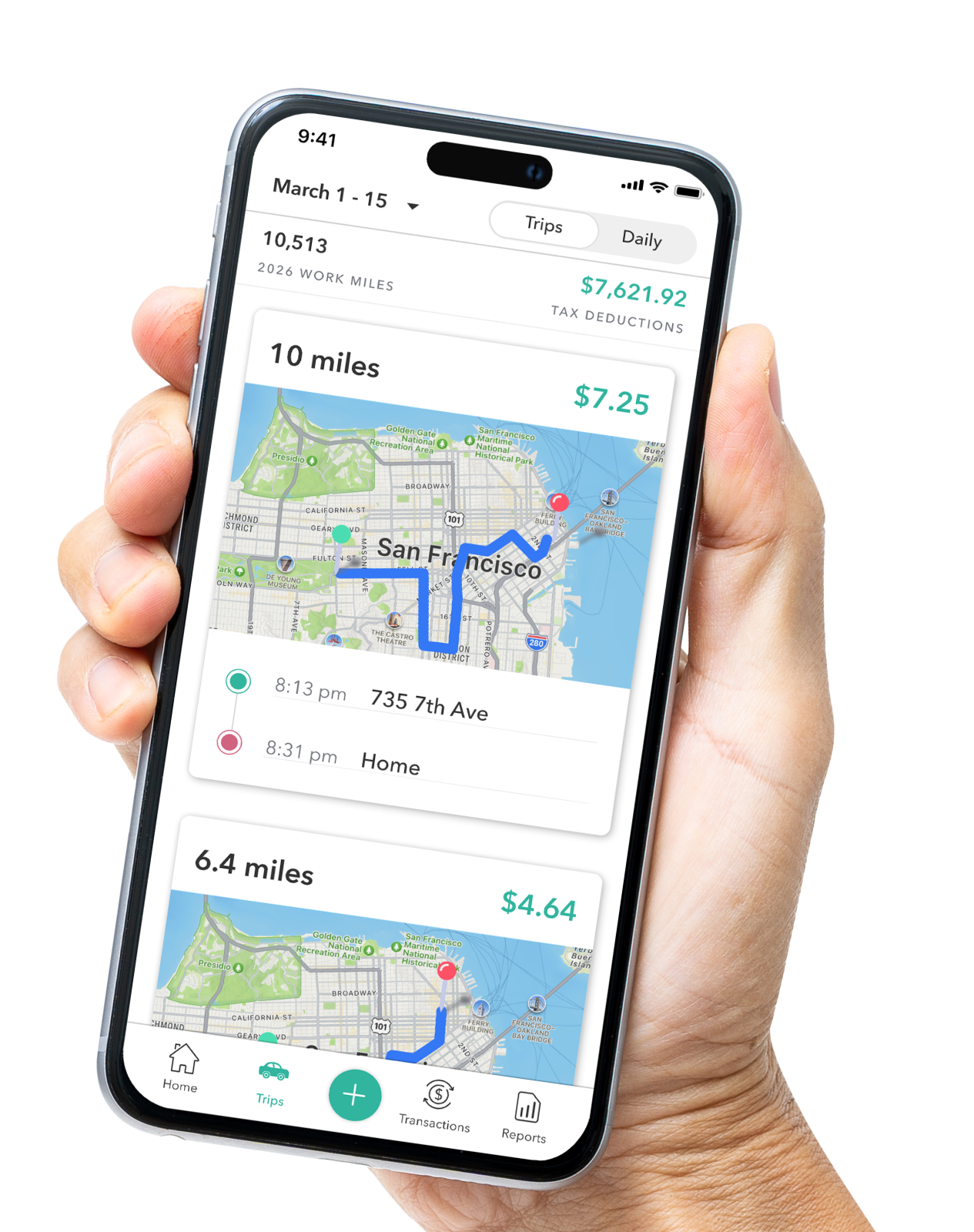
While AI helps you organize and estimate your taxes, Everlance automatically tracks your miles and expenses in real time, giving every AI tool accurate data to work with.



.webp)

.svg)


.svg)
