How the 2025 IRS mileage rate works, who can claim it, and what records you need to keep.
The good news: the IRS gives you a straightforward way to deduct the cost of driving your car for business, and for 2025, the rate went up. The bad news: most people either claim the wrong amount, keep sloppy records, or miss deductible trips entirely, leaving real money on the table. Whether you're a rideshare driver, a real estate agent, or a small business owner who racks up thousands of miles a year, understanding exactly how the 2025 IRS mileage rate works could save you hundreds or even thousands of dollars at tax time.
The IRS adjusts its standard mileage rates annually based on a study of fixed and variable costs of operating a vehicle. For 2025, the business rate is 70 cents per mile, a 3-cent increase from 2024's 67 cents. That might sound small, but if you drive 20,000 business miles a year, that bump alone is worth an extra $600 in deductions. The rest of this piece breaks down what each rate covers, who qualifies, how to choose between the standard rate and actual expenses, and exactly what records the IRS expects you to keep.

The IRS publishes standard mileage rates each year to simplify tax deductions for people who use personal vehicles for business, medical, charitable, or military-related moving purposes. These rates are meant to account for gas, insurance, depreciation, maintenance, and other ownership costs rolled into a single per-mile figure. You don't have to calculate each expense individually if you choose the standard rate: you just multiply your qualifying miles by the applicable rate.
For 2025, the IRS released its updated figures in late 2024, effective January 1, 2025. The rates reflect changes in fuel prices, vehicle maintenance costs, and depreciation trends observed over the prior year.
The 2025 standard mileage rate for business driving is 70 cents per mile. This is the rate self-employed individuals, independent contractors, and qualifying employees use when deducting vehicle expenses on their tax returns. It covers the full cost of operating a car for business purposes: fuel, oil, tires, insurance, registration, and depreciation.
Here's a quick example. Say you're a freelance consultant who drives 15,000 business miles in 2025. Using the standard rate, your deduction would be 15,000 x $0.70 = $10,500. That's a significant reduction in taxable income, and you didn't have to save a single gas receipt to claim it.
The business rate is by far the most commonly used and the most valuable. It applies to self-employed individuals filing Schedule C, as well as certain Armed Forces reservists and fee-basis government officials. W-2 employees generally cannot deduct mileage on their federal return since the Tax Cuts and Jobs Act of 2017 suspended unreimbursed employee expense deductions through 2025.
The IRS also sets rates for non-business driving. For 2025, the medical and moving rate is 21 cents per mile. The moving rate only applies to active-duty military members who are relocating due to a permanent change of station. Civilian taxpayers cannot deduct moving expenses at the federal level right now.
The charitable mileage rate remains fixed at 14 cents per mile. Unlike the other rates, this one is set by Congress, not the IRS, which is why it hasn't changed in years. If you volunteer for a qualified nonprofit and drive your own car, you can deduct those miles at this rate.
Knowing the rate is only half the battle. The real value comes from understanding which trips qualify and making sure you capture every single one. Many taxpayers undercount their deductible miles simply because they don't realize certain trips are eligible.
To claim the standard business mileage deduction for 2025, you need to meet a few basic requirements. First, you must use your vehicle for business purposes. Second, you must own or lease the vehicle: you can't claim the standard rate on a car someone else owns. Third, you cannot use the vehicle for hire, meaning fleet vehicles like taxis or buses don't qualify for the standard rate (though actual expenses may still be deductible).
One critical distinction: commuting miles are never deductible. Driving from your home to your regular workplace and back is a personal expense in the eyes of the IRS. However, if you have a home office that qualifies as your principal place of business, any drive from that home office to a client site, job location, or temporary work location counts as a business trip. This is a huge benefit for people who work from home, because essentially every work-related drive becomes deductible.
You also need to choose the standard mileage rate in the first year you place a vehicle in service for business. If you use actual expenses in year one, you're generally locked out of switching to the standard rate for that vehicle later.
Most people remember to log drives to client meetings or job sites. But plenty of qualifying trips get missed every week. Here are some commonly overlooked ones:
If you're self-employed and drive 50 miles a week on trips like these, that's roughly 2,600 miles a year, or $1,820 in deductions at the 2025 rate. Those small trips add up fast.
The IRS gives you two ways to deduct vehicle expenses: the standard mileage rate or the actual expense method. Choosing the right one can mean a difference of hundreds or thousands of dollars on your return.
The standard rate is simple. You track your miles, multiply by 70 cents, and you're done. No need to categorize gas receipts, insurance bills, or repair invoices. For most people, especially those driving relatively affordable, fuel-efficient cars, this method works well and often produces a larger deduction than actual expenses.
The downside is that it doesn't account for unusually high costs. If you had a $3,000 repair bill or your insurance premiums spiked, the standard rate won't reflect that. You also can't claim depreciation separately: it's baked into the per-mile rate.
The actual expense method requires you to track every cost related to operating your vehicle: gas, oil changes, tires, insurance, registration, loan interest, lease payments, depreciation, parking, and tolls. You then multiply the total by the percentage of miles driven for business.
This method tends to win out for people who drive expensive vehicles, have high fuel costs, or have a very high business-use percentage. For example, if you bought a $55,000 SUV and use it 90% for business, the depreciation deduction alone could exceed what you'd get from the standard rate.
Here's a rough comparison. Suppose you drove 18,000 total miles, 14,000 of which were business. Your total vehicle expenses for the year were $12,000. Under actual expenses, your deduction would be ($12,000 x 14,000/18,000) = $9,333. Under the standard rate, it would be (14,000 x $0.70) = $9,800. In this case, the standard rate wins, but shift those total expenses up to $15,000 and the actual method pulls ahead at $11,667.
Run the numbers both ways before committing. If you're in your first year with a new vehicle, consider which method gives you the bigger deduction now and in future years.
The IRS is clear: no log, no deduction. If you get audited and can't produce records, your mileage deduction gets thrown out entirely. Good tracking habits aren't optional.
The IRS requires what it calls "contemporaneous" records, meaning you should log trips at or near the time they happen, not reconstruct them from memory in April. For each business trip, your log needs to include:
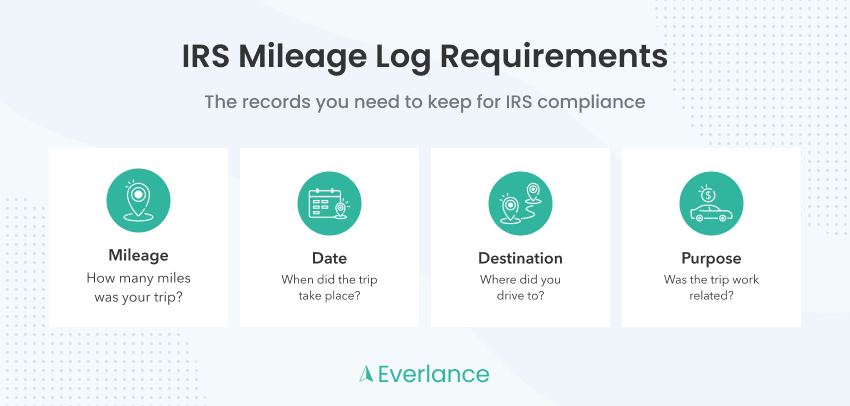
A vague entry like "drove around for work" won't survive an audit. Compare that to "March 12: Drove from home office to ABC Corp, 14 miles, client proposal meeting." The second version is what the IRS wants to see.
You should also keep records of your odometer reading at the start and end of the tax year. This helps establish your total miles driven and your business-use percentage.
You can keep a paper mileage log, and the IRS will accept it. But honestly, manual logs are error-prone and tedious. People forget to write trips down, lose their notebooks, or round numbers in ways that look suspicious during an audit.
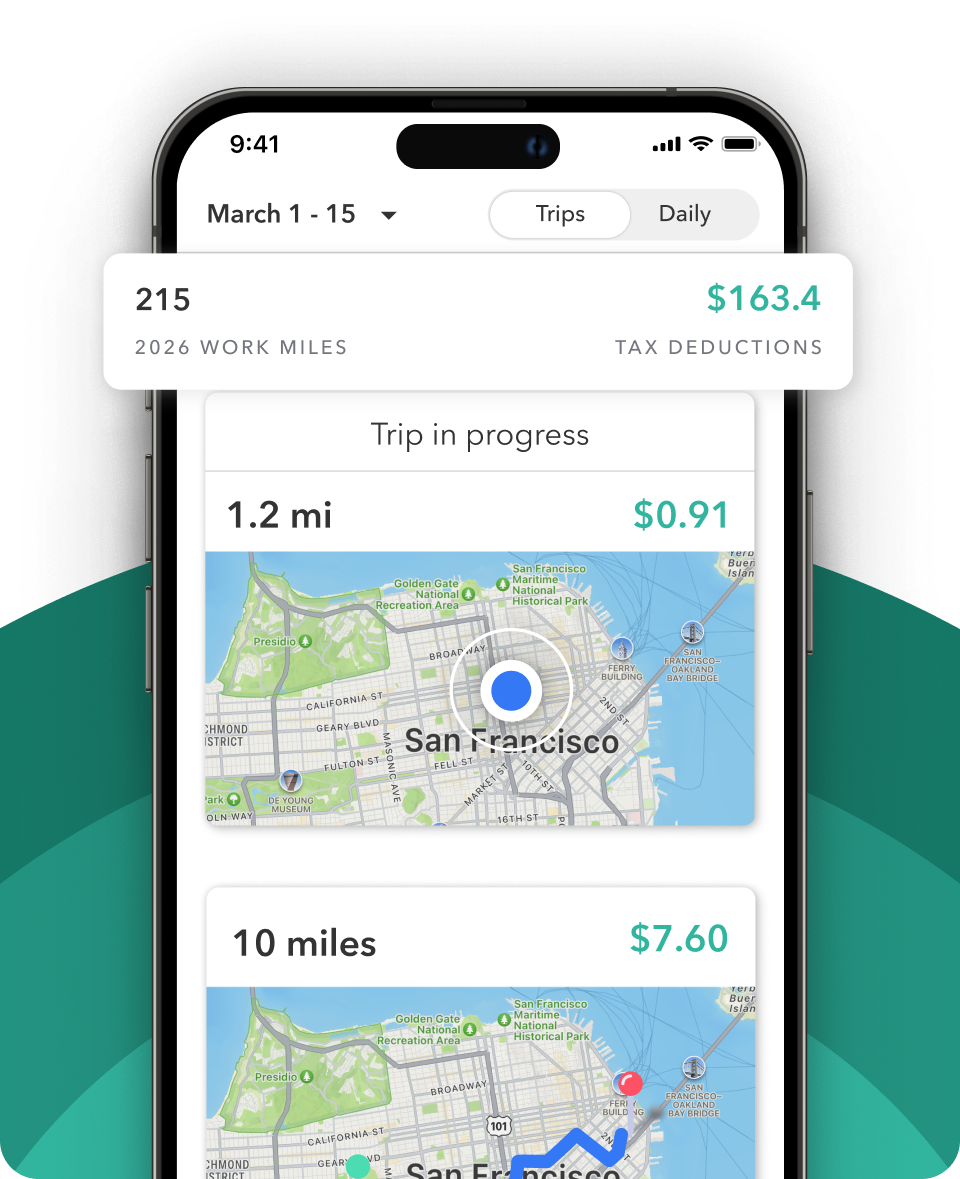
Digital mileage tracking apps solve most of these problems. GPS-based apps automatically detect when you're driving and log the route, distance, date, and time. You just swipe to classify a trip as business or personal. The best apps also sync with accounting software, generate IRS-compliant reports, and back up your data to the cloud.
If you do stick with a manual log, set a weekly reminder to review and update it. Back up your records by photographing your logbook pages or scanning them to a digital file. The worst outcome is losing a year's worth of records to a spilled coffee or a misplaced notebook.
Not all vehicles are treated equally under the tax code. The type of car you drive can affect both your deduction amount and which method makes more financial sense.
Electric vehicles (EVs) and plug-in hybrids qualify for the standard mileage rate just like gas-powered cars. The 70 cents per mile rate applies regardless of fuel type. However, EV owners should think carefully about whether the standard rate or actual expenses produces a better result.
EVs have lower fuel costs (electricity is cheaper per mile than gasoline) and lower maintenance costs (no oil changes, fewer brake replacements). This means the actual expense method might produce a smaller deduction for EV owners compared to what the standard rate offers. On the flip side, EVs often have higher purchase prices, which means higher depreciation, potentially tipping the balance back toward actual expenses for expensive models.
There's also the federal EV tax credit to consider. The credit (up to $7,500 for qualifying new EVs in 2025) is separate from mileage deductions and doesn't reduce your depreciable basis if you claim the standard mileage rate. But if you use actual expenses, the credit could interact with your depreciation calculations. Talk to a tax professional if you're claiming both.
Heavier vehicles over 6,000 pounds gross vehicle weight rating (GVWR) may qualify for accelerated depreciation under Section 179, which can dramatically increase first-year deductions under the actual expense method. This is why many business owners choose full-size SUVs and trucks: the tax math can be very favorable.
Your 2025 mileage deductions will be claimed on your 2025 tax return, which is due April 15, 2026. If you file for an extension, the deadline moves to October 15, 2026, but any taxes owed are still due by April 15.
Self-employed taxpayers report mileage deductions on Schedule C (line 9 for car and truck expenses). If you're using the actual expense method, you'll also need to complete Part IV of Form 4562 for depreciation. Make sure your mileage log is finalized before you file: reconstructing records after the fact is both stressful and risky.
If you haven't been tracking your miles consistently this year, start today. Even partial records are better than none, and most digital tracking apps let you add missed trips manually if you have calendar entries, GPS history, or receipts to support them.
For anyone tired of scrambling at tax time, Everlance makes mileage tracking automatic. The app uses GPS to detect and log your drives in real time, generates IRS-ready reports, and has helped over 3 million drivers ditch paper logs for good. Get started with Everlance and stop leaving deductions on the table.
Generally, no. The Tax Cuts and Jobs Act suspended unreimbursed employee expense deductions for W-2 workers through 2025. Exceptions exist for Armed Forces reservists, fee-basis government officials, and qualifying performing artists. Some states still allow the deduction on state returns.
Tolls and parking fees related to business travel can be deducted separately, on top of the standard mileage rate. They are not included in the per-mile figure.
If you used the standard mileage rate in the first year you placed your car in service for business, you can generally switch between methods in later years. If you started with actual expenses, you're typically locked into that method for that vehicle.
You can only deduct the business portion. Track your total miles and your business miles separately. Your business-use percentage determines how much you can deduct.
If your employer reimburses you under an accountable plan at or below the IRS rate, you don't owe taxes on the reimbursement and don't need to claim a deduction. You should still keep a log to substantiate the reimbursement to your employer.
The IRS doesn't set a cap on deductible business miles. However, an unusually high number relative to your income or profession could trigger closer scrutiny, so accurate records are essential.
Now that you know the 2025 IRS mileage rates, stay ahead for the year ahead. Visit our comprehensive guide to the IRS Mileage Rates 2026 to see the latest rates, updated deduction rules, and what changes you need to know before you file.



.svg)
