Every year, freelancers get blindsided by a tax bill they never saw coming. The income feels great when it lands in your account, but without an employer withholding taxes from each paycheck, the full burden lands on you.
So how much should you set aside? The short answer: 25% to 30% of your net income, meaning your revenue after business expenses. That range covers federal self-employment tax, federal income tax, and state income tax for most freelancers. Your exact number depends on your income, where you live, and how many deductions you claim.
Take your gross freelance income, subtract legitimate business expenses, and apply 25% to 30% to what is left. That remainder is your net self-employment income.
Example: You earn $60,000 in freelance revenue and have $12,000 in deductible expenses. Your net income is $48,000. Setting aside 28% means moving $13,440 into a separate savings account over the year. That is a lot, but far less painful than scrambling for it in March.
Nine states have no personal income tax in 2026: Alaska, Florida, Nevada, New Hampshire, South Dakota, Tennessee, Texas, Washington, and Wyoming. Freelancers there can aim for the low end. California's top rate is 13.3%, though it applies only above $1 million, and most freelancers face a 9.3% marginal rate. New York's top state rate is 10.9%, with New York City adding up to 3.876%. In high-tax states, budget toward the top of the range.
To see why the range works, take a single freelancer with $70,000 in net self-employment income and no other deductions. SE tax comes to about $9,891. After deducting half of that and the $16,100 standard deduction, taxable income is roughly $48,955, which produces about $5,627 in federal income tax. That totals $15,517, or 22.2% of net income, before any state tax. Add a 5% state rate ($3,500) and the total reaches about $19,017, or 27.2%. The QBI deduction could lower it further, which is why 25% to 30% is a sound target.
A percentage only works if the money actually moves. Open a separate savings account used only for taxes, and transfer your set-aside amount within a day or two of every client payment. Treat it like a bill that was never yours to spend. Review the balance each quarter against your estimated payment, and adjust the percentage if your income or deductions change.
The biggest shock for new freelancers is not income tax. It is self-employment tax, because employees never see the full picture. In 2026 the rate is 15.3%, made up of:
● Social Security: 12.4% on net earnings up to $184,500 (up from $176,100 in 2025)
● Medicare: 2.9% on all net earnings, with no cap
● Additional Medicare tax: 0.9% on earnings above $200,000 for single filers ($250,000 for joint filers)
When you had a W-2 job, you paid 7.65% and your employer paid the other 7.65%. As a freelancer, you pay both halves. The IRS softens this slightly: you can deduct half of your SE tax when calculating adjusted gross income, which lowers the income taxed at your federal rate.
Example at $50,000 net income: SE tax is calculated on 92.35% of net earnings, so $50,000 x 92.35% = $46,175. Multiply by 15.3% and you owe $7,065. Half of that, $3,532, is deductible. For a full walkthrough, see Everlance's self-employment tax guide.
You also owe federal income tax on your profits, using the same progressive brackets as everyone else. Here are the 2026 brackets for single filers (source: IRS Rev. Proc. 2025-32).
Progressive means you do not pay 22% on everything once you cross into that bracket. You pay 10% on the first $12,400, 12% on the next portion, and 22% only on dollars above $50,400. A single freelancer with $70,000 in taxable income has a 22% marginal rate but an effective federal rate closer to 14% to 15%.
The 2026 standard deduction is $16,100 for single filers and $32,200 for married couples filing jointly (up from $15,750 and $31,500). You claim it alongside your Schedule C business deductions, not instead of them.
The best way to lower your bill is to shrink your net income through self-employment tax deductions. Every deductible dollar cuts both your SE tax and your income tax. Common freelancer deductions include:
● Business mileage at the IRS standard rate, often the largest deduction for anyone who drives to clients
● Home office costs, including a share of rent or mortgage interest, utilities, and internet
● Health insurance premiums if you pay your own coverage (see how to write off health insurance premiums)
● Software, phone, and internet, based on business-use percentage
● Professional development such as courses and certifications, plus equipment like computers and cameras used for your business.
● Retirement contributions to a SEP-IRA or Solo 401(k)
Expenses must be "ordinary and necessary" for your work. For the complete list, see 25 freelancer tax write-offs.
If your work involves driving, mileage is often your largest deduction. The 2026 IRS standard mileage rates (full rate history and mid-year update details) are:
● January 1 to June 30: 72.5 cents per mile
● July 1 to December 31: 76 cents per mile (a rare mid-year increase driven by rising fuel and vehicle costs)
Here is what 12,000 business miles is worth, split evenly across the year:
At a 30% combined marginal rate, that is nearly $2,700 in tax savings. Use the free mileage deduction calculator to see what your own driving is worth.
Not every drive counts. Trips to client sites, supply runs, and meetings are deductible. Your ordinary commute to a regular workplace is not. If you have a qualifying home office, trips from home to a client generally count as business miles.
There is a catch: the IRS requires a contemporaneous mileage log, recorded at or near the time of each trip rather than reconstructed in March. Each entry needs the date, destination, business purpose, and miles driven. See the full IRS mileage log requirements.
If you use part of your home regularly and exclusively for business, you can deduct a share of housing costs. The simplified method allows $5 per square foot up to 300 square feet, a maximum of $1,500. The regular method applies your office's percentage of your home to actual rent, utilities, and insurance, which often yields more in high-rent markets. A spare room used only for work qualifies. The dining table does not. Keep the square footage measurement and related bills on file in case of questions.
Freelancers pay taxes quarterly instead of through paycheck withholding. Miss a deadline and you owe a penalty for that quarter, even if you pay everything by April.
Q2 covers only two months while Q3 covers three, which trips up many freelancers. You can pay through IRS Direct Pay (free, no account needed), EFTPS, or by mailing Form 1040-ES.
If you owe more than $1,000 at filing and underpaid during the year, the IRS charges interest on the shortfall, running 6% to 7% annualized in 2026. Two safe harbor rules keep you penalty-free:
● Pay 90% of this year's tax liability in roughly equal installments, or
● Pay 100% of last year's tax liability (110% if your prior-year AGI exceeded $150,000)
With variable income, the second option is simpler: take last year's tax bill and split it across four payments.
With 2026 winding down, a few steps can still lower your bill. First, total your business expenses so far and pay any outstanding deductible costs before December 31. Second, consider retirement contributions: Solo 401(k) employee deferrals generally need to happen by year-end, while SEP-IRA contributions can usually be made up to your filing deadline. Third, review your mileage log for gaps and fill them in while the trips are still fresh. Finally, compare your year-to-date net income against the estimated payments you have made, so the January 15 deadline holds no surprises.
The QBI deduction is permanent. The One Big Beautiful Bill Act (OBBBA), signed in July 2025, made the Qualified Business Income deduction permanent. Eligible self-employed workers can deduct up to 20% of qualified business income, and the full deduction generally applies below roughly $201,775 of taxable income for single filers. Many freelancers in fields like design, writing, and development qualify, yet it is one of the most overlooked deductions available. Higher earners and certain service professions face limits, so confirm your eligibility before relying on it.
The standard deduction rose again to $16,100 for single filers, up $350 from 2025, on top of your Schedule C write-offs.
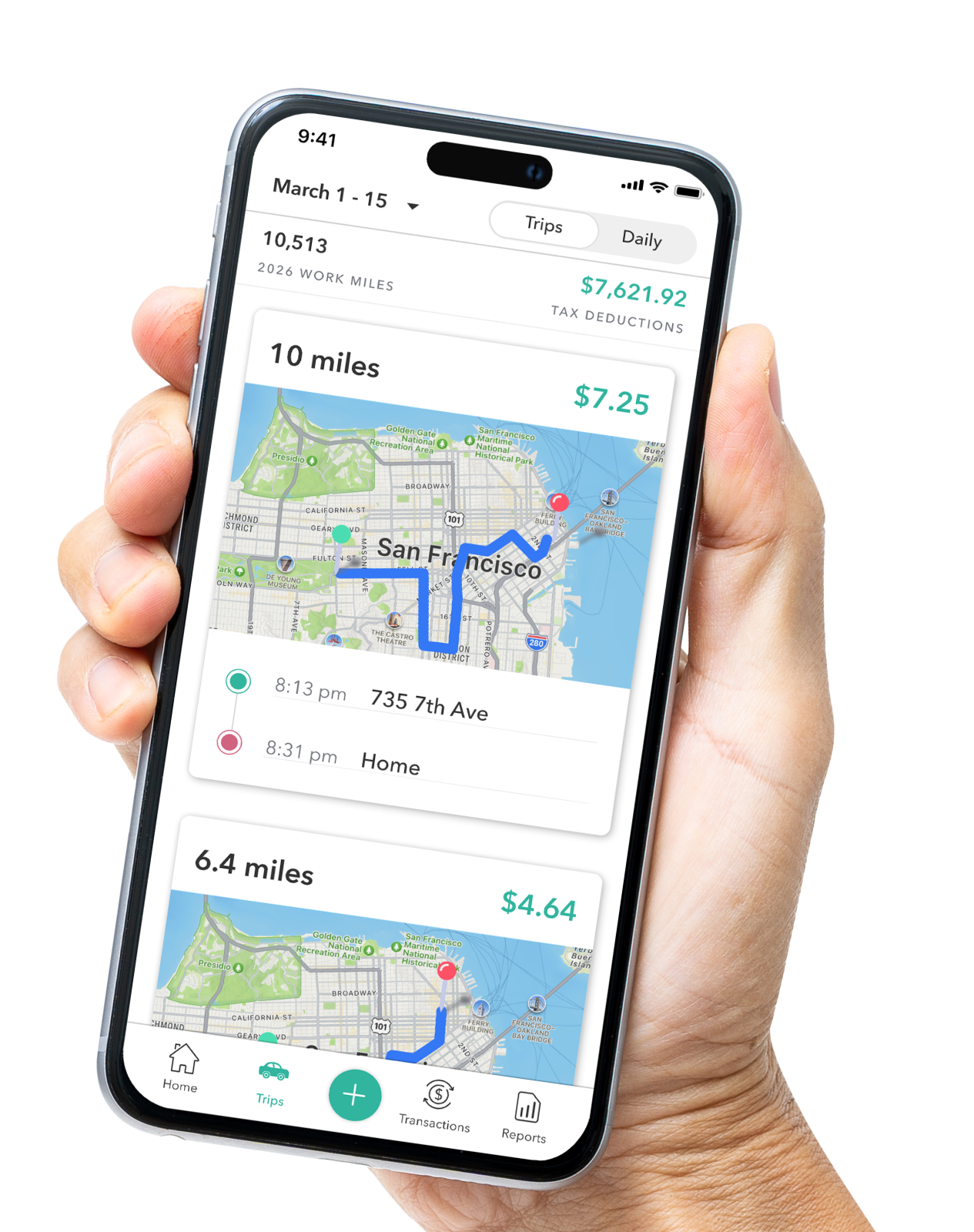
Knowing your percentage is step one. Step two is keeping the records to capture every deduction before April. Most freelancers lose money not because deductions do not exist, but because they did not track consistently. At 72.5 to 76 cents per mile, 10,000 documented business miles is worth $7,250 to $7,600. Undocumented miles are worth nothing. Start now, and by April you will have a complete record instead of a stack of guesses.
Find out how much to set aside for taxes and start planning your freelance savings today.




.webp)

.svg)




.svg)
