Ask a group of traveling nurses about their biggest tax confusion and the same phrase comes up again and again: tax home. Nurses who have been on the road for years sometimes do not fully understand what it means. New travelers often have never heard the term at all. Yet your tax home status is the single most consequential factor in your entire tax picture as a traveling nurse.
Whether your housing stipend is tax-free or fully taxable. Whether your facility commutes are deductible. Whether you can claim housing costs as a business expense. Whether your meals on assignment are deductible. All of it flows from one foundational question the IRS asks: do you have a valid tax home, and are you genuinely traveling away from it?
This guide explains what a tax home actually is under IRS rules, how to establish and maintain one, what documentation you need to protect it in an audit, and exactly how it unlocks the deductions and tax-free benefits that make travel nursing financially advantageous. For a full breakdown of every qualifying drive once your tax home is established, the mileage deductions for traveling nurses page covers every trip category with a free savings estimator.
The IRS defines your tax home as the general area of your main place of business, employment, or post of duty, regardless of where you maintain your family home. For most W-2 employees, the tax home is simple: it is wherever their employer is located. For traveling nurses, who move from assignment to assignment across multiple states and facilities, the definition is more nuanced and significantly more consequential.
A tax home is not necessarily where you sleep or where you keep your personal belongings. It is the location you are considered to work from on a regular basis for tax purposes. For a traveling nurse to maintain a valid tax home, the IRS generally looks for three indicators: you have established a permanent residence at a specific location, you incur duplicated living expenses when you travel for work (meaning you are still paying costs at home while paying for housing at the assignment location), and your presence at the assignment locations is temporary rather than indefinite.
This distinction matters enormously. A nurse with a valid tax home away from their assignment location is considered to be traveling for work on every contract. That travel status is what makes housing stipends tax-free, makes assignment-location living expenses deductible, and qualifies every drive from temporary housing to a facility as a deductible business mile under the IRS standard mileage rate.
If you have no valid tax home: every dollar of housing stipend you receive becomes ordinary taxable income. Your lodging and meal expenses at the assignment location are personal expenses, not business deductions. And your mileage deductions may be limited. The financial difference between having a valid tax home and not having one can easily reach $10,000 to $20,000 per year for a full-time traveler.
The IRS applies a three-factor test when evaluating whether a traveling nurse has a valid tax home. You do not need to pass all three, but the more factors you satisfy, the stronger your position. Courts and the IRS weigh these factors together, so a nurse who fails two of them is at real risk of having their tax home disallowed.
This factor is satisfied when you perform some portion of your nursing work in the area of your permanent residence - for example, picking up per diem shifts at a local hospital between travel contracts, maintaining active staff nursing privileges at a facility near your home, or conducting telehealth or chart review work remotely from your permanent address. Nurses who only work on travel contracts and do zero work near their permanent home score weakly on this factor.
This is the most commonly cited and most important factor. You must be able to demonstrate that when you are on assignment, you are paying for housing at two locations simultaneously: your permanent home (mortgage, rent, utilities, insurance) and your temporary housing at the assignment location. If you rent out your home during every assignment, eliminate your permanent housing costs between contracts, or have no ongoing financial obligation to a fixed location, this factor is weakened or eliminated.
The IRS looks at whether you have treated a location as your regular home over time. This includes where you are registered to vote, where your driver's license and vehicle registration are issued, where your bank accounts and professional nursing licenses are registered, where your immediate family lives, and whether you return to that location between contracts. Nurses who have not lived at their permanent address for years, who have moved their legal identity to a new state, or who have no ongoing ties to a specific location face significant challenges on this factor.
The practical takeaway: most traveling nurses who are new to the profession and moving straight into full-time contract work need to actively and deliberately establish their tax home before their first assignment begins. It cannot be created retroactively at tax time.
Because the tax home rules are situational rather than black-and-white, nurses encounter many variations. The table below covers the five most common scenarios and their tax implications.
Your tax home status and your mileage deduction are directly connected through a single IRS rule: the commuting rule. Under this rule, driving from your home to a regular, fixed place of business is a non-deductible personal commute. But when your home is your tax home and your assignment facility is a temporary work location away from it, the analysis changes entirely.
When you are a traveling nurse working under a temporary assignment contract - typically 13 weeks or less at a single location - the IRS treats your assignment facility as a temporary work location, not a regular place of business. That classification means every drive from your temporary housing to the facility is a deductible business trip, not a commute. The same applies to every other business drive during the assignment: agency meetings, supply runs, licensing appointments, and continuing education courses.
The financial impact is significant. A traveling nurse commuting 20 miles each way to a facility and working three 12-hour shifts per week accumulates over 3,000 deductible miles per 13-week contract. At the current IRS standard mileage rate, that single category of driving generates over $2,000 in deductions per contract, or more than $8,000 per year for a nurse on back-to-back assignments. None of those deductions exist without a valid tax home.
For a complete breakdown of every qualifying trip type and a free savings estimator built specifically for traveling nurses, see the mileage deductions for traveling nurses page.
The tax-free stipend is the financial centerpiece of most travel nursing packages. Agencies typically structure compensation as a combination of taxable hourly wages and non-taxable stipends for housing, meals, and incidentals. For a nurse on a standard 13-week contract, the non-taxable portion can represent $1,000 to $2,500 per week in effectively tax-free compensation.
Whether those stipends are actually tax-free depends entirely on your tax home status. The IRS allows non-taxable travel reimbursements only when a worker is temporarily away from their tax home for business purposes and incurring duplicate living expenses. If you do not have a valid tax home, you are not traveling away from it - and reimbursements for housing and meals become ordinary income that must be reported and taxed.
A nurse earning a $1,500 per week housing stipend over 48 working weeks per year receives $72,000 in stipends annually. If that nurse has a valid tax home, the entire amount may be tax-free. If they do not, the entire $72,000 is added to their taxable income. At a combined 30% effective tax rate, that is $21,600 in additional taxes per year. This is why tax home planning is not a minor consideration for traveling nurses - it is the most important financial decision in their career.
The 12-month rule: if you work at a single location for more than one year — or expect your assignment to last more than one year at the time it begins — the IRS treats that location as your regular place of business, not a temporary one. Your tax home shifts to the assignment location, and stipends for that assignment become taxable. Always structure contracts with this rule in mind, and work with a CPA experienced in travel nursing if you are considering extended placements.
The majority of traveling nurses are classified as W-2 employees through staffing agencies, not as independent contractors. This is an important distinction because it affects both what you can deduct and how stipends are structured.
As a W-2 traveling nurse, your agency includes stipends as non-taxable allowances on your W-2 (shown in box 12 with specific codes) when you have a valid tax home. Since the Tax Cuts and Jobs Act of 2017, W-2 employees cannot deduct unreimbursed business expenses on their federal return, which means your mileage is only deductible if you are classified as an independent contractor or if your agency reimburses it.
Independent contractor traveling nurses who receive 1099 income have a broader deduction landscape. They file Schedule C and can deduct mileage, licensing fees, professional supplies, continuing education, and a home office if they qualify. The tax home concept applies to both classifications, but the downstream deduction strategy differs significantly. Use the free 1099 tax calculator to see how your classification affects your estimated tax bill.
If you are unsure whether you are classified as a W-2 employee or an independent contractor, the distinction has major tax consequences. The full breakdown of how W-2 vs. 1099 classification affects nurses is covered in detail, including which deductions are available under each status.
A tax home that exists on paper but cannot be proven in an audit is effectively no tax home at all. The IRS has the right to challenge your tax home status, and traveling nurses - who claim large stipend exclusions and multi-state mileage deductions - are not an uncommon audit target. The documentation below is your defense.
Keep all of this documentation organized and accessible year-round, not just at tax time. If the IRS questions your tax home status in an audit, you will need to produce these records quickly. A shoebox of receipts assembled in March is not a contemporaneous record in the IRS's view.
Not establishing a tax home before the first assignment. The tax home must exist before you depart. Many new travelers set up their first contract, move to the assignment location, and then try to designate their home city as the tax home after the fact. The IRS does not allow retroactive tax home creation.
Renting out the permanent residence during every assignment. Renting your home between contracts eliminates the duplicate expense argument and signals to the IRS that you do not maintain an ongoing economic interest in the location. If you choose to rent your home during assignments, you must demonstrate other strong ties to the location and ongoing costs you bear regardless.
Taking an assignment in the same area as the permanent home. If your permanent home is in Chicago and you take an assignment at a Chicago hospital, you are not traveling away from your tax home - you are commuting to work. The stipends for that assignment are taxable, and the commute miles are not deductible.
Extending a single assignment beyond 12 months. As soon as an assignment is realistically expected to last more than one year, the tax home shifts to the assignment location. This is one of the most expensive mistakes in travel nursing, and it happens most often when nurses informally agree to extend beyond the stated contract end date without considering the tax implications.
Failing to track mileage during assignments. Even with a perfect tax home, a nurse who does not maintain a contemporaneous mileage log loses every deductible mile. The IRS requires documentation of each trip's date, starting location, destination, business purpose, and miles driven. Without it, the deduction does not exist regardless of tax home status. The mileage deductions for traveling nurses page covers the full IRS log requirements and how automatic GPS tracking satisfies them.
Not working with a CPA who specializes in travel nursing. Travel nursing tax returns involve multi-state income, tax home analysis, stipend reporting, mileage deductions across multiple assignment locations, and potential 1099 vs. W-2 classification questions. This is not a standard return. An accountant who understands the travel nursing tax structure will save you far more than their fee. The full picture of what nurses can deduct is covered in the complete tax deductions guide for nurses.
Once your tax home is established and documented, your mileage log becomes the mechanism that captures every deduction it unlocks. The IRS requires contemporaneous records - meaning every trip logged at or near the time it happens, not reconstructed after the fact. Each entry must include the date, starting and ending location, business purpose, and miles driven.
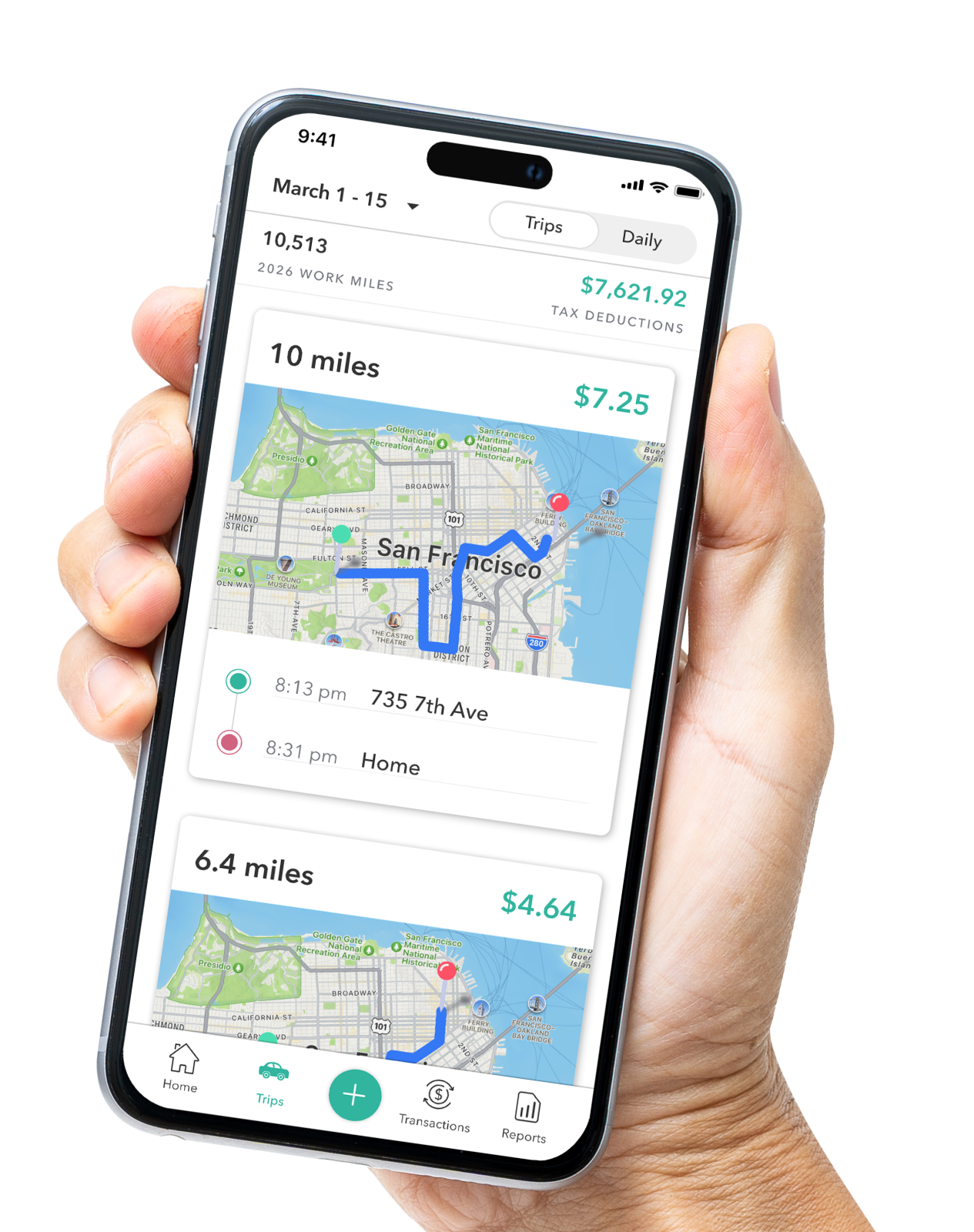
For a traveling nurse in the middle of a 13-week contract, this means logging every shift commute, every supply run, every agency check-in, every licensing appointment, and every continuing education drive. These are not occasional trips - they are the daily fabric of the job. An automatic GPS mileage tracker captures all of them without any manual effort, timestamps and geo-verifies every entry, and generates an IRS-compliant report at year-end with one tap.
Nurses who track consistently and have a solid tax home documentation file come to tax time with two things: a report that maximizes their deduction and a foundation that survives scrutiny. Those who reconstruct logs from memory in April and whose tax home status is vague and undocumented are at risk of losing both their mileage deductions and their stipend exclusions in an audit. Use the Everlance deduction finder to surface additional deductions beyond mileage that traveling nurses regularly overlook.
A valid, well-documented tax home is not a technicality - it is the legal foundation that makes the travel nursing financial model work. Without it, you are a worker who moves between jobs. With it, you are a business traveler whose entire assignment structure qualifies for the tax treatment designed for temporary workers away from their regular place of business.
In practical terms, that means tax-free stipends that can add $50,000 to $100,000 in untaxed compensation over a career, deductible mileage across every assignment that can reach $8,000 to $12,000 in annual deductions, housing and meal expense deductions that reduce your taxable income further, and the ability to structure your contracts in ways that maximize tax-free benefits without running afoul of the IRS.
The nurses who build the most financially successful travel careers are not necessarily the ones who take the highest-paying contracts. They are the ones who understand their tax obligations, document their tax home airtight, track every deductible mile, and work with a CPA who speaks their language. Start with your mileage - it is the most immediately actionable piece. The mileage deductions for traveling nurses page breaks down every qualifying trip type, the current IRS rate, and includes a free savings estimator built specifically for your situation.
Traveling Nurses: your tax home determines if your housing stipend is taxable or free.




.webp)

.svg)


.svg)
