The IRS mileage rate, sometimes referred to as the federal mileage rate or mileage reimbursement rate, is one of the most important tax deductions for anyone who drives for work, whether you’re a freelancer, rideshare driver, or small business owner. The IRS adjusts the mileage rate annually to reflect the costs of operating a vehicle, such as gas prices and vehicle maintenance.
For 2026, the IRS business mileage rate increased to 76 cents per mile, the highest rate in recent years. This change can significantly impact how much you can deduct on your taxes. In this guide, we’ll break down the 2026 mileage rates, explain how they’re calculated, and share tips to maximize your deductions.
IRS Mileage Rates 2026
2026 IRS Mileage Rate
After announcing December 29, 2025 that the standard mileage rate for business miles will increase by 2.5 cents in 2026, the IRS announced a rare mid-year adjustment to account for the rising costs drivers were facing, increasing the rate an additional 3.5 cents starting July 1.
IRS Mileage Rates 2026
Rate Category
Jan 1 – Jun 30, 2026
Jul 1 – Dec 31, 2026
Business
72.5¢ per mile
76¢ per mile ↑ +3.5¢
Medical / Moving
20.5¢ per mile
23.5¢ per mile ↑ +3¢
Charitable
14¢ per mile
14¢ per mile Unchanged
Source: IRS Announcement 2026-11 · IRS.gov Standard Mileage Rates (updated July 28, 2026)
The IRS issued a rare mid-year adjustment effective July 1, 2026 (Announcement 2026-11), raising the business rate from 72.5¢ to 76¢ and the medical rate from 20.5¢ to 23.5¢. The charitable rate is set by statute and cannot be adjusted mid-year.
The increase for 2026 is largely driven by higher transportation expenses across the board. Fuel prices have remained volatile, vehicle maintenance and repair costs continue to rise, and insurance premiums and financing costs are higher than they were just a few years ago. When combined with ongoing increases in vehicle depreciation, these factors pushed the IRS to raise the standard mileage rate to better match what drivers are actually spending out of pocket. In short, the higher 2026 rate is meant to keep mileage deductions aligned with the true cost of driving for work
What This Means for You
Here’s how the new rates impact your expense tracking and deductions:
✅ Business owners & contractors: Higher deduction values for driving can mean more write-offs and lower taxable income, especially if you use your vehicle frequently for work.
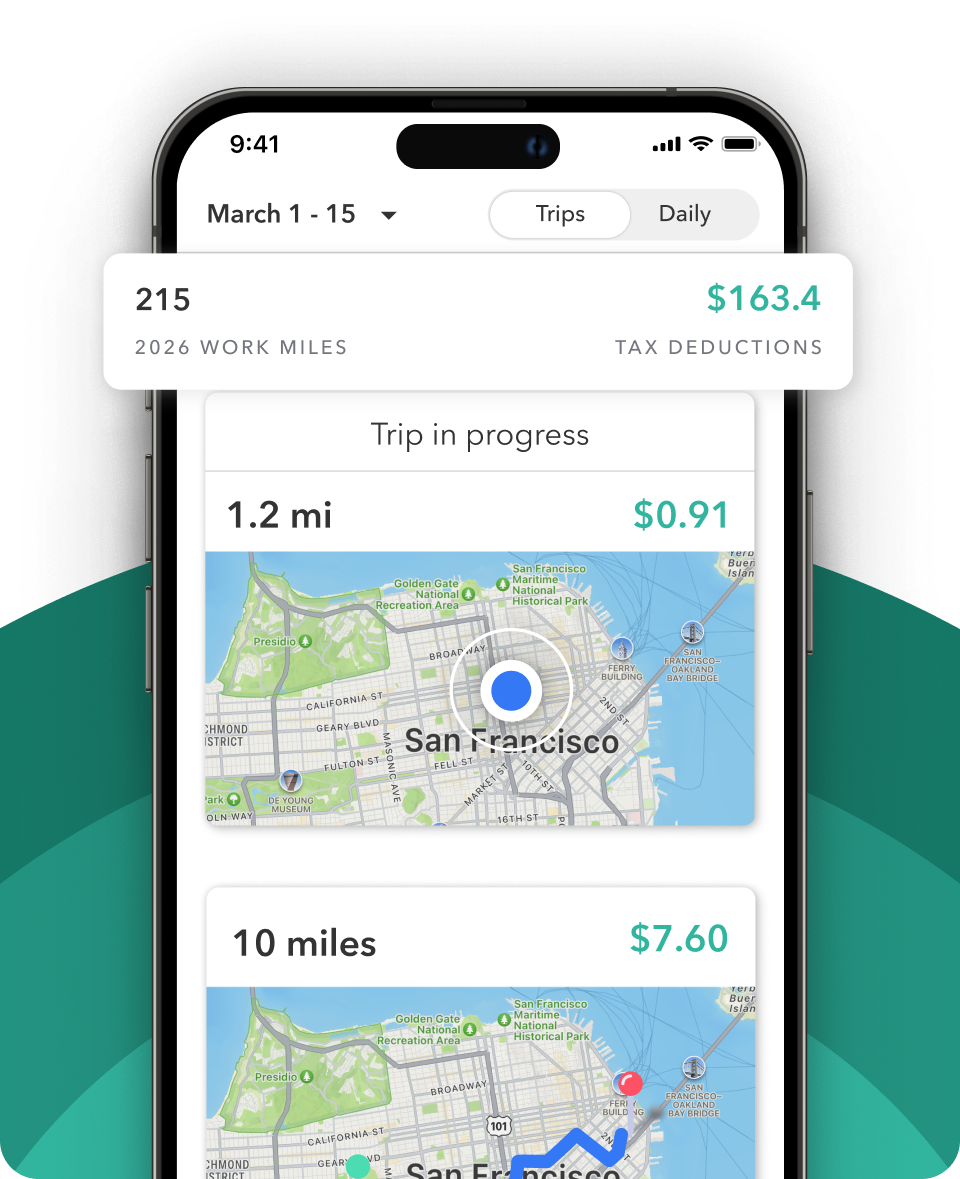
✅ Freelancers & gig workers: Apps like Everlance track mileage automatically, so you won’t miss out when rates change, it’ll calculate 76 cent per mile rate instead of the old rate.
✅ Employees with allowable deductions: While some employee travel deductions are limited under current tax law, charitable and medical mileage still count for itemized deductions where allowed.
Calculating your mileage deduction
It's important to understand how to calculate your deductions using the IRS mileage rate for 2026. To do this, simply multiply the number of business miles driven by the standard mileage rate for business use. For medical or moving purposes, multiply the number of qualifying miles by the applicable rate. And for charitable use, the deduction is based on the charitable mileage rate.
For example, let's cover some simple math:
If you drive 10,000 miles for work in 2026, your deduction would be 10,000 miles × 76 cents = $7,600 deduction.
Remember to keep detailed records of your mileage and the purpose of each trip to support your deduction claims in case of an IRS audit. We'll cover more on that below.
Federal mileage rate history over the past decade
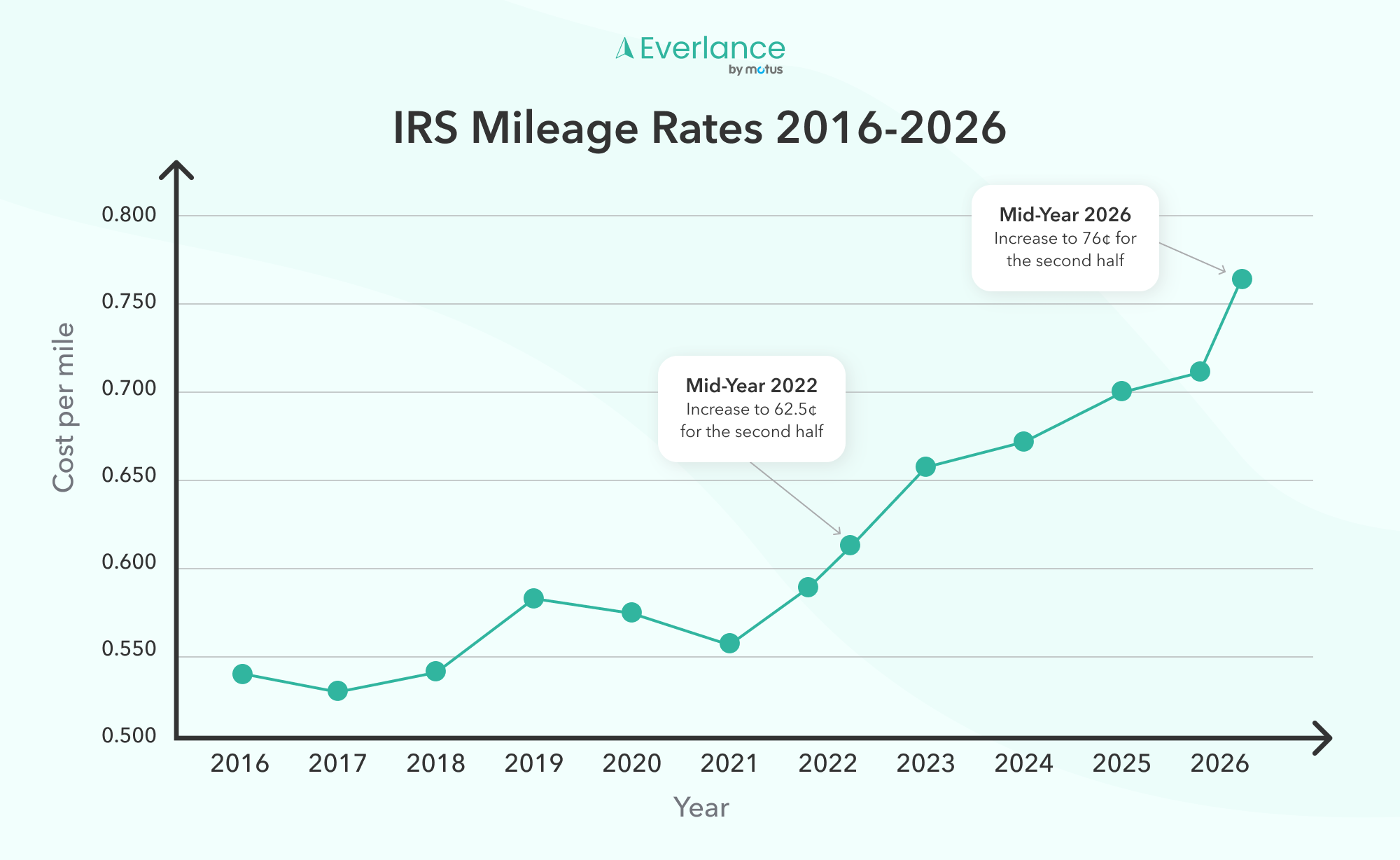
Looking back over the last decade of IRS standard mileage rates provides helpful context on how rates can fluctuate based on inflation, fuel prices, and other cost factors:
The IRS mileage rate from 2014-2026
2014 - 56 cents per mile 2015 - 57.5 cents per mile 2016 - 54 cents per mile 2017 - 53.5 cents per mile 2018 - 54.5 cents per mile 2019 - 58 cents per mile 2020 - 57.5 cents per mile 2021 - 56 cents per mile 2022* - 58.5 cents/62.5 cents per mile 2023 - 65.5 cents per mile 2024 - 67 cents per mile 2025 - 70 cents per mile 2026* - 76 cents per mile/72.5 cents per mile
*In 2022, the IRS mileage rate was raised from 58.5 cents to 62.5 cents for the second half of the year.
*In 2026, the IRS mileage rate was raised from 72.5 cents to 76 cents per mile for the second half of the year.
Rates trended lower between 2016 and 2018 due to low national gas prices and modest inflation. However, in recent years, the rate has gone up due to a reverse in those same factors. Higher rates better reflect the true costs that drivers are incurring for business transportation when gas and overall consumer prices are elevated.
When it comes to calculating the current mileage rate, there are a few key factors to consider. Whether you're a business owner reimbursing employees for travel or an individual looking to deduct mileage on your taxes, understanding the current rate is essential. Though based on thorough data analysis, IRS mileage rates are inherently estimates. Many variables influence transportation costs annually. Key factors that can impact rate changes include:
Gas prices - As the major cost is tied directly to mileage, fuel price fluctuations significantly sway annual rates. Unexpected gas price spikes or plunges alter projections.
Vehicle maintenance - Rises in parts, labor, and tire costs lead to rate increases to cover the gap. Improvements become headwinds.
Insurance premiums - Vehicle and commercial rideshare insurance pricing trends factor into the mileage deduction.
Inflation - High transportation cost inflation boosts rates. Low inflation contributes to a slower rate of growth.
Used car prices - Stronger used prices lead to higher depreciation costs factored in. Weaker prices have the opposite effect.
Tax policy - Tax code changes around business mileage could influence yearly rate decisions.
Industry factors - Wider economic or industry issues affecting personal transportation costs impact the annual analysis.
The medical and moving mileage rate is calculated differently, it reflects only the variable costs of vehicle operation (primarily fuel), which is why it is lower than the business rate. The charitable rate, currently 14 cents per mile, is set by Congress under the Taxpayer Relief Act of 1997 and can only be changed through legislation.
The IRS typically announces the following year's rate in November or December. Mid-year adjustments as in July 2022 and July 2026 occur when cost divergence becomes large enough that waiting until January would materially undercompensate drivers.
How to track mileage for business purposes
Maintaining detailed records of mileage, including dates, destinations, business purpose, and total miles driven, is crucial for accurate deductions. Utilizing modern technology, such as mileage tracking apps, can streamline the record-keeping process and ensure reliable documentation.
Moreover, embracing technology can further enhance your record-keeping efforts. Mileage tracking apps not only simplify the task of logging your trips but also provide a convenient way to store and categorize your mileage data. This digital approach not only saves time but also minimizes the risk of errors or missing information, ultimately maximizing your potential deductions.
IRS Mileage Recordkeeping Requirements
The IRS requires contemporaneous mileage records — logs created at or near the time of each trip, not reconstructed from memory weeks or months later. A mileage log rebuilt at year-end from rough estimates does not satisfy IRS documentation standards and will not support your deduction in the event of an audit.
What Every Mileage Log Entry Must Include
Per IRS Publication 463, each trip record must contain:
● Date: The date of the trip. In 2026 this field is especially important — it determines whether the 72.5¢ (H1) or 76¢ (H2) rate applies.
● Destination or total miles: The business destination address or the odometer reading at the start and end of the trip.
● Business purpose: A description of the business reason for the trip — for example, "client meeting at Acme Corp" or "delivery to warehouse." Vague entries ("work trip") may not satisfy IRS scrutiny.
● Miles driven: The number of business miles logged for the trip.
What Format the IRS Accepts
The IRS does not mandate a specific format. Acceptable mileage records include:
● A mileage tracking app with GPS-verified, timestamped trip logs (the most audit-proof format)
● A paper mileage logbook with entries made after each trip
● A spreadsheet updated regularly with the required fields
● Calendar or appointment records that document the business purpose of each drive (when combined with odometer or distance records)
IRS Mileage Rate FAQ 2026
Frequently Asked Questions About the IRS Mileage Rate
The current IRS standard mileage rate for business driving is 76 cents per mile, effective July 1, 2026. For miles driven between January 1 and June 30, 2026, the business rate was 72.5 cents per mile. The medical and moving rate is 23.5 cents per mile (July 1 onward; 20.5 cents for January through June). The charitable rate is 14 cents per mile for all of 2026, unchanged from prior years. The IRS sets rates annually in December; the 2026 mid-year adjustment is only the second in a decade.
The 2026 IRS standard mileage rate for business is 76 cents per mile (July 1 through December 31) and 72.5 cents per mile (January 1 through June 30). The IRS made a rare mid-year increase in July 2026 in response to rising fuel prices and vehicle costs. All rate categories for 2026:
Business: 72.5¢/mile (H1) and 76¢/mile (H2)
Medical / Moving: 20.5¢/mile (H1) and 23.5¢/mile (H2)
Charitable: 14¢/mile (full year, unchanged)
Self-employed individuals, freelancers, gig workers, and small business owners can use the standard mileage rate to deduct business driving costs on their tax returns. Employees can use it only for charitable or medical mileage. Unreimbursed employee business mileage is no longer deductible under current tax law (suspended through 2025 by the Tax Cuts and Jobs Act). Employers can use the IRS rate as a tax-free reimbursement benchmark: amounts paid at or below the IRS rate are not taxable income to the employee.
Qualifying business trips include travel to client or customer locations, travel between two work locations or job sites, business errands (such as trips to a bank, post office, or supply store for business purposes), and travel to temporary work locations. Commuting from home to a regular, fixed workplace does not qualify. The IRS commuting rule treats this as personal travel, not business mileage, regardless of distance.
Multiply your total qualifying business miles by the applicable IRS rate. For 2026, use 72.5 cents per mile for miles driven January 1 through June 30, and 76 cents per mile for miles driven July 1 through December 31. You must keep records for each period separately.
Example: 5,000 miles in H1 + 5,000 miles in H2 = (5,000 × $0.725) + (5,000 × $0.76) = $3,625 + $3,800 = $7,425 total deduction.
The standard mileage rate is simpler and often advantageous for high-mileage drivers, leased vehicles, and newer cars. Actual expenses — which include fuel, insurance, depreciation, repairs, and registration — may produce a larger deduction for low-mileage drivers or expensive vehicles.
The critical rule: if you choose actual expenses in the first year you place a vehicle in business service, you cannot switch to the standard mileage rate for that vehicle in later years. If you use the standard mileage rate first, you can switch to actual expenses later. Use the IRS mileage rate vs. actual expenses calculator to compare your specific situation.
The IRS requires contemporaneous mileage records — logs created at or near the time of each trip, not reconstructed from memory. Each record must include:
The date of the trip
The starting and ending location (or total miles driven)
The business purpose of the trip
The name of the client or destination when relevant
In 2026, the date field is especially important because it determines which rate (72.5¢ or 76¢) applies to each trip. The IRS accepts mileage apps, GPS logs, paper mileage books, and calendar entries. Keep records for at least 3 years from the tax return due date.
The IRS sets the standard mileage rate annually, typically in November or December, using an independent study of the fixed and variable costs of operating a personal vehicle in the United States. Motus, the parent company of Everlance, has supplied the transportation cost data used in this study since 1981.
The business rate accounts for fuel, depreciation, insurance, maintenance, and registration costs. The medical and moving rate reflects only variable costs. The charitable rate is set by statute (the Taxpayer Relief Act of 1997) and can only be changed by Congress.
The IRS mileage rate for 2025 was 70 cents per mile for business use (for the full calendar year). The medical and moving rate was 21 cents per mile. The charitable rate was 14 cents per mile. The 2026 business rate of 76 cents (H2) represents an 8.6% increase over 2025, driven by rising fuel prices and the mid-year IRS adjustment.
No. Employers are not legally required to reimburse employees at the IRS standard mileage rate — they can choose any per-mile rate. However, reimbursements paid at or below the IRS rate are non-taxable to the employee. The IRS treats them as a business expense reimbursement, not wages.
If an employer pays above the IRS rate, the excess is considered taxable income to the employee and must be reported on Form W-2. Most employers who peg their rate to the IRS standard do so to keep reimbursements tax-free and administratively simple.
Yes, if you itemize deductions and your qualifying medical expenses exceed 7.5% of your adjusted gross income. For 2026, the IRS medical mileage rate is 20.5 cents per mile for trips driven January 1 through June 30, and 23.5 cents per mile for trips from July 1 through December 31.
Qualifying medical trips include travel to doctor appointments, hospital visits, physical therapy, and pharmacy trips for prescriptions. You cannot deduct medical mileage if you take the standard deduction instead of itemizing.
The IRS increased the business mileage rate mid-year in 2026 because fuel prices, vehicle maintenance costs, and insurance premiums all rose significantly in the first half of the year, creating a material gap between the January rate (72.5¢) and actual driver costs.
Mid-year adjustments are rare: the 2026 change was only the second in a decade, the previous being July 2022. The IRS issued Announcement 2026-11 on July 13, 2026, raising the business rate to 76 cents effective July 1.



.svg)
