The IRS announced on November 5, 2026 (IR-2026-133) the official 2027 tax inflation adjustments affecting nearly 70 tax provisions. Here's what matters most if you're self-employed, drive for a gig economy platform, or run a small business:
· Standard deduction rises: Single filers get $16,600 (up $500), married couples get $33,200 (up $1,000)
· Tax brackets widen: Your income threshold for each tax rate moves higher, keeping more of your earnings in lower brackets
· Child Tax Credit increases: Maximum climbs to $2,300 (up $100)
· Retirement and HSA limits jump: More room to save pre-tax for your future
· Annual gift exclusion rises: You can now give $20,000 per person without filing a gift tax return (up from $19,000)
These changes take effect on January 1, 2027, and you'll report 2027 income on tax returns filed in early 2028. This is not about your 2026 taxes right now. It's about planning ahead for the year to come.
For gig workers and freelancers, these adjustments are the IRS's way of keeping tax brackets from "bracket creep," where inflation pushes you into higher rates even if your real income hasn't grown. But your biggest tax lever remains the one you control: tracking every deductible mile and business expense.
Every January 1, the IRS adjusts more than 60 tax provisions to keep pace with inflation. Tax brackets, standard deductions, retirement contribution limits, and credits all shift to reflect the rising cost of living.
Congress set this up to prevent "bracket creep," where inflation alone would push more of your income into higher tax brackets, increasing your effective tax rate without any real pay increase. Without these annual adjustments, you'd pay more taxes just because the dollar weakens, not because you actually earned more.
The adjustment mechanism has changed over time. From 1985 to 2017, the IRS used the Consumer Price Index (CPI). Since 2018, under the Tax Cuts and Jobs Act, the IRS uses the "chained CPI," which typically rises slightly slower than regular CPI. That's why your tax adjustments run modestly each year rather than spike.
The 2025 tax law, sometimes called the One Big Beautiful Bill Act, also reset the baseline for 2027 and beyond. It made the lower 2017 tax rates permanent (rather than expiring in 2025 as originally scheduled), raised the standard deduction baseline, and kept the personal exemption permanently at zero. All 2027 adjustments build on those new 2026 figures.
The seven federal tax rates (10%, 12%, 22%, 24%, 32%, 35%, and 37%) remain unchanged. What shifts annually is the income threshold for each bracket. When thresholds rise faster than your income, you get a real tax cut even though rates stay the same.
Let's work through a real example. Say you're a DoorDash driver in the 22% bracket with $55,000 in net business income for 2027 (after deducting mileage and other expenses).
In 2026, the 22% bracket for single filers started at $50,401. In 2027, it starts at $52,026, a $1,625 increase.
If your income stays steady at $55,000, that means $1,625 more of your income stays in the 12% bracket instead of moving to 22%. That's roughly $160 in federal income tax savings on that portion alone.
This assumes you take the standard deduction, which most self-employed drivers should. (You can also itemize, but for most gig workers, the standard deduction is much simpler and larger.)
Remember: These brackets apply only after you've deducted your business expenses. If you drove 20,000 business miles in 2027, those miles reduce your taxable income first, then the brackets apply.
The standard deduction is the amount you can subtract from your gross income before calculating income tax. Everyone qualifies, you just have to choose between taking the standard deduction or itemizing.
If you're 65 or older by December 31, 2027, you get an additional standard deduction:
· Single or Head of Household: Add $2,150 (so you'd claim $16,600 + $2,150 = $18,750 as a single filer 65+)
· Married Filing Jointly: Add $1,700 per spouse (both spouses 65+ = add $3,400)
There's also a newer provision: taxpayers aged 60-63 can claim an additional $4,700 "senior deduction" (not the regular age deduction) for tax years 2025-2028. This phases out at higher incomes, so check the IRS guidance if you're in that age range.
Your standard deduction and your business deductions are completely separate things. You don't choose between them.
Here's how they stack:
1. Schedule C (Business Income & Loss): You enter your gross business income, subtract mileage deductions and other business expenses, and calculate net profit.
2. Form 1040 (Individual Income Tax Return): You report that net profit, then subtract your standard deduction to arrive at taxable income.
3. Tax Calculation: Apply the tax brackets to your taxable income.
So mileage deductions reduce your self-employment income and your income tax. The standard deduction then reduces your income tax further. You don't have to pick one or the other, you get both.
Example: You drive for Lyft and earn $50,000 in 2027. Your business mileage deduction is $14,000 (at the 2027 standard mileage rate). Your net profit is $36,000. After the standard deduction of $16,600, your taxable income is $19,400. You owe tax only on that $19,400, not the full $50,000.
The bigger standard deduction means a larger portion of your income escapes federal income tax entirely, even before the brackets apply.
The combination of wider brackets + higher standard deduction gives most self-employed filers a modest tax cut in 2027, assuming income stays roughly flat. If your income grows faster than inflation, you'll likely pay more tax despite the adjustments.
Here's the tricky part: self-employment tax doesn't inflate annually. Self-employment tax has two parts:
· Social Security tax: 12.4% on net self-employment earnings, up to a wage base that does adjust annually
· Medicare tax: 2.9% on all net self-employment earnings (plus 0.9% extra on earnings over $200,000 for single filers, $250,000 for married couples filing jointly)
For 2027, the Social Security wage base is $194,900. That means you pay 12.4% Social Security tax on the first $194,900 of net self-employment income, then nothing on amounts above that.
If you're a high-earning gig worker pushing above the wage base, only the Medicare part applies to the excess. The standard deduction helps here too, it lowers your net self-employment income before these taxes are calculated.
Self-employed people often come out ahead on taxes by maximizing retirement savings. Every dollar you contribute to a pre-tax account is a dollar that doesn't get taxed this year, plus you get decades of tax-free growth.
If you have employees and a regular 401(k), or if you're self-employed and set up a Solo 401(k), here are the 2027 contribution limits:
· Employee deferrals: $24,500 (same as 2026)
· Catch-up for age 50+: $8,000 (same as 2026)
· Super catch-up for age 60-63 (new for 2025-2027): $11,250 (same as 2026)
· Employer contributions: Up to 20% of net self-employment earnings (capped at the total employee deferral limit)
The combined employee + employer limit stays at $70,000.
For Solo 401(k)s, you're both the employee and employer. That lets you max out the employee deferral ($24,500) plus add an employer contribution on top, up to the combined limit. It's a powerful move for high-earning drivers.
Traditional and Roth IRA limits for 2027:
· Standard contribution: $7,500
· Catch-up for age 50+: $1,000
IRAs are simpler than 401(k)s if you don't have employees. The tradeoff: lower contribution limits. But the tax savings are real. A 22% tax bracket means each $7,500 contribution saves about $1,650 in federal tax.
If you're self-employed with no employees, a SEP IRA is another option. It lets you contribute roughly 20% of net self-employment income (after deducting half your SE tax), with no employee-side contributions or catch-up provisions.
HSAs offer a triple tax break: your contribution is deductible, the money grows tax-free, and withdrawals for qualifying medical expenses are tax-free.
For 2027:
· Self-only coverage: Deductible $3,000-$4,550; out-of-pocket maximum $6,050
· Family coverage: Deductible $6,050-$9,050; out-of-pocket maximum $11,050
· Catch-up for age 55+: Add $1,050 to either plan
You must have a high-deductible health plan to use an HSA. As of 2026, bronze and catastrophic marketplace plans qualify, which is huge for gig workers buying individual coverage.
If your employer offers an FSA (or if you have a business partner and set one up), the limit for 2027 is $3,500 per employee. This covers medical, dental, and vision expenses, but use it or lose it (with a $700 carryover option allowed by law).
The Child Tax Credit is one of the most valuable tax breaks for parents. For 2027, it grows even more valuable.
2027 Child Tax Credit: Maximum $2,300 per qualifying child (up $100 from 2026)
Refundable portion for 2027: $1,800 per child (up $100 from 2026)
The refundable portion matters if your credit exceeds your tax liability. The IRS can refund the difference, subject to the refundable limit.
High earners phase out the credit. For 2027, the credit begins to phase out at $418,750 (married filing jointly) and $209,375 (single or head of household).
You're a self-employed consultant married filing jointly with two kids. Your 2027 net business income is $120,000, and you claim the standard deduction of $33,200. Your taxable income is $86,800, which puts you in the 12% bracket. Your federal income tax (before credits) is roughly $10,400.
Your Child Tax Credit is $2,300 × 2 = $4,600, which covers your tax bill and leaves you with a $4,600 refund (capped at $1,800 per child refundability, so your actual refund might be lower depending on your exact situation. Work with a tax professional to confirm).
If you adopted a child or paid for childcare while working, two credits help offset those costs.
Adoption Credit for 2027: Up to $18,250 in qualified adoption expenses per child
Refundable portion: $5,280
Employer-Provided Childcare Credit for 2027: Up to $515,943.67 (or $619,132.40 for eligible small businesses) if you're an employer providing childcare benefits
For most self-employed drivers, these are less relevant unless you're running a larger business with employees.
Here's the reality: Tax brackets and deduction amounts are set by Congress and the IRS. You can't change them. But the one lever you can control is documenting every business expense, especially mileage.
The standard business mileage rate for 2027 has not yet been announced, but historically, it comes out in December of the prior year. For 2026, the rate was 76 cents per mile. Track your business miles to maximize this valuable deduction.
You have two ways to deduct vehicle costs:
· How it works: Business miles × IRS rate = deduction
· Includes: Gas, repairs, depreciation, insurance, registration (all built in)
· Requires: Contemporaneous mileage log (date, purpose, miles, business use)
· Best for: High-mileage drivers, fuel-efficient vehicles
· How it works: Vehicle's total operating cost × business-use percentage
· Includes: Gas, maintenance, repairs, insurance, registration, depreciation, lease payments
· Requires: Mileage log + every receipt
· Best for: Expensive vehicles, high repair costs
Most gig drivers benefit from the standard mileage method because it's simpler and the rate is generous. But run the numbers for your specific vehicle.
Let's run the numbers for 2027. Assume a DoorDash driver logs 18,000 business miles at 76 cents per mile (the 2026 rate, used as a placeholder):
· Mileage deduction: 18,000 × $0.725 = $13,050
· Federal income tax savings (at 22% bracket): $13,050 × 0.22 = $2,871
· Self-employment tax savings (at ~14.13%): $13,050 × 0.1413 = $1,844
· Total annual tax savings: $4,715
That's real money. And it doesn't include parking, tolls, or repairs, all separately deductible.
The IRS scrutinizes mileage deductions from self-employed filers more closely than most deductions. Here's what doesn't hold up:
· "March - driving for work - about 400 miles" Too vague, not contemporaneous
· "Drove for work every day in March" Estimates don't work
Here's what does hold up:
· "March 15, 2027 - Home to Uber airport queue to downtown drop-offs - 87.4 miles - passenger rides" Specific, contemporaneous, business purpose clear
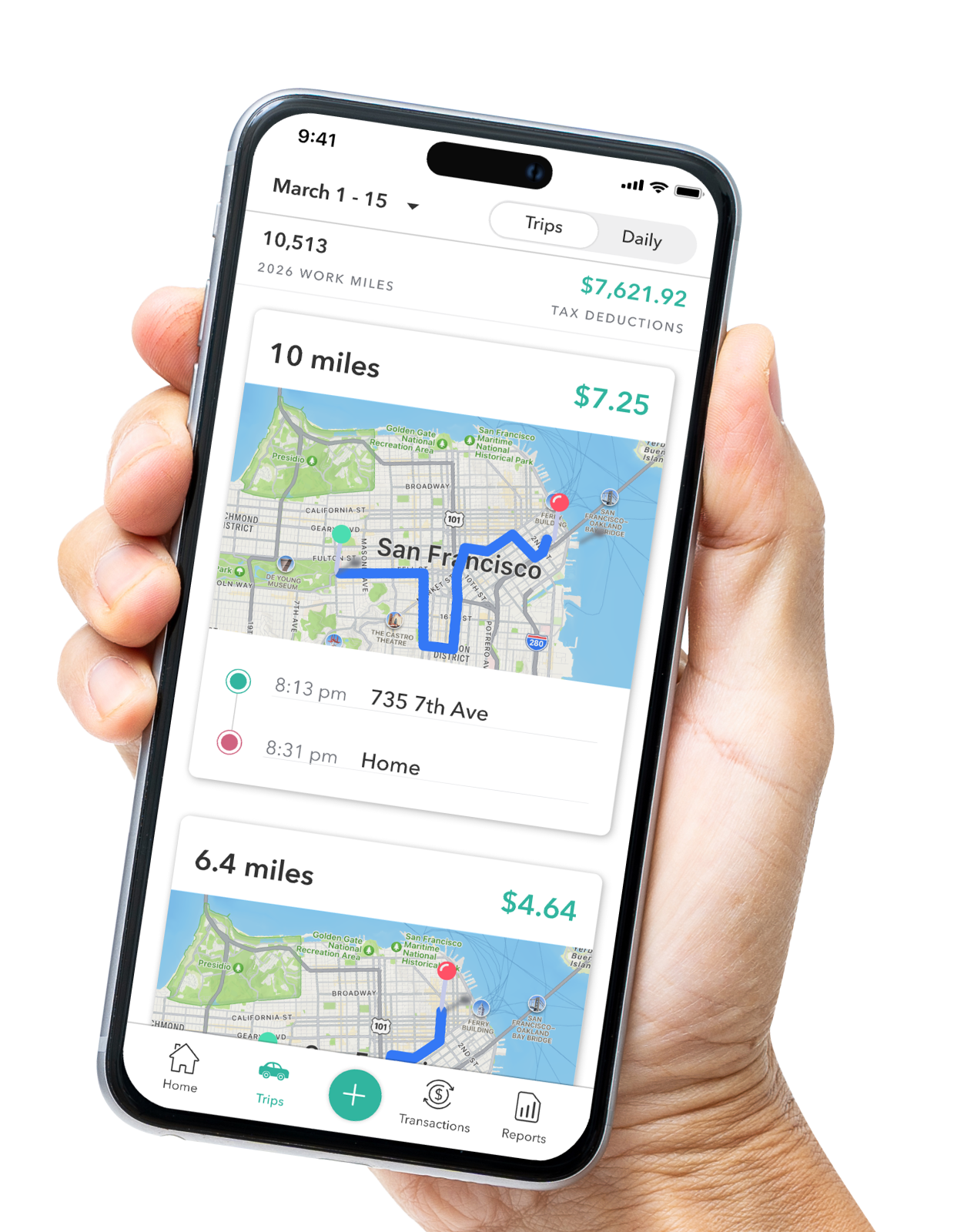
Apps that use GPS to auto-record trips as they happen meet the IRS "contemporaneous" standard far better than a notebook filled out in April. Everlance automatically logs your trips using GPS technology, ensuring compliance with IRS requirements. The goal: records made at or near the time of the trip, not reconstructed later from memory.
The AMT is a parallel tax system that can hit high earners. For 2027:
· Single filers: $93,000 exemption (phases out starting at $515,950)
· Married filing jointly: $144,700 exemption (phases out starting at $1,031,900)
Unless you're a high-earning business owner, the AMT is unlikely to affect you. But it's worth knowing it exists.
Estate Tax Exemption for 2027: $15,480,000 per person (up from $15,000,000 in 2026)
Annual Gift Exclusion for 2027: $20,000 per recipient (up from $19,000 in 2026)
These matter if you're gifting money to family or kids. You can give up to $20,000 per person per year without filing a gift tax return or using your lifetime exemption.
Spouse who is not a U.S. citizen: Gift exclusion rises to $201,000 for 2027.
If you buy equipment, vehicles, or software for your business, Section 179 lets you deduct the full cost immediately rather than depreciating it over years.
For 2027:
· Maximum expensing: $2,640,000 (up from $2,560,000)
· Sport utility vehicles: $33,100 (up from $32,000)
This is useful if you buy a used commercial van for deliveries or a computer setup for your freelance work.
If your business provides employee transportation perks (or if you're claiming such benefits), the monthly limit for 2027 is $350 (up $10 from 2026).
The EITC helps low and moderate-income workers. For 2027:
· Three or more qualifying children: Maximum $8,496 (up from $8,231)
· Two qualifying children: Maximum $5,328 (up from $5,160)
· One qualifying child: Maximum $3,733 (up from $3,617)
· No qualifying children: Maximum $671 (up from $649)
The EITC is based on earned income, so for self-employed people, it's your net profit after business deductions. Over-deducting can actually lower your EITC, so track carefully and file accurately.
If you work overseas, you can exclude up to $137,300 of foreign earned income (up from $132,900 in 2026).
If you're self-employed and expect to owe more than $1,000 in taxes, the IRS requires quarterly estimated payments. The deadlines for 2027 are:
· Q1 (Jan 1 - Mar 31): Due April 18, 2027
· Q2 (Apr 1 - Jun 30): Due June 15, 2027
· Q3 (Jul 1 - Sep 30): Due September 15, 2027
· Q4 (Oct 1 - Dec 31): Due January 17, 2028
Note that Q2 is only two months, so set cash aside faster in spring to cover that payment.
To estimate your 2027 tax:
1. Estimate your 2027 net business income
2. Subtract the standard deduction ($16,600 for single filers in 2027)
3. Multiply by your effective tax rate (roughly 15% to 30% depending on income)
4. Divide by four for quarterly payments
The tax adjustments are great, but they're automatic. The real opportunity lies in the deductions you control.
Everlance Mileage Tracking automatically logs your trips using GPS, creating an IRS-ready mileage record without the paperwork. When the 2027 standard mileage rate is announced, you'll know exactly how many deductible miles you drove and what your write-off is worth.
Everlance Expense Tracking captures receipts for gas, maintenance, tolls, parking, and other business costs. Instead of scrambling for receipts at tax time, your expenses are organized and ready.
Everlance Tax Center (learn more) connects your mileage and expense data to tax guidance tailored to self-employed workers. When filing season arrives in 2028, you'll have a clear picture of your deductions and tax obligations for 2027 income.
Millions of drivers have already dropped paper logs and receipts. With automatic tracking, you're not just complying with IRS requirements, you're maximizing every deductible dollar and reducing audit risk.
Start tracking mileage, claim eligible deductions, and maximize your tax savings with Everlance