Freelancers can deduct any expense that is "ordinary and necessary" for their business. That includes business mileage, a home office, equipment, software, platform fees, marketing, professional services, health insurance, and retirement contributions. This checklist covers every major freelance tax write-off, where each one goes on your return, and the records you need to back it up. It is part of Everlance's Freelancer Tax Guide, which explains how freelancer taxes work from start to finish.
Here is why it matters. Freelancers pay income tax and self-employment tax on net profit, not total revenue, so every deduction lowers both. In the 12% to 22% federal brackets, each legitimate $1,000 deduction saves roughly $250 to $350 in federal tax, before any state savings. If you drive for work, your car is probably your biggest deduction, and also the one freelancers most often under-claim because their records are incomplete.
Freelancers can deduct the following business expenses, in full or for the business-use share:
• Business mileage, parking, and tolls
• A home office
• Computers, cameras, and other equipment
• Software and subscriptions
• Phone and internet (business share)
• Platform, marketplace, and payment processing fees
• Advertising, website, and marketing costs
• Accountant, attorney, and other professional fees
• Business insurance (not health insurance)
• Courses, books, and professional memberships
• Business travel and 50% of business meals
• Subcontractors, coworking space, licenses, and bank fees
Three more deductions come off your Form 1040 instead of Schedule C: self-employed health insurance, retirement plan contributions, and half of your self-employment tax. All of them are covered below.
A tax deduction lowers your taxable profit. It is not a dollar-for-dollar refund. If you earn $60,000 and have $15,000 in business expenses, you pay tax on $45,000. You report income and expenses on Schedule C, which you file with your Form 1040 (here is how to complete Schedule C). These rules work the same whether a client pays you by 1099-NEC, a platform reports it on a 1099-K, or you receive no form at all, so every 1099 freelancer deduction below applies to you. For a broader list that covers every kind of self-employed worker, see the full list of self-employed tax write-offs.
Freelancers feel the savings twice because of self-employment (SE) tax. SE tax is 15.3% of 92.35% of your net earnings, made up of:
• Social Security (12.4%): applies only up to the annual wage base. The base is $184,500 for 2026 and is adjusted each year.
• Medicare (2.9%): applies to all net earnings, with no cap.
• Additional Medicare tax (0.9%): applies to earnings above $200,000 for single filers ($250,000 for married filing jointly).
Here is a quick example. A freelance driver in the 12% bracket deducts $8,000 in mileage. That cuts about $1,130 in SE tax and roughly $890 in income tax, which is more than $2,000 back in their pocket. Plug your own numbers into the 1099 tax calculator to see what your deductions are worth.
You also pay estimated taxes four times a year, and the quarters are uneven. The deadlines are April 15, June 15, September 15, and January 15, moving to the next business day when one lands on a weekend or holiday. Tracking deductions all year helps you avoid overpaying in a tight quarter. The quarterly tax calculator can estimate each payment.
These are the most recent confirmed figures as of October 2026. The IRS and SSA adjust many of them every year, so check IRS.gov before you file.
Tick off every category that applies to you. The "where it goes" notes use Schedule C line numbers from the 2025 form. Double-check them against the current Schedule C instructions.
☐ Business miles in your own vehicle: client visits, supply runs, meetings, and trips between job sites
☐ Parking fees and tolls for business trips (deductible on top of either vehicle method)
☐ Business taxi, rideshare, or public transit fares
☐ Actual vehicle costs, if you choose that method: gas, insurance, repairs, tires, registration, depreciation, and loan interest (business share only)
The 2026 standard mileage rate is 72.5 cents per mile for January 1 to June 30 and 76 cents per mile from July 1 to December 31. The IRS made that mid-year increase because of rising fuel and vehicle costs. The IRS sets a new rate each year, usually in December. Check Everlance's current IRS mileage rates page for the latest.
Business miles include driving to clients, picking up supplies, traveling between job sites, and time you spend driving between rideshare or delivery orders. An ordinary commute from home to a regular office does not count. But if your home is your main place of business, trips from home to clients usually do.
Here is how the math works. A delivery driver logs 20,000 business miles in 2026, split evenly across both halves of the year. That is 10,000 miles at 72.5 cents plus 10,000 miles at 76 cents, or $14,850. If the car costs $11,000 a year to run and 80% of its miles are for business, the actual-expense method gives only $8,800, so the standard rate wins. A heavy SUV with big repair bills might come out the other way, so compare both in your first year with the standard mileage vs. actual expenses calculator.
Keep: a mileage log recorded at or near the time of each trip (see the IRS mileage log requirements), plus receipts for parking and tolls. Schedule C also asks for your total business, commuting, and other miles for the year.
☐ Simplified method: $5 per square foot, up to 300 square feet (maximum $1,500)
☐ Regular method: your office's share of rent or mortgage interest, utilities, insurance, and repairs (plus depreciation if you own)
You can claim a home office if you use part of your home regularly and only for business. A spare bedroom used for editing videos qualifies. A kitchen table where your family eats dinner does not. For many freelancers, the desk where you do bookkeeping, schedule jobs, and handle client calls counts, as long as it is your main place of business administration. Renters qualify too.
Consider a freelancer with a 200-square-foot office in a 1,600-square-foot apartment. The simplified method gives $1,000. With the regular method, the office is 12.5% of the home, so if rent and utilities total $24,000 a year, the deduction is $3,000, three times as much.
Keep: lease or mortgage statements, utility bills, your insurance policy, and a photo and measurements of the space. If you own your home and use the regular method, depreciation on the office may be taxed when you sell.
☐ Computers, laptops, monitors, and tablets
☐ Cameras, microphones, lighting, and editing gear
☐ Printers, desks, chairs, and other office furniture
☐ Driver and field gear: dash cams, phone mounts, chargers, and insulated delivery bags
☐ The business-use share of your phone
For most items you can write off the full cost in the year you buy them instead of spreading it over several years. Three rules make that possible: the de minimis safe harbor (items up to $2,500 each, elected on your return), Section 179 (a $2,560,000 limit for 2026, with the property used more than 50% for business), and 100% bonus depreciation (permanent for qualifying property acquired after January 19, 2025). The Section 179 limit is adjusted for inflation each year.
Keep: invoices or receipts and the date each item was put into service.
☐ Design, editing, and writing tools: Adobe Creative Cloud, Canva, Figma, Grammarly
☐ Business software: QuickBooks, FreshBooks, Zoom, Google Workspace, Slack, Notion
☐ Cloud storage, password managers, and project management tools
These small recurring charges are easy to forget. Scan your card statements once a quarter for monthly and annual renewals. If a tool serves both work and personal use, deduct only the business share. Keep: invoices or card statements.
☐ The business share of your monthly phone plan
☐ The business share of your home internet
☐ A dedicated business phone line (100% if it is used only for work)
Be honest about mixed use. If you use your phone for business 60% of the time, deduct 60% of the bill. A $90 monthly plan used 60% for business gives you $648 a year in deductions. Do not claim 100% unless the line is only for work, and do not count the same internet bill again inside a home office calculation. Keep: a short note explaining how you set the percentage.
☐ Fees charged by Upwork, Fiverr, Thumbtack, Etsy, and similar marketplaces
☐ Payment processing fees from Stripe, PayPal, or Square
☐ Service fees that rideshare and delivery apps keep before paying you
☐ Invoicing and payment platform subscription fees
Platforms often report your gross payments on a 1099-K or 1099-NEC, before fees come out. Report the gross amount as income and deduct the fees separately so your return matches the forms. A 1099-K is only issued above $20,000 and 200 transactions, but all of your income is taxable whether or not you receive a form. See how platform income flows into your tax bill with the Upwork 1099 tax calculator. Keep: annual fee summaries and payout statements.
☐ Website domain, hosting, and design (Squarespace, Wix, WordPress)
☐ Paid ads on Google, Meta, or LinkedIn, and sponsored listings
☐ Business cards, signage, and car magnets or wraps
☐ Portfolio costs, stock photos, email marketing tools, and directory fees
Anything you spend to find clients counts. Keep: invoices and ad platform billing statements.
☐ CPA or tax preparer fees for the business part of your return
☐ Bookkeeper or accountant fees
☐ Attorney fees for contract reviews or client disputes
☐ Business consultants and coaches
☐ Annual LLC and state filing fees (initial formation costs may need to be amortized instead)
If you pay $400 for tax prep, ask your preparer to split the invoice. The business part is deductible. The personal part is not.
☐ Professional liability (errors and omissions) insurance
☐ General liability, cyber liability, business property, and equipment insurance
Health insurance is separate. It is deducted on Form 1040, as covered below.
☐ Courses and certifications that improve skills for your current work
☐ Books, trade publications, conference tickets, and workshops
☐ Professional association dues and license renewals
Think of a Coursera course on bookkeeping, a commercial driving endorsement, or industry conference tickets. Training for a brand-new career is not deductible.
☐ Paper, ink, notebooks, and other office supplies
☐ Postage and shipping
☐ Packaging and materials used up in delivering your service
☐ Airfare, hotels, rental cars, and baggage fees for overnight business trips
☐ 50% of business meals while traveling or meeting a client to discuss business
Meals are deductible only when you are traveling away from your tax home overnight or meeting a client to discuss business. A sandwich between local deliveries is a personal expense. For travel, the IRS requires receipts for lodging and for any single expense of $75 or more.
☐ Payments to other freelancers, virtual assistants, designers, editors, or developers
Collect a W-9 before you pay anyone. If you pay a contractor $2,000 or more in 2026, you generally must send a 1099-NEC. The threshold was $600 before 2026 and is indexed for inflation in later years, so check the current amount. Some states set their own thresholds. You can deduct what you pay contractors even when it falls below the reporting threshold.
☐ Coworking memberships and day passes
☐ A rented studio, office, or business storage unit
If you also claim a home office, make sure the home space still meets the regular and exclusive use test.
☐ Business licenses and permits
☐ State and local business taxes
☐ Business bank account fees and business credit card annual fees
☐ Interest on a business-only credit card or loan
These come off your income on Form 1040 and Schedule 1 instead of Schedule C. They lower income tax, but not self-employment tax.
☐ Self-employed health insurance. You can deduct premiums for yourself, your spouse, and your dependents, including medical, dental, and qualifying long-term care coverage. You cannot claim it for any month you were eligible for an employer plan, including a spouse's plan, and the deduction cannot exceed your net self-employment profit. Read Everlance's guide to writing off health insurance premiums.
☐ Retirement contributions. A SEP-IRA lets you contribute up to 25% of compensation, which works out to about 20% of your net self-employment earnings (after deducting half of SE tax), capped at $72,000 for 2026. A Solo 401(k) lets you contribute as both employee ($24,500 in 2026) and employer, which often allows far more savings at lower incomes, up to the same $72,000 combined cap. A traditional IRA ($7,500 limit in 2026) may add a deduction, subject to income limits. The IRS adjusts these limits most years.
☐ Half of your self-employment tax. You deduct the employer-equivalent half automatically on Schedule 1.
☐ QBI deduction. Many freelancers can deduct up to 20% of qualified business income. The One Big Beautiful Bill Act made this deduction permanent. Income limits and special rules for certain service businesses apply at higher incomes.
☐ Qualified tips. If you earn tips in an occupation on the IRS list, which includes rideshare and delivery drivers, you may deduct up to $25,000 of qualified tips for tax years 2025 through 2028. The deduction phases out above $150,000 of modified adjusted gross income ($300,000 for joint filers) and reduces income tax only, not SE tax.
Here is a retirement example. A freelance courier nets $100,000 and puts $10,000 into a SEP-IRA. In the 22% bracket, that saves about $2,200 in federal income tax this year, and the money keeps growing tax-deferred.
• Your ordinary commute from home to a regular workplace
• Personal expenses, even when you pay them from a business account
• Parking tickets, traffic fines, and penalties
• Entertainment, such as concert or sports tickets, and personal meals
• Training that qualifies you for a new trade or business
• Costs of an activity you do as a hobby rather than to earn a profit
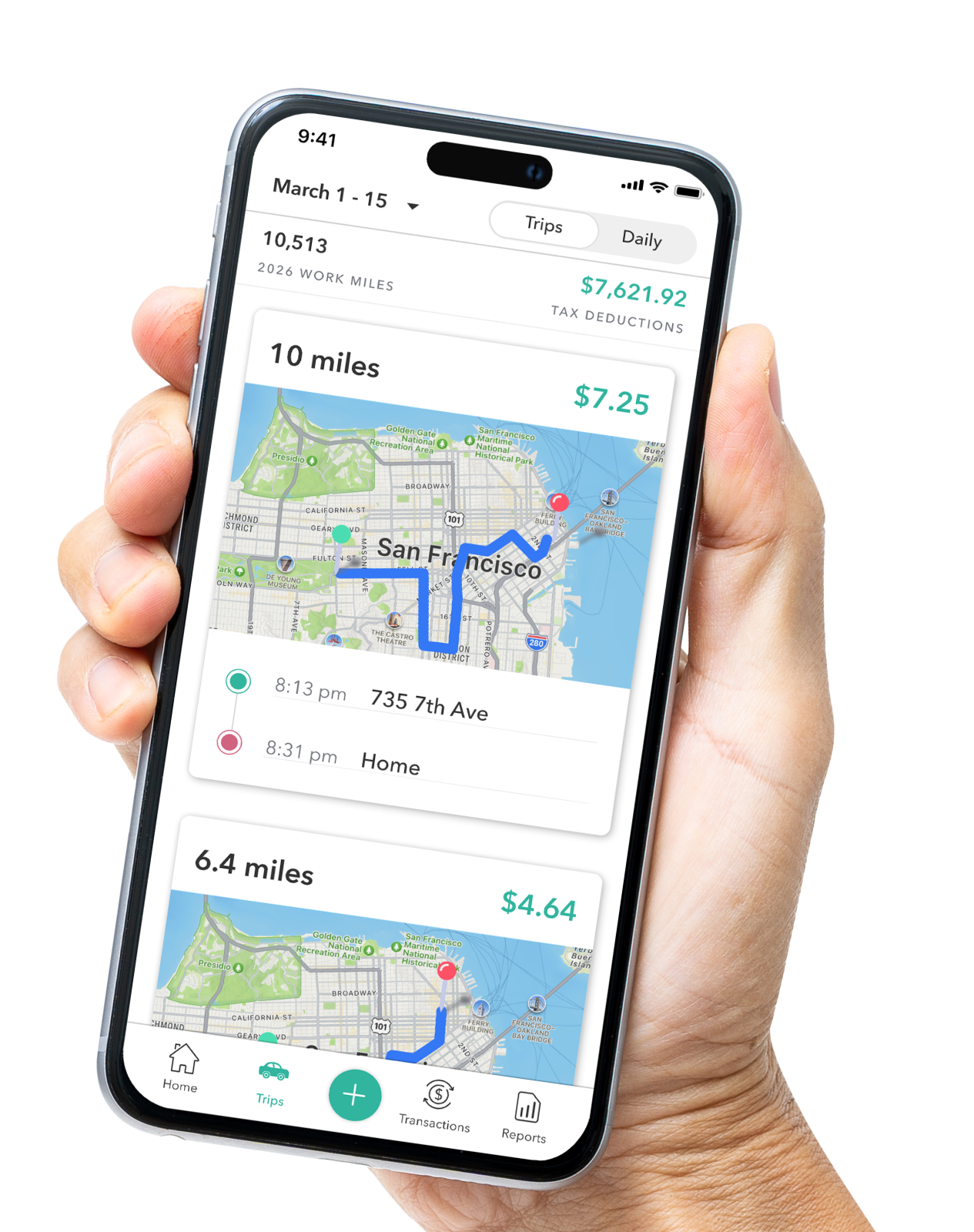
The IRS can ask you to prove any deduction, and the biggest risk is weak records, especially for mileage. The IRS expects a log to be "contemporaneous," meaning recorded at or near the time of the trip. A log you rebuild in March from memory is easy for an auditor to reject. A strong entry includes the date, starting point and destination, business purpose, and miles driven. Compare:
Beyond your mileage log, keep:
• Receipts and invoices for every expense
• Bank and credit card statements (a dedicated business account and card make this much easier)
• 1099s and platform payout summaries
• Home office measurements and photos
• A short written note for any percentage you estimate, such as phone and internet
Keep records for at least three years from the date you file. Keep them for six years if you may have underreported income by more than 25%. Hold records for vehicles and equipment until three years after you sell or dispose of them.
Track deductions, plan quarterly taxes, and maximize savings with our Freelancer Tax Guide and Tax Hub.




.webp)

.svg)


.svg)
