The second half of the year is where most self-employed workers either save thousands or leave money on the table. By July, you already have six months of income data, expense patterns, and a clearer picture of what your annual tax bill will look like. That makes right now the perfect time to course-correct.
Whether you drive for a rideshare company, run a freelance business or operate as an independent contractor, the moves you make between now and December 31 can dramatically shift what you owe the IRS next April. These seven tax tips for the second half of 2026 are built around real strategies that actually reduce your liability, not generic advice you've already heard a dozen times. Each one is specific, timely and designed for people who work for themselves.
Mid-year tax planning is less about big, dramatic moves and more about small corrections that compound. Think of it like adjusting your GPS halfway through a road trip: a few degrees now saves you from ending up miles off course later.
The IRS standard mileage rate for the second half of 2026 is 76 cents per mile for business use, up slightly from 2025. Self-employment tax remains at 15.3%, broken down into 12.4% for Social Security (on income up to $184,500 in 2026) and 2.9% for Medicare, with an additional 0.9% Medicare surtax kicking in above $200,000 for single filers. These numbers matter because every deduction you capture directly reduces the income these percentages apply to.
The strategies below focus on what you can control right now. Some take five minutes. Others require a bit more planning. All of them are worth your time.
If you haven't looked at your expense records since January, you're almost certainly missing deductions. A mid-year audit isn't just about finding lost receipts: it's about fixing your system so the second half of the year runs smoother.
Start by pulling every bank statement and credit card record from January through June. Compare them against whatever tracking system you use. Look for business purchases that slipped through: software subscriptions, office supplies, professional development courses, even that new phone case for the device you use for work. The IRS requires that you keep records showing the amount, date, place and business purpose of each expense. A vague entry like "supplies - $47" won't hold up. An entry like "printer ink for client proposals, Staples, June 12, $47" will.
Self-employed workers can deduct ordinary and necessary business expenses on Schedule C, but only if they're properly documented. Common deductions that get overlooked include internet service (the business-use percentage), professional liability insurance, continuing education, and health insurance premiums.
Here's a practical comparison of weak vs. strong record-keeping:
If you're using a tool like Everlance for expense tracking, your categorized transactions and digital receipt photos already satisfy the IRS's contemporaneous record-keeping standard. That means your records were created at or near the time of the expense, which is exactly what auditors want to see.
For self-employed drivers, mileage is often the single largest deduction available and it's the one most people undercount. At 76 cents per mile in H2 2026, every forgotten trip costs real money. Drive 10,000 business miles and you're looking at a $7,600 deduction. Miss even 10% of those trips and you've lost $7,600 in deductions, which means overpaying your taxes.
You have two methods for claiming vehicle expenses. The standard mileage method uses the IRS rate of 76 cents per mile. The actual expense method lets you deduct gas, insurance, repairs, depreciation and other costs based on your business-use percentage. Most self-employed drivers find the standard method simpler and more beneficial, but it's worth running both calculations at mid-year to see which saves you more.
The IRS requires a contemporaneous mileage log that includes the date, destination, business purpose and miles driven for each trip. Paper logs fail because people forget to fill them in. By the time you try to reconstruct a week's worth of driving from memory, you've already lost trips.
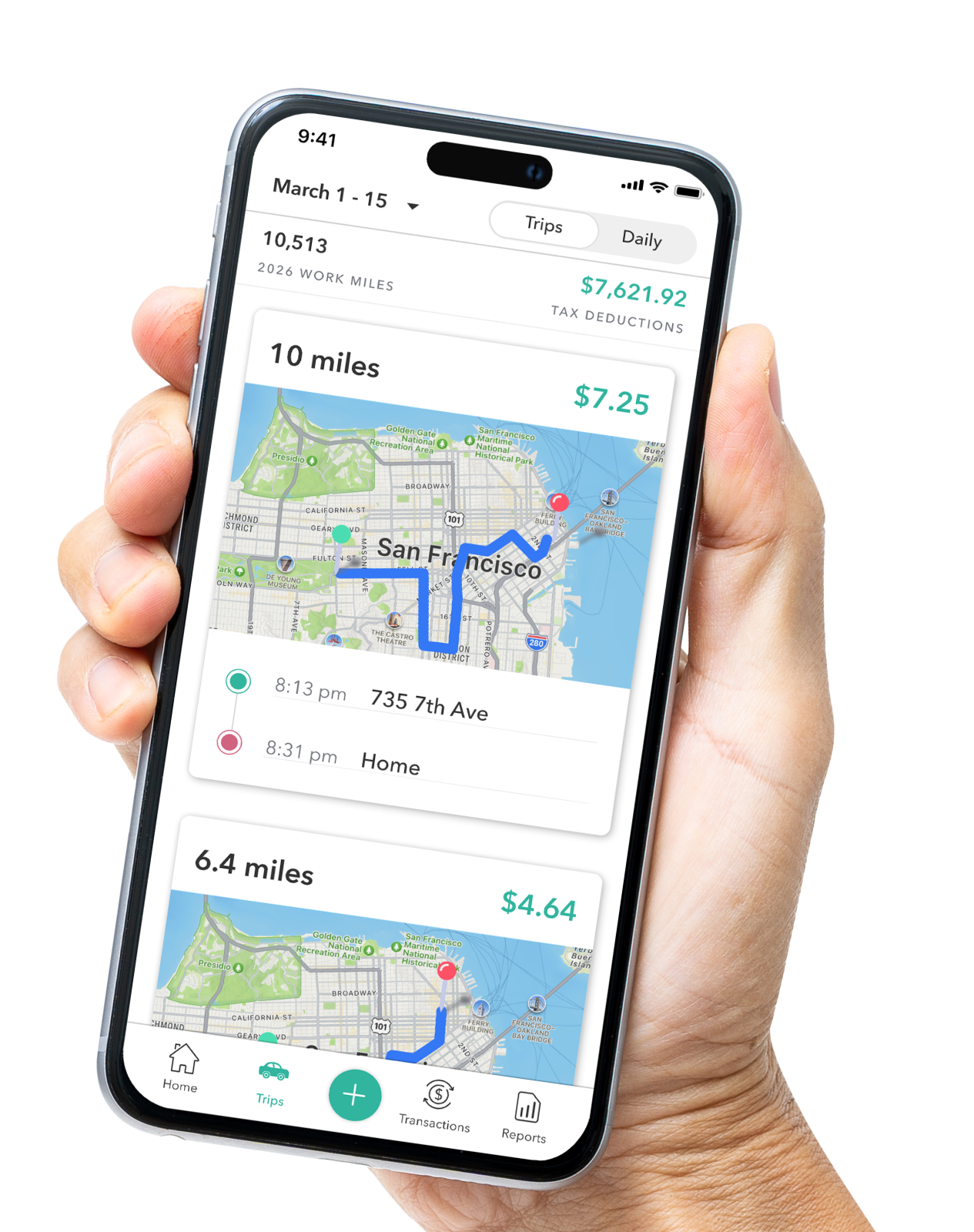
Automatic GPS-based tracking solves this. Everlance has helped over 4 million self-employed workers record their mileage automatically using features like geofencing and real-time GPS detection. Your phone detects when you start driving and logs the trip without you lifting a finger. Each entry captures the exact data points the IRS requires, which means your records are audit-ready from the moment they're created.
Self-employed individuals pay estimated taxes four times a year. The third quarter payment is due September 15, 2026 and the fourth quarter payment is due January 15, 2027. If your income has changed significantly since you set your payment amounts, now is the time to adjust.
Underpaying triggers a penalty. Overpaying means you've given the IRS an interest-free loan. Neither is ideal. Pull up your year-to-date income, subtract your projected deductions and recalculate using Form 1040-ES. A good rule of thumb: you need to pay at least 90% of your 2026 tax liability or 100% of your 2025 liability (110% if your adjusted gross income exceeded $150,000) to avoid penalties.
If your income spiked in the first half, increase your Q3 and Q4 payments. If business slowed down, reduce them so you're not tying up cash unnecessarily. This 30-minute exercise can save you from a surprise bill or a penalty notice next spring.
Retirement contributions are one of the most powerful ways to reduce your taxable income and most self-employed workers don't take full advantage. Unlike W-2 employees who might max out a 401(k) through payroll deductions, you have to make these contributions yourself, and mid-year is a great checkpoint.
Two options stand out for self-employed individuals:
Run the numbers on your first-half income and project forward. If you earned $80,000 in net self-employment income, a SEP-IRA contribution of $20,000 would reduce your taxable income by that full amount. At a 22% marginal tax rate plus 15.3% self-employment tax, that's roughly $7,460 in tax savings. That's money working for your future instead of going to the IRS.
The home office deduction trips people up because they think it's complicated or risky. It's neither, as long as you qualify. You need a dedicated space used regularly and exclusively for business. A corner of your living room where you also watch TV doesn't count. A spare bedroom converted into your office does.
You can choose the simplified method ($5 per square foot, up to 300 square feet, for a maximum $1,500 deduction) or the regular method, which requires calculating the actual expenses of your home proportional to your office space. The regular method often yields a larger deduction but demands more record-keeping.
For equipment, Section 179 expensing lets you deduct the full purchase price of qualifying business equipment in the year you buy it, up to $2,560,000 in 2026. If you purchased a laptop, printer or other equipment in the first half of the year, make sure it's properly recorded. If you're planning a large purchase, buying before December 31 lets you claim the deduction on your 2026 return.
Think of this as a financial health check at the halfway mark. Gather your income from all sources, subtract your deductions and estimate what you'll owe. This exercise takes about an hour and can prevent nasty surprises.
Here's a simple framework: take your total gross income through June, double it for a rough annual projection, then subtract your estimated deductions (mileage, expenses, retirement contributions, self-employment tax deduction). Apply the 2026 tax brackets to the result. Compare that number against what you've already paid in estimated taxes.
If there's a gap, you still have two quarterly payments to close it. If you're ahead, you might redirect some cash toward retirement contributions or reinvest in your business. The point is awareness. Too many self-employed workers don't look at their tax picture until they're sitting across from their accountant in March, and by then it's too late to change anything.
For years, self-employed workers planned around the uncertainty of expiring Tax Cuts and Jobs Act provisions. The One Big Beautiful Bill Act (OBBBA), signed July 4, 2025, resolved most of that uncertainty permanently. Here's what that means for your 2026 taxes.
This deduction allows eligible sole proprietors, S-corp owners and partnership owners to deduct up to 20% of their qualified business income, which significantly lowers the effective tax rate on self-employment income. It was set to expire after 2025. It did not expire. If you've been claiming this deduction, you can continue planning around it indefinitely. If you've never explored whether you qualify, this mid-year checkpoint is the right time to ask your tax professional. The OBBBA also added a new minimum QBI deduction of $400 for taxpayers with at least $1,000 in active qualified business income, ensuring smaller operators don't lose the benefit entirely.
The OBBBA restored first-year bonus depreciation to 100% for qualifying property placed in service after January 19, 2025. Combined with the 2026 Section 179 expensing limit, this gives self-employed workers significant tools to accelerate deductions on business equipment and vehicles in the year of purchase.
The Earned Income Tax Credit, credits for health insurance purchased through the marketplace and energy efficiency credits for business vehicles can all reduce your bill directly. Credits are more valuable than deductions because they reduce your tax dollar-for-dollar rather than just lowering your taxable income. A tax professional current on 2026 law can confirm which ones apply to your situation.
The common thread across all these tips is that preparation and consistent tracking are what separate people who owe thousands from people who save thousands. You don't need to become a tax expert. You just need good systems running in the background while you focus on earning.
If you're still recording miles on paper or stuffing receipts in a shoebox, you're making this harder than it needs to be. Everlance records your mileage automatically, categorizes your expenses and keeps your records IRS-ready all year long. No other mileage app bundles mileage tracking with expense management and tax filing in one place. Over 4 million self-employed workers have already made the switch from paper logs to automatic tracking, and the difference shows up directly on their tax returns.
Your second half of 2026 starts now. Make it count.
Free yourself from tedious logging with the top rated mileage & expense tracking app, Everlance. Trusted by over 4 million drivers




.webp)

.svg)





.svg)
