Real estate is one of the most vehicle-dependent professions in America. Between buyer tours, listing appointments, open houses, neighborhood farming, and the countless in-between trips that keep a transaction moving forward, agents routinely drive tens of thousands of miles for business every year. Yet when tax season arrives, a surprising number of those agents leave significant money on the table. Not because the deductions do not exist, but because the trips were never logged.
This guide breaks down everything a self-employed real estate agent or independent contractor Realtor needs to know about deducting vehicle expenses. That includes which trips qualify, what the IRS actually requires in a mileage log, how the home office rule can unlock even more deductible miles, and how to choose between the standard mileage rate and the actual expense method. This is a strategy guide, not a product pitch. If you are ready to see the current IRS rate and calculate your estimated deduction, the mileage deductions for real estate agents page has a free savings estimator built for exactly that.
Most self-employed professionals work from a single location. A consultant works from a home office. A freelance designer works from a studio. A real estate agent's entire business is movement. The property is the office. The car is the conference room. The IRS tax code reflects this reality.
Under IRS Publication 463, self-employed individuals, including independent contractor Realtors and agents operating as sole proprietors or single-member LLCs, can deduct the cost of driving for any trip that is ordinary and necessary for their business. In real estate, that phrase covers an enormous amount of ground. Showing a home? Ordinary and necessary. Driving to a listing presentation? Ordinary and necessary. Scouting a neighborhood for expired listings? Still ordinary and necessary. The IRS does not require the trip to be glamorous or immediately revenue-generating. It requires only that it serves a legitimate business purpose in your field.
The result is that real estate agents have access to one of the most powerful Schedule C deductions available to any self-employed worker: a per-mile deduction at the IRS standard mileage rate applied to every qualifying business drive, all year long.
Each year the IRS announces a standard mileage rate for business use. The current rate is among the highest in recent years, reflecting elevated vehicle operating costs across the board.
For a real estate agent, this translates directly into deductible dollars. Every business mile you drive reduces your taxable income at the current IRS per-mile rate. The chart below shows what that looks like across five realistic mileage levels, and how much of that deduction comes back to you in actual tax savings at a 22% federal bracket.
At a 22% federal tax bracket, these deductions translate into real thousands of dollars in tax savings before any state-level deductions are factored in. For an independent contractor who is also paying self-employment tax on top of income tax, every dollar of Schedule C deduction carries extra weight because it reduces both.
The math is straightforward. What prevents agents from capturing the full benefit is almost never a lack of qualifying trips. It is a lack of documentation.
The range of qualifying trips for a real estate agent is broader than many agents realize. The breakdown below shows not just the categories but how they stack up in terms of total annual mileage for a typical full-time agent.
Every leg of a buyer tour qualifies. This means the drive from your home or home office to the first property, the drive between properties during a multi-stop showing day, and the drive home at the end. You are not required to return to your brokerage between showings for each segment to count. Each consecutive leg of a continuous business trip is deductible in full.
Driving to a seller's home to present a comparative market analysis, review staging recommendations, or execute a listing agreement is core revenue-generating activity. The IRS recognizes these trips as clearly ordinary and necessary, and every mile belongs in your log.
Both the drive to set up and the drive to host qualify as separate, deductible trips. If you work multiple open houses on the same weekend, which is common for listing agents in active markets, each property counts as a distinct deductible trip. Agents who run three or four open houses on a Sunday afternoon accumulate more deductible mileage in a single day than many other self-employed professionals log in a week.
This is one of the most under-claimed categories in real estate. Driving through a farm area to deliver marketing materials, identify FSBO opportunities, scout recently expired listings, or simply observe neighborhood activity all qualify under the IRS ordinary and necessary standard. Neighborhood farming is recognized as legitimate business development, and every mile put toward building your pipeline is just as deductible as the client-facing trips that close deals.
The location of the meeting does not determine deductibility. Whether you are driving to a buyer's home for an initial consultation, to a coffee shop to review contract terms, or to your brokerage's conference room for a scheduled closing walkthrough, any drive made for the purpose of meeting, advising, or building a client relationship is fully deductible.
Attending a home inspection as the listing or buyer's agent, being present for a professional photo shoot, or accompanying an appraiser qualifies as ordinary and necessary business activity. These visits are critical transaction milestones. They cannot be skipped, and the miles driven to attend them cannot be ignored at tax time.
Driving to your brokerage for mandatory meetings, compliance sessions, or to pick up transaction documents qualifies, provided your brokerage is not your principal place of business (see the home office discussion below). Trips to a title company, escrow office, attorney's office, or lender to advance a transaction also qualify.
Real estate agents are required to complete continuing education to maintain licensure. Driving to CE courses, state or local Realtor association meetings, MLS training sessions, or broker-required educational programs qualifies as deductible professional development mileage.
This is where many real estate agents leave the most money on the table without realizing it.
Under IRS rules, your commute from home to your principal place of business is not deductible. If your brokerage is considered your primary place of work, driving there and back is treated as a personal commute, the same as any W-2 employee. That round trip, repeated several times per week over the course of a year, can represent thousands of undeducted miles.
However, if you maintain a home office that qualifies under IRS rules, meaning a space used regularly and exclusively for business, your home becomes a place of business. Under this framework, driving from your home office to any client, property, or business destination is deductible from the moment you leave your driveway. The commute to your brokerage can even become deductible as a trip between two business locations rather than a personal commute.
The qualifying home office does not need to be a separate room, though that helps. It does need to be a dedicated space used regularly and exclusively for business tasks: managing listings, responding to client communications, preparing marketing materials, coordinating transactions. Many full-time agents easily qualify. The benefit is significant: converting what was a non-deductible commute into a series of deductible business drives can add thousands of additional miles to your annual total.
If you are not currently claiming a home office deduction and you believe you may qualify, this is a conversation worth having with your CPA before the next tax year begins.
Self-employed real estate agents have two methods available for deducting vehicle costs on Schedule C: the standard mileage rate and the actual expense method.
The standard mileage rate is simpler, requires far less record-keeping, and for most agents produces a larger deduction than the actual expense calculation. You track your miles, multiply by the current rate, and deduct the result. That is the entire calculation.
The actual expense method requires tracking every dollar you spend operating your vehicle for business: fuel, insurance, registration fees, maintenance, repairs, and depreciation. You then deduct the business-use percentage of those total costs. For example, if 70% of your total driving is for business, you deduct 70% of your total vehicle expenses. This method can occasionally produce a larger deduction for agents who drive an expensive vehicle with high operating costs, but the administrative burden is substantially greater and the outcome is less predictable.
The deduction is only as strong as the documentation behind it. The IRS requires contemporaneous records for mileage, meaning each trip must be logged at or near the time it occurs, not reconstructed weeks or months later from memory or calendar entries. Reconstructed logs are one of the leading causes of disallowed deductions in IRS audits of self-employed taxpayers.
A compliant mileage log must include four elements for every trip:
1. Date of the trip
2. Starting and ending location (specific addresses, not just "client's neighborhood")
3. Business purpose (e.g., "buyer showing at 412 Oak St with Johnson clients" not just "work")
4. Total miles driven
The IRS cross-references mileage claims against MLS activity, showing appointment records, and client communications. Generic entries like "showing" or "work meeting" are flagged because they cannot be independently verified. Specific entries tied to real addresses and real clients are far more defensible and, in practice, rarely questioned.
For a deeper look at what qualifies trip-by-trip, along with the current IRS rate applied to real agent workloads, the IRS mileage deduction for Realtors page walks through each deductible trip category with the specificity the IRS requires.
Understanding what not to do is just as valuable as knowing what qualifies.
Waiting until tax season to log. Reconstructing a year's worth of drives from memory or calendar notes is both unreliable and risky. The IRS knows the difference between a real-time log and a year-end estimate, and it treats them accordingly.
Excluding prospecting miles. Many agents log showings and listing appointments but forget that prospecting drives, door-knocking routes, farm area canvassing, FSBO scouting, are equally deductible. These miles can add up to hundreds of deductible trips per year.
Ignoring multi-stop days. On a busy showing day with five or six properties, agents sometimes log only the total round-trip mileage from home rather than each segment. Capturing each leg separately is both more accurate and, for multi-stop days originating from a home office, can result in a higher total deduction.
Failing to note the business purpose. A log full of addresses with no description of why you went there is a log that will not survive scrutiny. Every entry needs a brief, specific note.
Mixing personal and business trips. If you stop at a grocery store during a business drive, that personal segment is not deductible. The business portion is. Keeping clear separation, or noting the split, protects the deductible portion of genuinely mixed trips.
Not claiming the home office. Failing to establish and document a qualifying home office means treating every drive to your brokerage as a personal commute and paying taxes on income that could legally have been reduced.
The agents who capture the most from their mileage deductions are not necessarily the ones who drive the most. They are the ones who track consistently. Here is a simple system that works:
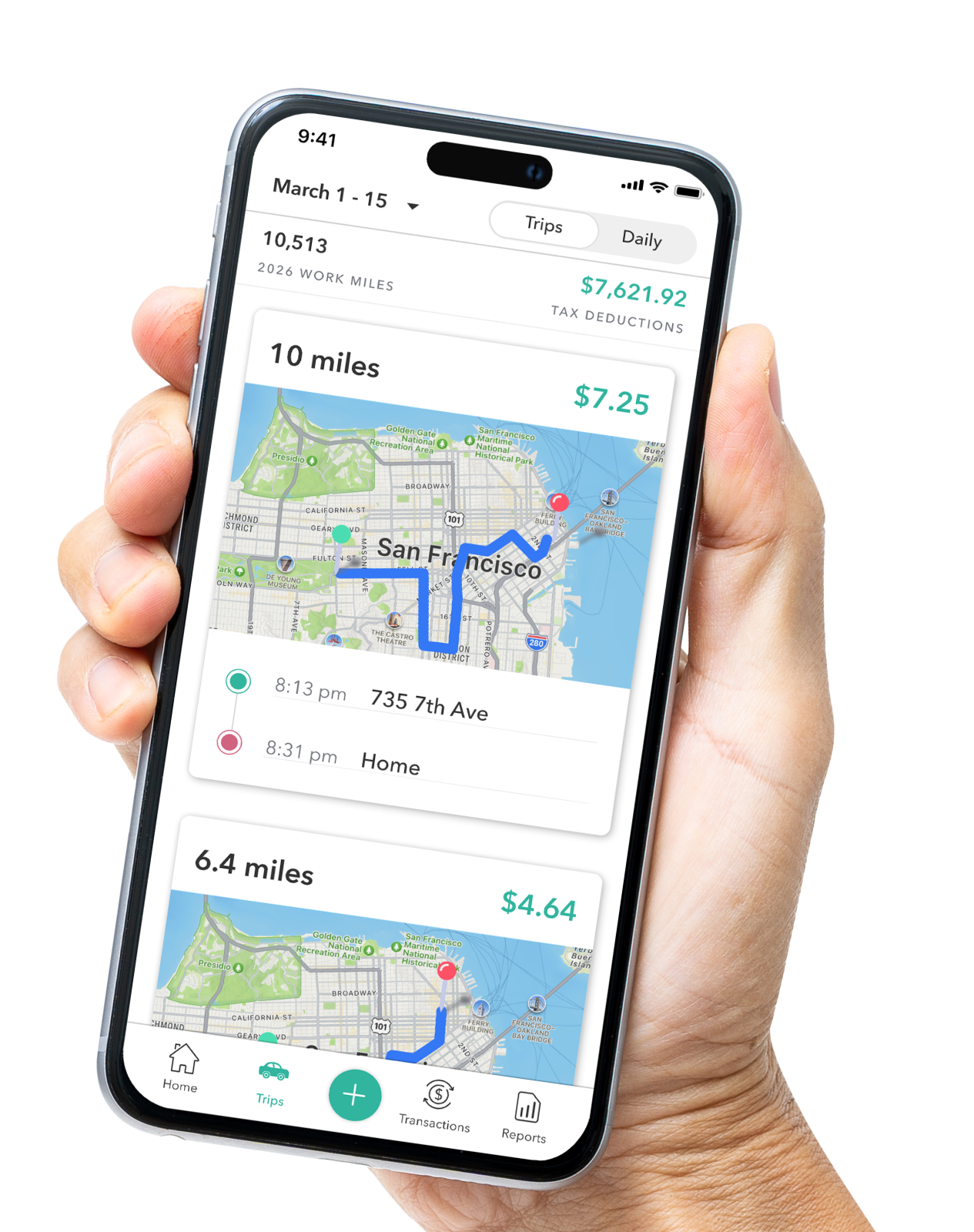
Log in real time, every time. The moment you leave for a business drive, your mileage tracking should start. Whether you use a dedicated app or a paper log, the habit of logging immediately, not at the end of the day, is what produces audit-proof records.
Use specific notes. Train yourself to write the address and the purpose every time. "Buyer showing, 1022 Maple Ave, Chen clients" takes six seconds to type and is ten times more defensible than "showing."
Review and classify weekly. Set aside 10 minutes each week to confirm that every business drive from the prior week is properly categorized and annotated. This prevents small gaps from accumulating into large problems.
Generate quarterly summaries. A running quarterly total lets you project your annual deduction, identify any recording gaps early, and make sure you are not under-estimating your tax liability throughout the year.
Export an IRS-compliant report at year-end. Your CPA or tax preparer needs a complete, formatted mileage log, not a raw list of GPS coordinates. Make sure your record-keeping system can produce a report that clearly lists date, origin, destination, purpose, and miles for every business trip of the year.
Vehicle mileage is almost always the largest deduction available to an active real estate agent, but it is not the only one. A complete tax strategy for an independent contractor Realtor also includes deductions for marketing and advertising expenses, professional dues and licensing fees, E&O insurance, MLS fees, transaction coordination costs, continuing education, and the home office itself. Each of these belongs on Schedule C alongside your mileage deduction.
The agents who consistently keep the most of what they earn treat deduction tracking as a year-round discipline rather than a tax-season scramble. They know what qualifies. They document it in real time. They work with a CPA who understands independent contractor real estate and they come to that conversation armed with clean, organized records rather than a shoebox of receipts.
Your vehicle is one of the most important tools in your business. Make sure the IRS tax code reflects that.
This article is for informational purposes only and does not constitute tax advice. Consult a qualified CPA or tax professional for guidance specific to your situation.
Real estate agents lose thousands in untracked miles. Don't let that be you.




.webp)

.svg)






.svg)
