You trained six clients today. You drove to three different locations, made a supply run between sessions, and scouted a new outdoor venue before heading home. Every one of those drives is a legitimate tax deduction. And every one of them will be worthless if you cannot prove them.
Most self-employed personal trainers understand that business miles are deductible. Far fewer understand what the IRS actually requires to accept them. The difference between knowing mileage is deductible and building a log that survives an audit is not a small one. At the 2026 IRS standard mileage rate of 76 cents per mile, a trainer who logs 14,000 qualifying miles has a $10,150 deduction on the table. A trainer who cannot document those miles in an audit loses the entire amount, not just the trips that look questionable.
Before building your log, you need a clear picture of what trips qualify. The Mileage Deduction for Personal Trainers page covers every qualifying drive category in detail, from client sessions and equipment runs to location scouting and continuing education. For the full picture of every self-employed tax deduction available to fitness professionals, that resource is worth bookmarking too. This guide picks up where that page leaves off: once you know what counts, here is how to document it so it stays counted.
Most trainers who lose mileage deductions in an audit did not fabricate anything. They simply logged their trips weeks or months after the fact, pulling numbers from memory, calendar appointments, and rough estimates. The IRS has a name for what that produces: a reconstructed record. And reconstructed records are routinely disallowed.
The legal standard comes from IRC Section 274(d), which requires that vehicle expenses be supported by adequate recordsmaintained in a way that substantiates the amount, time, place, and business purpose of each trip. The word the IRS uses in its own guidance is contemporaneous, meaning the record must be created at or near the time of the trip, not assembled later from memory.
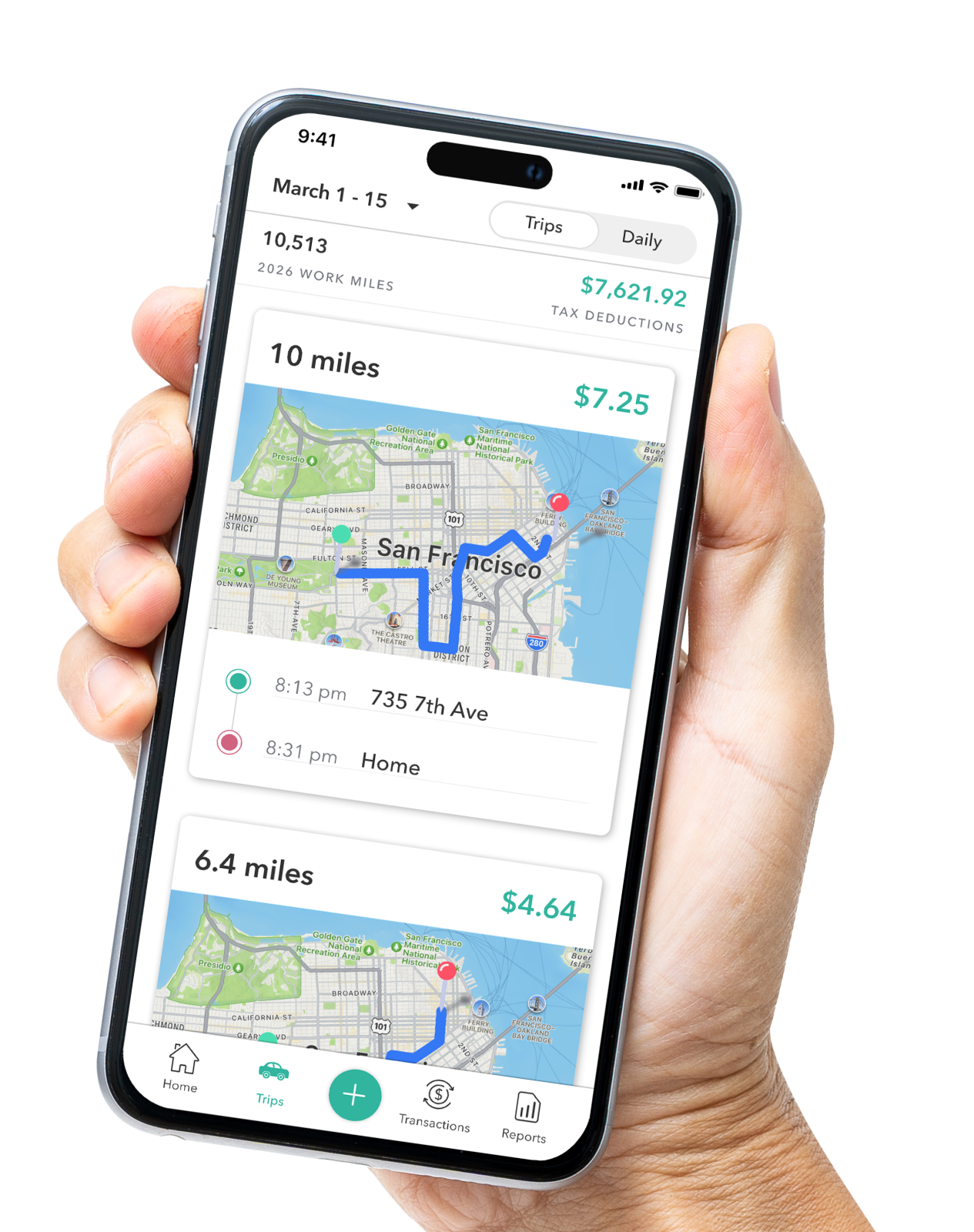
For a personal trainer, this matters more than it might for someone who drives the same route every day. Trainer schedules are inherently variable: different clients, different locations, supply runs that happen between sessions, venue scouting that occurs weeks before a program launches. The more diverse your driving patterns, the more a reconstructed log diverges from what actually happened. GPS-based tracking eliminates this risk by recording each trip the moment your vehicle moves, with a timestamp and location data the IRS cannot dispute.
The practical consequence of the contemporaneous standard is straightforward. A log created in real time is your strongest possible audit defense. A log assembled in March from notes, texts, and Google Maps estimates is your weakest. Everything in this guide is built around the goal of creating the first kind, not the second.
IRS Publication 463 is explicit about what adequate records require for vehicle deductions. Every single trip in your log needs five pieces of information. Miss any one of them for a given entry and that entry is vulnerable. The IRS mileage log requirements guide covers this in detail, but here is what each field means specifically for a personal trainer's driving patterns.
Log the specific date, not the week or the pay period. The IRS cross-references vehicle logs against client records, receipts, and appointment histories. A supply run logged on a Tuesday that corresponds to a receipt timestamped Thursday is a discrepancy that invites follow-up. GPS tracking timestamps every trip automatically at the moment it begins.
Both the starting location and the ending location must be specific. Your home address as the origin. The client's full street address as the destination. Not "gym" or "client's house." The IRS expects an address or a named business location precise enough to verify. GPS tracking captures coordinates automatically. If you are logging manually, write the full address every time, not a shorthand you will not remember in three years.
This is the field that separates defensible logs from disallowed ones. The business purpose needs to name the specific activity: the client, the session type, the supply purchased, or the venue being scouted. Generic entries like "work," "gym," or "client" give an IRS examiner grounds to disallow the trip because there is nothing to verify. Specific entries like "mobility session, K. Torres, 7am recurring slot" or "supply run: agility ladders for Tuesday bootcamp group" leave no room for ambiguity. The table in the next section shows exactly how this plays out.
Log the exact distance for each trip leg. If you use GPS tracking, this is captured automatically. If you log manually, record odometer readings at the start and end of each leg. A note on odometer readings: the IRS does not formally require them for every trip, but recording your odometer at the start and end of each year is strongly recommended. The full explanation of why odometer readings matter for mileage deductions covers when they become relevant, especially when total logged business miles are a high percentage of total miles driven.
Your log must produce a clean annual summary: total business miles separated from personal and commuting miles. This is the number that flows onto your Schedule C and calculates your deduction at the IRS standard mileage rate. Personal trainers who use GPS tracking can generate this summary in seconds. Those logging manually need to ensure their records add up cleanly and reconcile against the odometer reading at year-end.
The business purpose field is where most trainer mileage logs fall apart. Not because trainers are dishonest, but because after a full day of sessions, the instinct is to enter something fast and move on. Fast entries are usually vague entries, and vague entries are the first thing an IRS examiner challenges.
The right-hand column takes only a few seconds longer to write than the left-hand column. Over the course of a year, that extra effort is worth thousands of dollars in protected deductions. If you use a GPS tracking app, you can save preset purpose notes for your most common trip types and apply them in seconds with a tap.
The best way to understand what the IRS expects is to see it in practice. Below is a sample two-day log for a mobile personal trainer with a mixed schedule of in-home sessions, gym floor training, an outdoor bootcamp, a supply run, and a venue scout. Every entry meets the five-field standard and every business purpose is specific enough to verify.
A few things worth noting about this sample. The July 8 entries capture a full multi-stop day correctly: each leg is logged separately with its own origin, destination, and purpose. The supply run on the same day gets its own entry with a specific description of what was purchased and why. The venue scout on July 10 is logged even though no session occurred there, because the IRS treats scouting trips as ordinary and necessary business activity for a mobile trainer.
Mobile trainers running back-to-back sessions across different locations are where the mileage deduction gets most valuable and also most undercounted. A trainer who visits four clients at four different locations in a single day can generate a significant amount of deductible mileage before noon, but only if every leg of that route is logged. The Mileage Deduction for Personal Trainers page walks through every qualifying trip category, including several that routinely go unlogged.
Here is what a real-time log captures on a busy training day that a year-end estimate will miss:
● The drive from home to the first client of the day: if your home qualifies as your principal place of business under IRS rules, this leg is fully deductible from the moment you leave the driveway
● Every leg between clients: each drive from one client location to the next is a separate deductible segment, not a single combined daily total
● Supply runs between sessions: a stop at a sporting goods store for resistance bands or a warehouse club for supplement inventory is a deductible leg even when it sits in the middle of a client day
● Location scouting drives: any trip made to evaluate a park, trail, track, or recreation area as a potential training venue qualifies whether or not the location gets used
● Continuing education and certification drives: trips to NASM or ACE recertification workshops, fitness conferences, nutrition seminars, or skills training sessions are fully deductible as professional development mileage
● Fitness-related business expenses beyond mileage, including gym memberships required for your work, may qualify as additional deductions; see whether gym membership write-offs apply to personal trainers for a detailed breakdown
● Vehicle maintenance trips: oil changes, tire service, and shop visits for a vehicle used primarily for your training business are deductible miles
For a trainer running six sessions per day across different neighborhoods, the legs that fall outside of direct client-to-client travel can represent 25 to 40% of total qualifying mileage.
One of the most common mistakes on personal trainer mileage logs is claiming the drive from home to the first client of the day as a deductible business mile without understanding the rule that governs it.
Under IRS rules, driving from your personal residence to a regular place of business is a non-deductible personal commute. For a trainer who works out of a single gym every day, the drive to that gym is a commute. For a truly mobile trainer with no fixed commercial location, the analysis is more nuanced and depends on whether a qualifying home office exists.
If you conduct your client intake, program design, billing, and schedule management from a dedicated space in your home that is used regularly and exclusively for your fitness business, that space likely qualifies for the home office deduction under IRS rules. When a qualifying home office exists, travel from your home directly to a client location is generally deductible from the moment you leave. That single determination converts what would otherwise be a non-deductible commute into fully deductible business mileage across every working day of the year.
If you are unsure whether your workspace qualifies, the top tax deductions for personal trainers guide covers the home office deduction requirements in detail, including both the simplified method and the regular method for calculating it.
The IRS does not specify a format for mileage records. A handwritten logbook, a spreadsheet, and a GPS tracking app are all technically acceptable. What the IRS specifies is that records be contemporaneous, accurate, and sufficient to establish the five required elements for each trip. The IRS mileage log requirements guide addresses this directly: the format matters far less than the content and the timing.
In practice, the format has significant consequences for what you can actually prove in an audit.
A handwritten logbook completed in real time satisfies the contemporaneous standard, but it creates two practical vulnerabilities. First, an IRS examiner can scrutinize handwriting consistency and ink to detect batch entries (a full week logged at once in the same pen). Second, paper logs have no corroborating data: no timestamps, no route maps, no GPS coordinates. They are harder to challenge than reconstructed spreadsheets but considerably weaker than GPS-verified records.
A spreadsheet can satisfy IRS requirements if it is updated in real time. A free mileage log template gives you the correct field structure. The same vulnerability as paper applies: nothing in a spreadsheet proves when the entry was made. A spreadsheet updated the same day as each trip is defensible. A spreadsheet filled in retrospectively is structurally indistinguishable from a reconstruction.
Automatic mileage tracking produces records the IRS cannot argue with. Every trip is timestamped at the moment it begins, geo-verified with start and end coordinates, and stored in a format that proves it was created contemporaneously. There is no mechanism by which a past trip can be retroactively created in a GPS log, which is exactly the structural credibility that matters when an examiner is reviewing your records. At year-end, you can generate an IRS-compliant mileage report in PDF or Excel format, ready to hand to your accountant or attach directly to your Schedule C.
Use this as your setup and maintenance guide, whether you are starting fresh or cleaning up an existing habit.
A practical note on the three-year retention rule: the IRS generally has three years from your filing date to audit a return. If you underreport income by more than 25%, that window extends to six years. Keep mileage records for at least three years from the date you file, and consider six years if your return involves a large deduction relative to reported income.
Understanding what an actual IRS examination of vehicle deductions looks like makes every recommendation in this guide concrete rather than abstract.
When an IRS examiner reviews a personal trainer's mileage deduction, they typically request the full mileage log for the tax year in question along with any corroborating records: receipts for supplies, client contracts or schedules, and any business documentation that can be cross-referenced against log entries. Knowing what to expect and how to prepare is what tax audit protection is built around for self-employed professionals.
They then test a sample of entries against third-party evidence. A supply run logged on a Tuesday can be checked against a store receipt. A continuing education drive can be checked against registration records. A client session can be checked against the client's own records or payment history.
They look for patterns that suggest reconstruction: entries that are uniformly round numbers, trips logged in identical formats suggesting batch entry, business purposes that are all identical or all vague. Any of these patterns give the examiner grounds to challenge the entire log, not just individual entries.
The trainers who emerge from this process with their deduction intact share one characteristic: their logs were built in real time, with specific entries, and backed by GPS data that independently confirms each trip occurred when and where the log says it did.
Personal training is physically demanding work. The administrative side of it, including mileage documentation, should take as little time as possible. With GPS tracking running in the background, logging a full day of client sessions, supply runs, and venue scouts takes less than two minutes of active attention: review the captured trips, add specific purpose notes, and move on.
The alternative is spending that two minutes per day trying to reconstruct everything from memory in March, with a materially weaker record as the result. The Mileage Deduction for Personal Trainers page shows what the deduction is worth across a full year of training activity, with a free savings estimator you can use right now. The full list of qualifying trip categories is there too, including several that mobile trainers with diverse schedules regularly undercount.
Use the personal trainer 1099 tax calculator to see how your mileage translates into real dollar savings at your income level. And if you want to make sure you are capturing every deductible expense beyond mileage, the Everlance deduction finder scans your records and surfaces the categories you may be missing.
Personal trainers: every mile you cannot prove is a mile you cannot keep.




.webp)

.svg)






.svg)
