
FOR RIDESHARE DRIVERS

Rideshare Drivers Tax Guide

what the platforms report, what only you can claim, and how to close the gap.

Uber, Lyft, and Uber Eats report your earnings to the IRS not your deductible miles. This guide covers self-employment tax, quarterly payments, and the mileage documentation that protects your largest deduction.

15.3%

self-employment tax rate on net rideshare earnings

$12,000+

average annual mileage deduction for active drivers

4

quarterly estimated payment deadlines per year

$0

taxes withheld by Uber, Lyft, or any rideshare platform
THE COMPLETE GUIDE

The rideshare driver's complete guide to taxes

Every driver earning income through Uber, Lyft, or Uber Eats is an independent contractor. That classification determines how you're taxed, which forms you file, and why mileage tracking and quarterly payments are required.

What rideshare driver taxes are and why they're different from a regular job

W-2 employees have taxes withheld automatically and their employer covers half of Social Security and Medicare. Rideshare platforms pay gross earnings with no deductions and issue a tax form at year-end not a W-2.

As a rideshare driver, you are generally responsible for:

Federal income tax:  Based on your net business profit and personal income tax bracket.

Self-employment tax:  15.3% applied to 92.35% of net earnings, covering both the employee and employer portions of Social Security and Medicare.

State income tax:  Where applicable, based on your state's tax rules.

Because platforms withhold nothing, setting aside part of every deposit throughout the year is essential. Quarterly estimated payments help avoid a large year-end balance and potential underpayment penalties.

How rideshare driver taxes work: fares, self-employment tax, and quarterly payments

The tax calculation for a delivery driver follows a clear sequence.

Report gross earnings from all rideshare platforms, including fares, tips, bonuses, surge pay, and incentives on Schedule C.

Subtract deductible business expenses, including mileage, phone costs, vehicle cleaning, passenger amenities, and operating expenses from gross income.

Calculate net profit after deductions, which determines your self-employment tax and federal income tax liability for the year.

Calculate 15.3% self-employment tax on 92.35% of net profit, then deduct half when calculating adjusted gross income.

Apply federal income tax to adjusted gross income after deductions and adjustments to determine your total federal tax obligation.

Quarterly estimated tax payments are generally due four times each year. Missing a deadline may trigger underpayment penalties, even if you pay the full balance when filing your annual tax return.

TAX BREAKDOWN AND CALCULATOR

See what your delivery earnings actually cost in taxes, and what deductions recover

Mileage determines the gap between what rideshare drivers owe and what they keep. Adjust the sliders to see your driving volume's deduction value and the cost of miles left untracked.
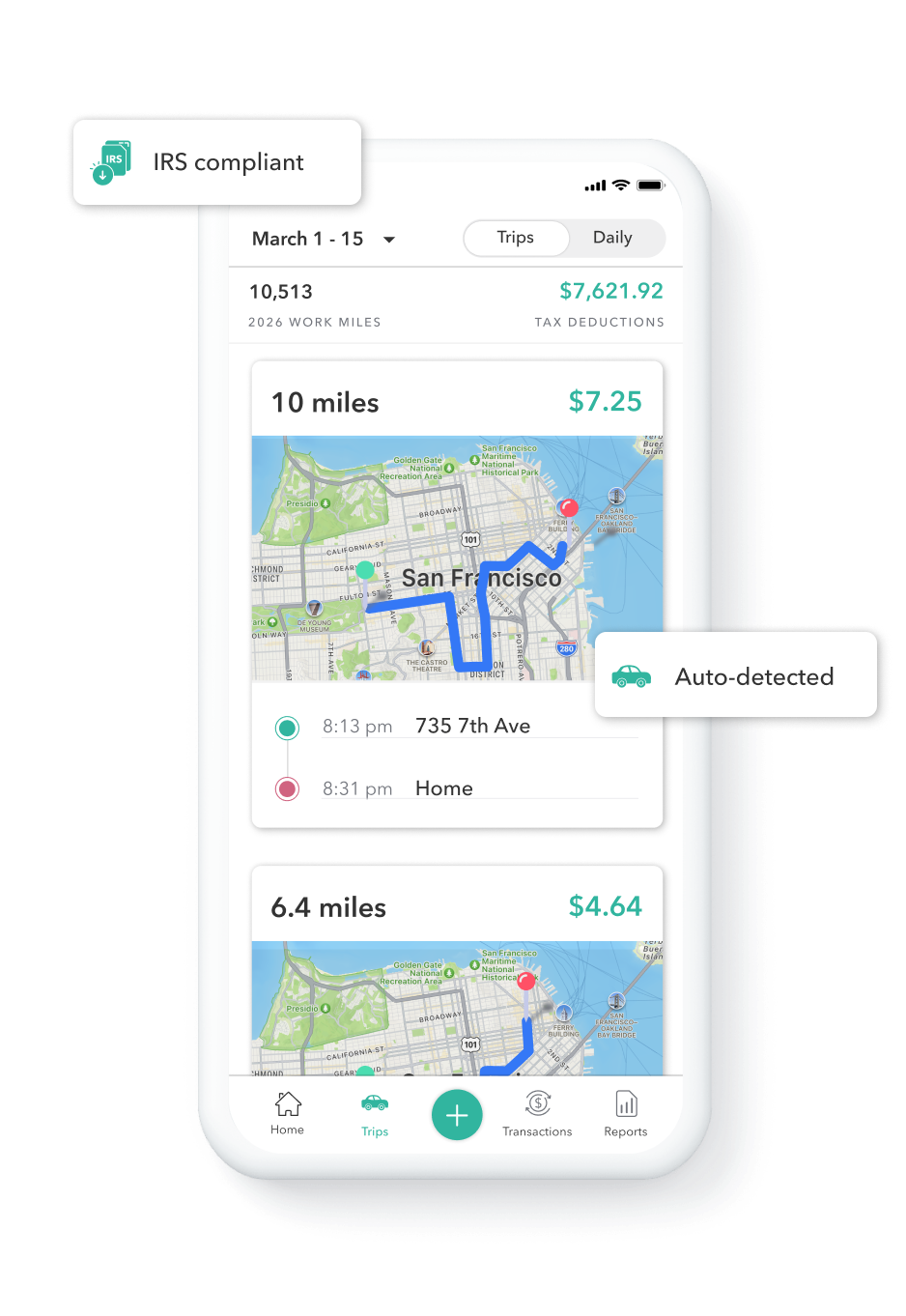
Everlance app showing tracked trips and tax deductions

Your 2026 rideshare tax estimate

Current IRS rate applied

$32,000
$5,000$80,000
22,000 mi
2,000 mi50,000 mi
22%
10%37%
5%
0%13%

Estimated tax after mileage deduction

$4,880

Federal and state combined

Estimated tax before deductions $10,890
Mileage deduction value $15,950
Miles left untracked (avg 30%) -$1,165
Start tracking and reduce this number
WHY IT MATTERS

Uber and Lyft won't remind you what you still owe

Every platform pays you, issues a tax form, and moves on. What you owe, when payments are due, and whether your mileage log holds up to IRS scrutiny are entirely your responsibility.

Platforms report earnings, not your deductible expenses

Uber and Lyft report gross earnings, but drivers must independently document mileage, phone costs, and other deductible expenses to claim them properly.

Self-employment tax applies to every dollar of net rideshare profit

Rideshare drivers pay self-employment tax plus income taxes, while mileage and eligible expenses reduce net profit and potentially lower both tax obligations.

Quarterly payment deadlines are not optional for working drivers

Drivers expecting to owe $1,000 or more generally make quarterly estimated payments, while missed deadlines may result in accumulating underpayment penalties.

Qualifying trip types:

Property showings — each leg is a separate deductible trip

Listing appointments and CMA presentations

Open house setup, signage, and hosting runs

Neighborhood farming and prospecting drives

Client meetings at any location

Home inspections, appraisals, and photo shoots

Continuing education and broker training

Title company, lender, and escrow visits

Platform-tracked mileage isn't your total deductible mileage

Uber and Lyft track active-trip mileage, but eligible pickup, repositioning, deadhead, and other business miles may require independent documentation to claim.

Qualifying rideshare driving scenarios:

Miles from home to the pickup zone or area where you go online and begin accepting trips
All miles during active trips from passenger pickup to drop-off location
Deadhead miles between a completed drop-off and the next accepted pickup request
Drives to surge pricing zones or high-demand areas while waiting for a match
Miles accumulating while the app is active and you are available for incoming requests
Return trip home at the close of a working shift
Simultaneous multi-app sessions running Uber and Lyft in the same driving window
Miles to car washes, auto supply stores, or service centers for business-related vehicle care
MILEAGE AND DEDUCTIONS

The most valuable tax deductions for rideshare drivers

Vehicle mileage typically accounts for 65-75% of total Schedule C expenses for rideshare drivers. A distinct set of vehicle and operating expenses also applies and most drivers consistently overlook them.

The mileage deduction: the right method for most rideshare drivers

Most Uber and Lyft drivers use the IRS standard mileage rate over tracking actual vehicle costs. It produces a larger deduction for most rideshare vehicles, requires only a mileage log rather than individual receipts, and simplifies annual filing.

Multiply total qualifying business miles by the IRS-published rate for the year. That single figure covers fuel, depreciation, insurance, and vehicle wear. The IRS adjusts the rate annually and it applies to every documented qualifying mile.

The standard rate must be elected in the first tax year you place a vehicle in business use. Starting with actual expenses locks you into that method for that vehicle. Beginning automatic tracking from your first rideshare shift preserves the election.

Drivers who lease their vehicle, have unusually high actual vehicle expenses, or operate a high-mileage commercial vehicle may benefit from the actual expense method. A qualified tax professional can run both calculations to determine which produces the larger deduction for a specific situation.

Drivers with a leased vehicle or high actual vehicle costs may benefit from comparing both methods with a tax professional before committing.

IRS STANDARD MILEAGE RATE

Updated each year by the IRS

Covers gas, insurance, depreciation & maintenance. Applies to all qualifying rideshare business miles.

Deduction CategoryWhat QualifiesIRS Notes
Vehicle mileageAll qualifying rideshare driving at IRS standard rateStandard or actual; elect standard in first year
Phone and data planBusiness-use percentage of monthly billPersonal-use portion is not deductible
Phone mount and chargerVehicle accessories used exclusively for rideshare navigation100% deductible if business-only use
Dash camCamera used for business documentation and ride securityPrimarily business-use required to deduct
Car cleaning and detailingCleaning directly required for platform eligibility or rider experienceBusiness purpose must be documented
Passenger amenitiesWater, mints, or phone chargers provided to ridersOrdinary and necessary; personal use excluded
Parking fees and tollsBusiness-related parking, bridge, and highway toll costsReceipt required for amounts over $75
Health insurance premiums100% deductible without access to employer-sponsored coverageAbove-the-line deduction on Form 1040
SE tax deduction50% of self-employment tax paid for the yearDeducted on Form 1040; reduces income tax bill
Platform service feesUber and Lyft commissions deducted from fare earningsDeduct only amounts not already excluded from income
Vehicle mileage
Phone and data plan
Phone mount and charger
Dash cam
Car cleaning and detailing
Passenger amenities
Parking fees and tolls
Health insurance premiums
SE tax deduction
Platform service fees
All qualifying rideshare driving at IRS standard rate
Business-use percentage of monthly bill
Vehicle accessories used exclusively for rideshare navigation
Camera used for business documentation and ride security
Cleaning directly required for platform eligibility or rider experience
Water, mints, or phone chargers provided to riders
Business-related parking, bridge, and highway toll costs
100% deductible without access to employer-sponsored coverage
50% of self-employment tax paid for the year
Uber and Lyft commissions deducted from fare earnings
Standard or actual; elect standard in first year
Personal-use portion is not deductible
100% deductible if business-only use
Primarily business-use required to deduct
Business purpose must be documented
Ordinary and necessary; personal use excluded
Receipt required for amounts over $75
Above-the-line deduction on Form 1040
Deducted on Form 1040; reduces income tax bill
Deduct only amounts not already excluded from income
PLATFORM GUIDES AND DOCUMENTATION

Uber and Lyft each have their own tax forms and driver-specific rules. Here’s where to go deeper.

The core tax rules here apply across all rideshare platforms, but 1099 forms, reporting thresholds, and relevant deductions vary. Drivers primarily using Uber or Lyft should review the dedicated guides below.

Platform-specific tax guides

Uber Driver Tax Guide

Uber reports driver earnings through Stripe on Form 1099-K or 1099-NEC depending on earnings volume. This guide explains how surge earnings and quest bonuses affect taxable income, the Stripe tax form process, and how to reconcile what the 1099 reports with your actual deductible expenses.

Read the Uber Driver Tax Guide

Lyft Driver Tax Guide

Lyft reports qualifying income on Form 1099-NEC or 1099-K. This guide covers Lyft's earnings structure, how streak bonuses are reported, the most relevant deductions, and how Lyft tax forms fit into your Schedule C filing.

Read the Instacart Tax Guide

1099 documentation and IRS compliance facts

What a 1099-K or 1099-NEC reports and what it doesn't

Uber and Lyft forms report platform earnings; drivers must independently track deductible mileage, vehicle costs, and business expenses.

How 1099-K and 1099-NEC thresholds work for rideshare drivers

Drivers may receive one or both forms, but all rideshare income remains reportable and taxable regardless of forms.

Driving for Uber and Lyft in the same session

W-2 salon employees cannot generally deduct unreimbursed work expenses at the federal level. Booth renters and self-employed cosmetologists can deduct qualifying costs on Schedule C.

The IRS requires contemporaneous mileage documentation

The IRS requires timely mileage logs documenting each business trip; platform records alone may not provide sufficient documentation.

Rideshare drivers face elevated Schedule C audit risk

High-mileage deductions may receive IRS scrutiny, making GPS-verified, timestamped mileage records valuable documentation for rideshare drivers during audits.


FREQUENTLY ASKED QUESTIONS

Rideshare driver tax FAQs

Answers to the questions Uber and Lyft drivers ask most about taxes, mileage, 1099 forms, and quarterly payments. For advice specific to your situation, consult a qualified CPA or tax professional.

Yes. All rideshare income including fares, tips, surge pay, bonuses, and incentive earnings from Uber, Lyft, and Uber Eats is self-employment income subject to federal income tax and the 15.3% self-employment tax. Tips are fully taxable, although a deduction for qualifying tip income may be available for eligible workers for tax years 2025 through 2028 under the One Big Beautiful Bill Act. A tax professional can confirm whether your tip income qualifies under current rules.
Most rideshare drivers receive a 1099-K if earnings processed through the platform exceed the applicable threshold, or a 1099-NEC for direct non-employee compensation payments. Some drivers receive both forms depending on how income is categorized by the platform. For 2026, the 1099-NEC reporting threshold increased to $2,000 under updated rules. Regardless of which form you receive — or whether you receive any — all rideshare income is reportable and must be included on Schedule C.
Vehicle mileage. Qualifying business miles reduce taxable income at the IRS standard mileage rate, and that single deduction accounts for the majority of Schedule C expenses for most active rideshare drivers. The full scope of deductible driving extends well beyond active accepted-trip miles: pre-shift drives to pickup zones, repositioning miles, deadhead miles between riders, and end-of-shift return trips all qualify when properly documented with a contemporaneous mileage log.
Multiply total qualifying business miles by the IRS standard mileage rate for the year. The result enters Schedule C and reduces net profit, which lowers both income tax and self-employment tax simultaneously. That single deduction figure replaces the need to track separate receipts for fuel, insurance, and maintenance. You do need a contemporaneous mileage log showing the date, starting and ending location, total miles driven, and business purpose for each qualifying trip.
If you expect to owe $1,000 or more in federal taxes for the year, yes. Quarterly estimated payments are generally due in April, June, September, and January. Missing a deadline triggers underpayment penalties calculated per quarter — they are not resolved by paying the full balance in April. The safe harbor rule protects drivers who pay at least 100% of their prior-year tax liability (110% if prior-year income exceeded $150,000) from penalties even when the current year's liability is higher.
The IRS requires a contemporaneous mileage log documenting the date of each trip, the starting and ending location, total miles driven, and the specific business purpose. Uber and Lyft trip histories do not satisfy this standard: they capture only accepted-trip mileage, omit pre-trip and post-trip driving, and lack a per-trip business purpose entry. A GPS mileage app creates fully compliant records automatically in real time for every qualifying trip — including deadhead miles and repositioning drives that the platforms do not track.
All rideshare income from every platform is combined on a single Schedule C. A single mileage log covers all qualifying driving from the moment you go online through the end of the session, regardless of which app generated each trip. You may receive separate 1099 forms from Uber and Lyft, but all earnings are reconciled and reported together. Mileage apps that support custom trip categories let drivers who want per-platform breakdowns track that detail without running separate logs.
As an independent contractor, you are classified as self-employed running a business rather than working for an employer. No taxes are withheld from Uber or Lyft earnings. You are responsible for reporting all income, making quarterly payments, and maintaining documentation for every deduction you claim. The advantage is access to a meaningful range of business deductions — led by mileage — that can substantially reduce taxable income. That advantage only materializes when the records are in place.

Track Every Mile. Turn Rideshare Driving Into Tax Savings.

Track every qualifying rideshare mile automatically across platforms, including deadhead and repositioning drives.