
FOR INDEPENDENT INSURANCE AGENTS  |  LIFE, P&C, HEALTH, AND FINANCIAL PRODUCTS

Independent Insurance Agents Tax Guide

What carriers report, you deduct, and records prove.

Your carriers issue 1099-NECs for commissions earned. They do not document your mileage, marketing spend, or the business expenses that reduce your tax bill. This guide covers self-employment tax, quarterly payments, and the deduction habits that protect what you earn.
15.3%

self-employment tax rate on net commission earnings

$10,500+

estimated annual mileage deduction for active agents

4

quarterly estimated payment deadlines per year

$0

taxes withheld by carriers on 1099 commission payments
THE COMPLETE GUIDE

The independent insurance agent's complete guide to taxes

Most independent agents receive commissions as 1099 contractors, not W-2 employees. That classification determines how you're taxed, which forms you file, and why quarterly payments and deduction tracking are non-negotiable.

What independent insurance agent taxes are and why they differ from a salaried position

W-2 employees have taxes withheld automatically and their employer covers half of Social Security and Medicare. Independent agents receive gross commissions with no withholding and receive a 1099-NEC from each carrier at year-end, not a W-2.

As an independent insurance agent, you are generally responsible for:

Federal income tax: Based on net commission income and your personal income tax bracket

Self-employment tax: 15.3% on 92.35% of net earnings, covering both the employee and employer portions of Social Security and Medicare.

State income tax: Where applicable; agents licensed in multiple states may have additional filing obligations.

Because carriers withhold nothing, setting aside a portion of each commission check throughout the year is essential for avoiding a large year-end balance and underpayment penalties.

How insurance agent taxes work: commissions, self-employment tax, and quarterly payments

The independent agent tax calculation follows a clear sequence each year.

Report total commission income from all carriers, including bonuses, overrides, and renewal commissions on Schedule C

Subtract deductible business expenses including mileage, E&O premiums, licensing fees, marketing costs, and home office

Net profit after deductions determines both your self-employment tax and federal income tax for the year

Calculate 15.3% SE tax on 92.35% of net profit, then deduct 50% from adjusted gross income on Form 1040

Apply federal income tax to adjusted gross income after all deductions to arrive at your total federal tax owed

Quarterly payments are due four times per year. Missing a deadline may trigger underpayment penalties even if you pay the full balance when filing your annual return.

TAX BREAKDOWN AND CALCULATOR

See what your commission income actually costs in taxes, and what expense tracking recovers

Business mileage and deductible expenses directly close the gap between what independent agents owe and what they keep. Adjust the sliders to see your numbers.
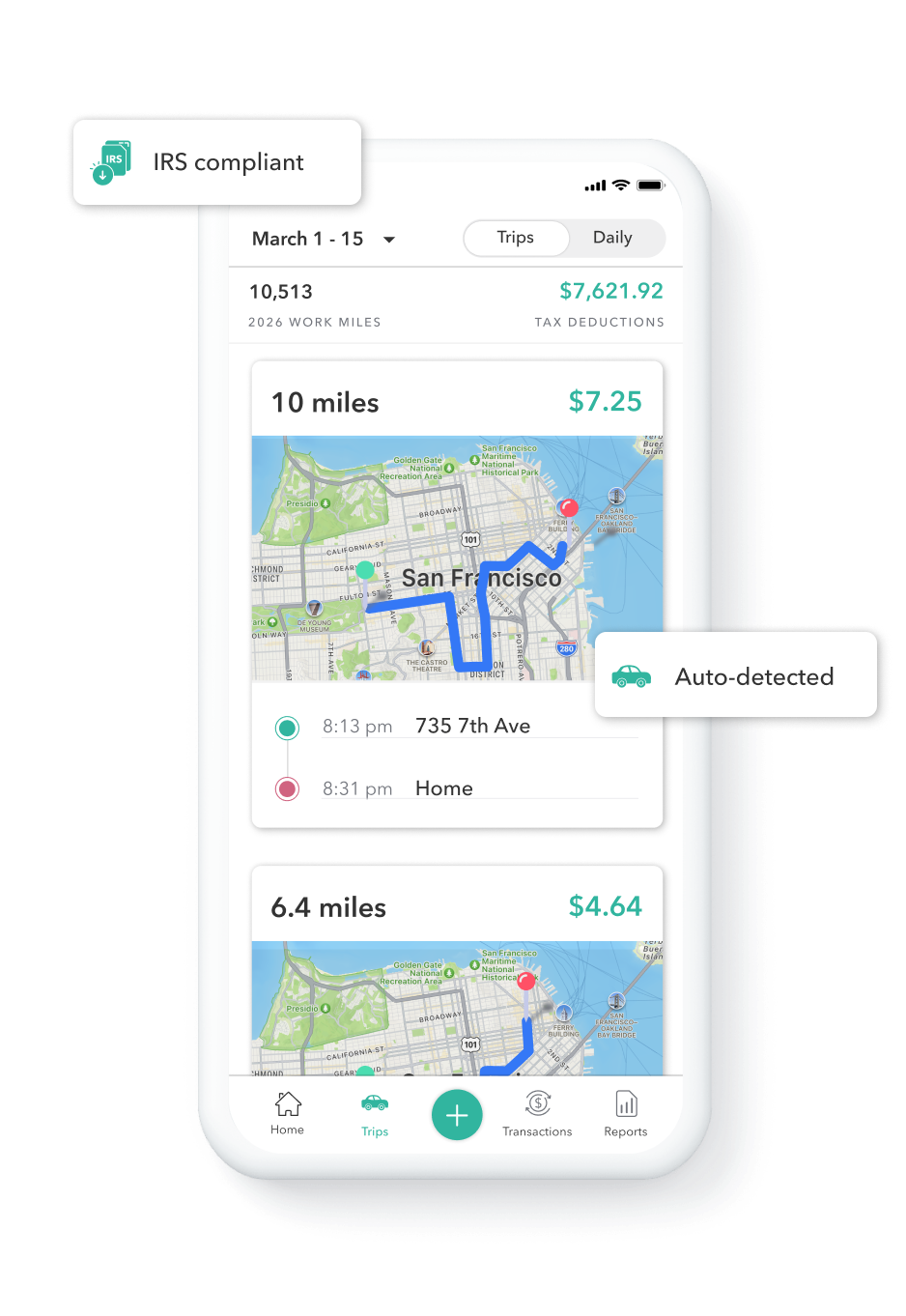
Everlance app showing tracked trips and tax deductions

Your 2026 rideshare tax estimate

Current IRS rate applied

$85,000
$20,000$250,000
15,000 mi
2,000 mi40,000 mi
24%
10%37%
5%
0%13%

Estimated tax after mileage deduction

$23,100

Federal and state combined

Estimated tax before deductions $28,900
Mileage deduction value $10,875
Miles left untracked (avg 30%) -$940
Start tracking and reduce this number
WHY IT MATTERS

Your carriers won't remind you what you still owe

Carriers issue your 1099-NEC and move on. What you owe, when payments are due, and whether your expense records hold up to IRS scrutiny are entirely your responsibility.

Carriers report commissions, not your deductible expenses

Your 1099-NEC shows gross commissions paid. Agents must independently track mileage, marketing, professional fees, and other costs to claim them as deductions.

Self-employment tax applies to every dollar of net commission income

Independent agents pay SE tax plus income taxes. Mileage and qualifying business expenses reduce net profit, which lowers both obligations simultaneously.

Quarterly payment deadlines are required, not optional

Agents expecting to owe $1,000 or more generally make quarterly estimated payments. Missed deadlines accumulate underpayment penalties regardless of when the balance is ultimately paid.

Qualifying trip types:

Property showings — each leg is a separate deductible trip

Listing appointments and CMA presentations

Open house setup, signage, and hosting runs

Neighborhood farming and prospecting drives

Client meetings at any location

Home inspections, appraisals, and photo shoots

Continuing education and broker training

Title company, lender, and escrow visits

Your business driving is larger than most agents realize

Tracking only direct client appointments misses deductible drives to prospect meetings, networking events, carrier trainings, and continuing education. That documentation gap compounds over a full production year.

Qualifying insurance agent driving scenarios:

Drives to client homes or businesses for policy reviews, renewals, or new applications
Travel to prospect appointments, referral meetings, and cold-call visits
Trips to networking events, chamber of commerce meetings, or industry association functions
Drives to carrier offices, insurance conferences, or required continuing education courses
Travel between multiple client or prospect appointments during the same workday
Trips to print shops, office supply stores, or sign vendors for business materials
Drives to the bank, post office, or accountant for business-related purposes
Return trips home following a final business appointment of the day
MILEAGE AND DEDUCTIONS

The most valuable tax deductions for independent insurance agents

Business mileage is often the largest single deduction for active agents, but a full range of qualifying operating expenses is regularly overlooked at tax time.

The mileage deduction: the right method for most insurance agents

Most independent agents use the IRS standard mileage rate over tracking actual vehicle costs. It requires only a mileage log, produces a larger deduction for most business vehicles, and simplifies annual filing.

Multiply total qualifying business miles by the IRS-published rate for the year. That single figure covers fuel, depreciation, insurance, and vehicle wear. The rate is updated annually.

The standard rate must be elected in the first tax year you use a vehicle for business. Starting with actual expenses locks you into that method for that vehicle. Beginning automatic tracking from your first client visit preserves the election.

Agents with a leased vehicle or high actual vehicle costs may benefit from comparing both methods with a tax professional.

IRS STANDARD MILEAGE RATE

Updated each year by the IRS

Covers gas, insurance, depreciation & maintenance. Applies to all qualifying business miles driven by insurance agents using a personal vehicle.

Deduction CategoryWhat QualifiesIRS Notes
Vehicle mileageAll qualifying business driving at IRS standard rateStandard or actual; elect standard in first year
Phone and data planBusiness-use percentage of monthly billPersonal-use portion is not deductible
E&O insuranceErrors and omissions premium for your insurance practiceRequired for business; fully deductible
Licensing and CEState license renewal fees and required continuing educationMust relate to current insurance practice
Marketing and advertisingLead generation, digital ads, direct mail, business cardsOrdinary and necessary; document business purpose
CRM and business softwareInsurance CRM, quoting tools, and business applicationsBusiness-use percentage or 100% if business-only
Home officeSpace used regularly and exclusively for insurance workSimplified ($5/sq ft) or actual expense method
Professional association duesIndependent agent association memberships and industry duesPersonally paid; ordinary and necessary
Parking and tollsBusiness-related parking, bridge, and highway toll costsReceipt required for amounts over $75
Health insurance premiums100% deductible without employer-sponsored coverage availableAbove-the-line deduction on Form 1040
Vehicle mileage
Phone and data plan
E&O insurance
Licensing and CE
Marketing and advertising
CRM and business software
Home office
Professional association dues
Parking and tolls
Health insurance premiums
All qualifying business driving at IRS standard rate
Business-use percentage of monthly bill
Errors and omissions premium for your insurance practice
State license renewal fees and required continuing education
Lead generation, digital ads, direct mail, business cards
Insurance CRM, quoting tools, and business applications
Space used regularly and exclusively for insurance work
Independent agent association memberships and industry dues
Business-related parking, bridge, and highway toll costs
100% deductible without employer-sponsored coverage available
Standard or actual; elect standard in first year
Personal-use portion is not deductible
Required for business; fully deductible
Must relate to current insurance practice
Ordinary and necessary; document business purpose
Business-use percentage or 100% if business-only
Simplified ($5/sq ft) or actual expense method
Personally paid; ordinary and necessary
Receipt required for amounts over $75
Above-the-line deduction on Form 1040
RELATED GUIDES AND DOCUMENTATION

Insurance agent tax situations vary. Here’s where to go deeper.

The core tax rules here apply broadly to independent agents. Contract structure, carrier relationships, and income type can affect which forms you receive and how deductions apply.

Tax guides by agent situation

 Captive vs. Independent Agent: Tax Differences

Moving from a captive position to independent contractor status changes nearly everything about how you're taxed. This guide explains the self-employment tax shift, the deductions that become available, and how quarterly estimated payment obligations differ between the two arrangements.

Read the Captive vs. Independent Agent Tax Guide

Insurance Agent Mileage and Vehicle Deduction Guide

Client meetings, prospect appointments, and carrier training generate significant deductible mileage for active agents. This guide covers the IRS standard mileage rate, when actual vehicle expenses produce a larger result, and the records the IRS requires to substantiate the deduction.

Read the Mileage Deduction Guide

1099 documentation and IRS compliance facts

What a 1099-NEC from your carrier reports and what it doesn't

Your 1099-NEC shows gross commissions paid. Mileage, E&O premiums, and other business costs must be tracked and documented independently to be claimed.

Multiple carriers, multiple 1099s, one Schedule C

Each carrier paying you $600 or more issues a 1099-NEC. All commission income from every carrier, including bonuses and renewals, combines on one Schedule C.

Renewal income, overrides, and bonuses are also taxable  

Residual commissions, contingency bonuses, and production bonuses are self-employment income and belong on Schedule C alongside first-year commissions.

The IRS requires contemporaneous mileage documentation  

A mileage log created at or near the time of each trip is required. A client appointment calendar alone does not satisfy the IRS contemporaneous documentation standard.

Independent agents face Schedule C audit attention  

Vehicle deductions and home office claims draw IRS scrutiny. GPS-verified, timestamped mileage records provide the strongest available documentation for agents.


FREQUENTLY ASKED QUESTIONS

Independent insurance agent tax FAQs

Answers to the tax questions independent insurance agents ask most. Consult a qualified CPA for advice specific to your situation.

Yes. Commission income paid as a 1099 contractor is self-employment income subject to SE tax at 15.3%, covering both Social Security and Medicare. Unlike W-2 employees whose employer covers half, independent agents pay the full amount. You can deduct 50% of SE tax from adjusted gross income on Form 1040, and business expenses like mileage and marketing reduce the net income subject to SE tax.
Each carrier paying $600 or more in commissions during the year must issue a Form 1099-NEC by January 31. Active agents working with multiple carriers typically receive several. All commission income — including bonuses, overrides, and renewal commissions — belongs on Schedule C regardless of how many forms arrive. Income below the $600 threshold from a single carrier may not generate a form, but it remains taxable.
Vehicle mileage. Driving to client appointments, prospect meetings, policy reviews, and carrier training generates significant deductible miles at the IRS standard rate. The key is consistent documentation: without a contemporaneous log showing the date, destination, and business purpose of each trip, the deduction is difficult to substantiate. E&O insurance and home office expenses are also among the largest recurring deductions agents frequently underestimate.
Multiply total qualifying business miles by the IRS standard mileage rate for the year. The result reduces net profit on Schedule C, lowering both income tax and self-employment tax simultaneously. That single figure covers fuel, vehicle depreciation, insurance, and maintenance. You still need a contemporaneous mileage log with the date, starting and ending location, total miles, and business purpose for each qualifying trip.
Generally yes, if you expect to owe $1,000 or more in federal taxes for the year. Quarterly payments are due in April, June, September, and January. Missing a deadline triggers underpayment penalties calculated per quarter — not resolved by paying the full balance in April. The safe harbor rule protects agents who pay at least 100% of their prior-year federal tax liability (110% if prior-year income exceeded $150,000) from penalties even when the current year's balance is higher.
A contemporaneous mileage log documenting the date, starting and ending location, total miles, and specific business purpose for each qualifying trip. An appointment calendar alone does not meet this standard. Apps like Everlance automatically create GPS-verified, timestamped records for every business drive — including client visits, networking trips, and carrier meetings — producing an IRS-ready log without manual entry throughout the year.
Yes, if you use a portion of your home regularly and exclusively for your insurance business — such as meeting clients, managing policies, or handling administrative work. The simplified method deducts $5 per square foot up to 300 square feet. The actual expense method deducts the business-use percentage of rent, mortgage interest, utilities, and insurance. The exclusive-use requirement is strict: a space that serves personal purposes as well typically does not qualify.
As an independent contractor, you run a business. No taxes are withheld from commission payments. You are responsible for reporting all income, making quarterly estimated payments, and documenting every deduction. The advantage: meaningful business deductions unavailable to W-2 employees — including mileage, E&O premiums, home office, and marketing costs — can substantially reduce taxable income. Those deductions only reduce your bill when the records are in place to support them.

Track Every Client Visit. Protect Every Deduction.

Everlance automatically tracks qualifying drives in IRS-ready records.